
The Stone Age is named after stone because stone is what lasted. Early humans probably worked wood more than anything else, since it is far easier to shape, but wood rots, and so we know very little about how anyone in the Paleolithic worked it. The record was lost long before anyone thought to keep one. What we call prehistory is mostly a list of the things that refused to decay.
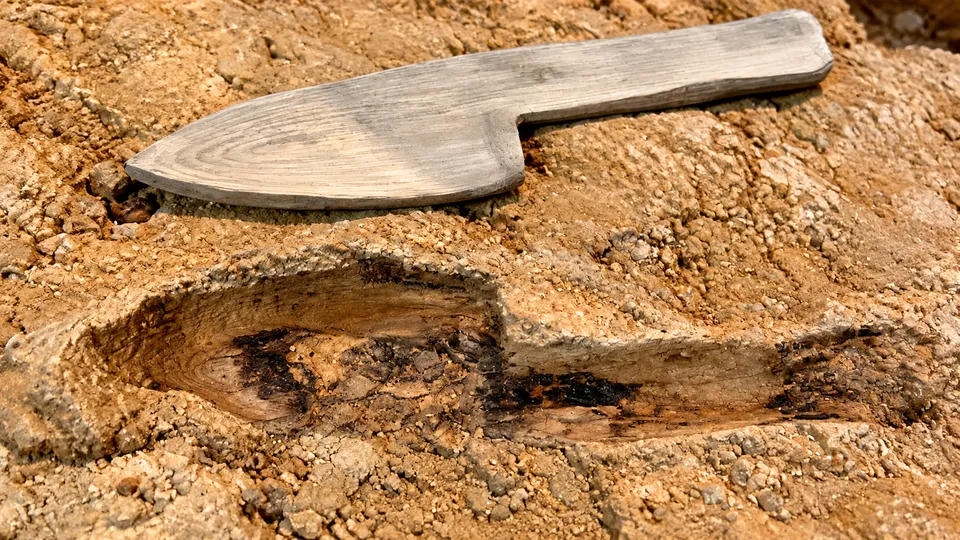
Capellades lies west of Barcelona. Above the town stands a cliff of travertine, a limestone laid down by spring water heavy with calcium, and at its foot is a rock shelter called Abric Romaní. For thousands of years that water dripped across the shelter floor and left calcium carbonate on whatever lay there: logs, leaves, pine cones, and the tools of the Neanderthals who lived there. Inside the crust the wood slowly rotted away. What remained were hollow molds, exact negatives of the objects, so detailed in places that the outlines of individual wood cells show under a microscope.
As Jacek Krywko reported for Ars Technica, a team of Spanish archaeologists has now catalogued 597 wooden remains from Neanderthal living areas there, dated to between 62,000 and 40,000 years ago, in Science Advances. The study is led by Palmira Saladié of the Catalan Institute of Human Paleoecology and Social Evolution (IPHES-CERCA), and the material comes from 16 archaeological levels, according to Phys.org. Phys.org adds that some of the wood survived as charred remains rather than as molds. Gizmodo dates the paper to October 7 but gives the time range as roughly 62,000 to 42,000 years ago.
Digging up empty space
The shelter has been excavated without a break since 1983, and in that time the team has had to learn how to dig up objects that are mostly hollow. Each find is outlined, mapped and photographed. Restoration specialists then consolidate the fragile crust. “Then we open very carefully one part of the object,” says M. Gema Chacón, an archaeologist at IPHES-CERCA and a co-author of the study. The hollows used to be filled with resin or plaster to make a positive cast. “Now all the wooden remains are printed in 3D,” she says. The molds are digitised by 3D scanning and photogrammetry, and the printed copies serve both researchers and museum visitors.
Thirteen
Most of the 597 pieces turned out to be natural: trunks, fallen branches and a great deal of firewood, mostly Scots pine. Only 13 objects had been made or modified by Neanderthal hands. “The morphology of these 13 tools is impossible to find in nature,” Chacón says.
Thirteen out of almost six hundred, spread across some twenty thousand years.
The oldest wooden artefacts we have are mostly weapons: the spears of Schöningen in Germany, a spear tip from Clacton-on-Sea in England, and a spear found with an elephant skeleton at Lehringen. Most survived in waterlogged sediments, where the lack of oxygen slowed decay, and they tell us mainly how Neanderthals hunted. Abric Romaní tells us about a home, a place where people slept, cooked and made tools. “We have a sample of wooden tools for different subsistence activities, not only hunting,” Chacón says. Because wood appears in level after level, the team reads woodworking as routine work, done again and again rather than once.
The household
Four shallow trays of juniper bark lay near the hearths. The largest measures 55 by 20 centimetres. They may have been used to carry food or scoop embers, much like the bark dishes Aboriginal Australians call coolamons. Crossed poles above a thick hearth may be what is left of a tripod, possibly for processing food. In the innermost part of the shelter lay a branchless pole more than five metres long.
That pole fits a pattern seen in every level excavated so far. Along the back wall the Neanderthals kept a row of small hearths, about 50 centimetres across and a metre or so apart, with almost no debris around them. Chacón suspects they were sleeping hearths: “This gives you illumination and also protects you from possible carnivores or other animals that could attack the group.” The team thinks the pole leaned against the wall as a windbreak or simple hut, and experiments showed that five metres is about the length such a structure needs. At the other end of the shelter, large overlapping hearths were surrounded by animal bones, stone-knapping debris and firewood. This is where food was prepared and tools were made, and where, the team believes, meals were shared.
Put together, the finds amount to a floor plan, with a quiet end for sleeping and a busy end for work.
A club with no relatives
There were weapons too. A pointed stick and two spears lay close to the antlered skulls of red deer. The better-preserved spear is 2.45 metres long. Archaeology Magazine reports that the second measures 1.99 metres, and that both came from Level R and have deliberately modified tips. According to Chacón, a cast of one point shows an impact fracture identical to those on spears used by Aboriginal Australians. That kind of damage happens when a point strikes bone or something equally hard.
The club was the surprise. It was carved from a single piece of wood, with a 16-centimetre handle and a pointed, roughly triangular head about 14 centimetres tall. Where handle meets head there is an abrupt right-angled step that may have kept the hand from slipping. The only older object proposed as a club, from Kalambo Falls in Zambia, is roughly 400,000 years old. Chacón says nothing quite like the Romaní club has been found anywhere.
Hunter-gatherers documented by anthropologists over the past couple of centuries used similar clubs to kill game at close range, to fight, and sometimes to show social standing. In human history the club has often doubled as a sceptre, and it would be easy to read power into this one. The team is more careful. “But when it comes to this club it’s true that we are not sure,” Chacón admits. It was found in a living area, beside bones, stone tools and a hearth, so the researchers suspect it served for everyday work rather than ceremony.
Knowing the wood
The choice of materials was deliberate. Scots pine is easy to work and dries quickly, which made tools cheap to make and to replace. Juniper’s fibrous bark suited the trays. Firewood was usually dry, while tools were cut from fresh wood. “When they went to look for wood, it was like when they went to look for stone; they knew exactly what they wanted to make,” Chacón says. “This implies not only planning, but a bit of complexity in the brain to organize your activities.”
The finds add to a growing body of evidence that Neanderthals twisted fibres into cord, made symbolic objects and interbred with our species, and they chip further at the old image of a brutish cousin. “Neanderthals are no longer perceived as Homo sapiens’ dumb cousins,” Chacón says. Like the worked timbers recently raised from a German lake, the Romaní wood shows how much of the past depends on rare conditions that happen to preserve it.
The tools were first described in the 1990s, and it took decades to identify and catalogue them all. “To study all these types of tools properly, you need a lot of time and budget,” Chacón says. She worries that other sites may already have lost similar finds for lack of both. “I hear from colleagues telling me ‘perhaps we found something that we thought was wood, we excavated it, we took pictures, but we didn’t keep it,’” she says. “Now they say perhaps it could be a tool.”