
The Asus ProArt P16 tops out at $7,000 and ships with 128GB of memory shared between its CPU and GPU, four times the 32GB of dedicated VRAM on Nvidia’s own RTX 5090 desktop card. The number that matters isn’t the price. It’s the memory pool: a laptop that can load a 125-billion-parameter language model locally, something no consumer GPU can do on its own, because consumer GPUs top out around 32GB of VRAM and a 125B-parameter model in a quantized format runs to roughly 90GB. As Ryan Whitwam wrote in his review for Ars Technica, the laptop is built around Nvidia’s new RTX Spark N1X system-on-a-chip, the same silicon inside Nvidia’s DGX Spark desktop box, now squeezed into a 3.9-pound chassis.
Unified memory is the mechanism worth understanding here, because it’s the whole pitch. A discrete GPU has its own memory, separate from the computer’s system RAM, connected by a fast but fixed-size bus; once a model’s weights exceed that card’s VRAM, the GPU can’t run it, full stop, regardless of how much system memory the PC has elsewhere. Nvidia’s GB10 chip, marketed as RTX Spark, does away with that split. The CPU (a 20-core Arm design, 10 Cortex-X925 cores for performance and 10 Cortex-A725 cores for efficiency, per Nvidia’s product page) and the Blackwell GPU (6,144 CUDA cores across 48 streaming multiprocessors, per Whitwam’s teardown) draw from the same 128GB LPDDR5x pool instead of two separate ones.
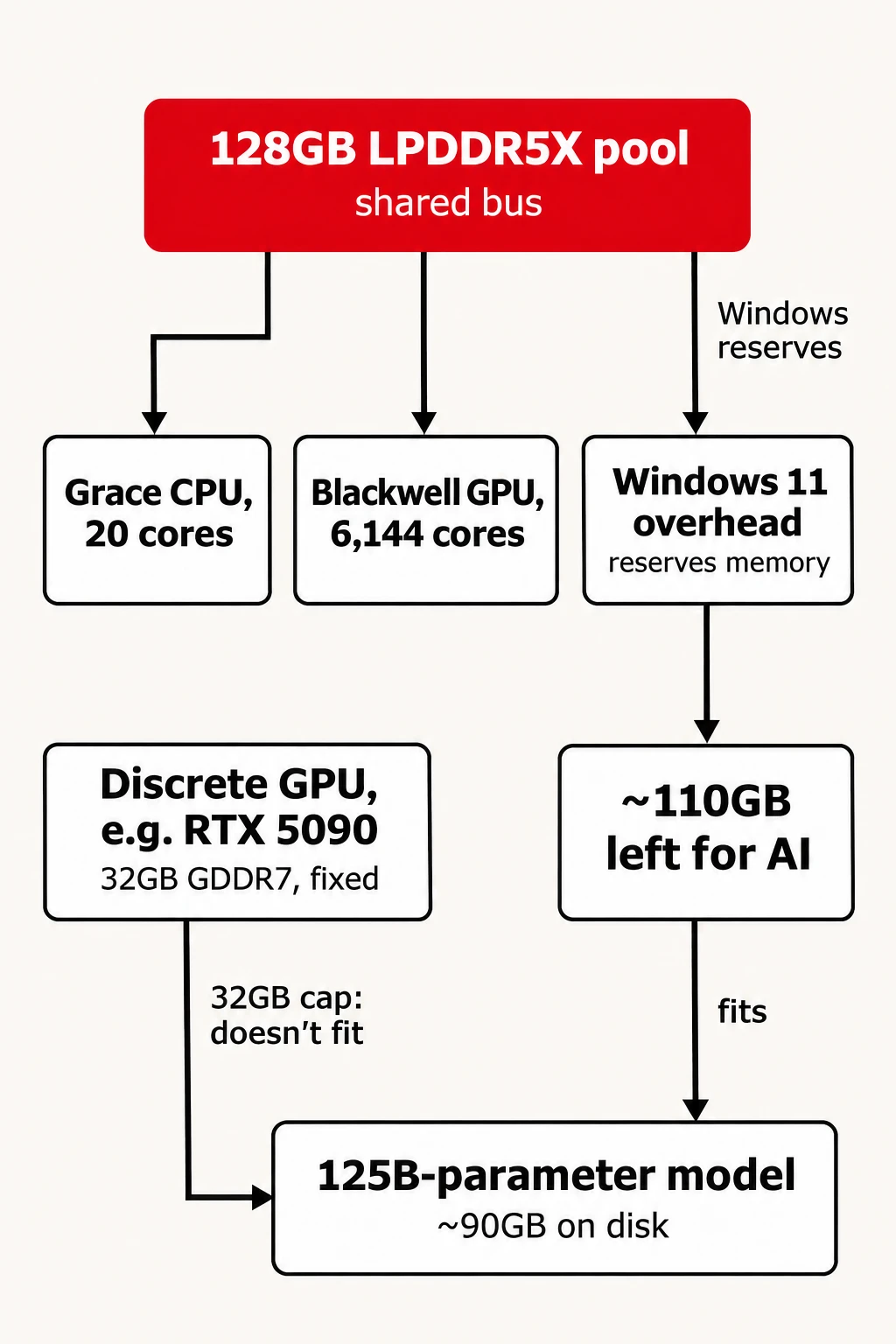
| From | To | How |
|---|---|---|
| 128GB LPDDR5X pool (shared bus) | Grace CPU, 20 cores | |
| 128GB LPDDR5X pool (shared bus) | Blackwell GPU, 6,144 cores | |
| 128GB LPDDR5X pool (shared bus) | Windows 11 overhead (reserves memory) | Windows reserves |
| Windows 11 overhead (reserves memory) | ~110GB left for AI | |
| ~110GB left for AI | 125B-parameter model (~90GB on disk) | fits |
| Discrete GPU, e.g. RTX 5090 (32GB GDDR7, fixed) | 125B-parameter model (~90GB on disk) | 32GB cap: doesn't fit |
Based on Nvidia; Ars Technica
Bandwidth is the trade-off, and the two primary sources don’t quite agree on the number. Whitwam’s review puts the ProArt’s shared memory bus at up to 300GB/s. Nvidia’s own DGX Spark specification sheet lists the identical GB10 chip’s memory interface at 256-bit with 273GB/s of bandwidth. Either figure is well below what a dedicated GDDR7 or HBM memory system delivers on a discrete GPU card. The trade Nvidia is selling is capacity over speed: more room to hold a big model, less raw throughput to move data through it once loaded.
Windows adds its own tax on top. On Nvidia’s own DGX Spark box, which runs a Linux-based DGX OS, nearly all 128GB is available to AI workloads. On the ProArt P16 running Windows 11, Whitwam found the practical ceiling is about 110GB, with the operating system splitting the rest into a notional 64GB of system RAM and 64GB of video memory that Windows then juggles dynamically. Eighteen gigabytes of overhead, in other words, before an engineer even starts loading a model.
Compute on the GPU side is rated at up to 31 TFLOPS of FP32 and roughly 1,000 TOPS of FP4 tensor performance, which Nvidia also expresses as 1 petaFLOP of FP4 compute, a figure the company’s own spec sheet flags as theoretical, reliant on the sparsity feature that only applies to models built to exploit it. Whitwam loaded a range of models to test the memory headroom in practice: Qwen’s 27B mixture-of-experts model, several sizes of Google’s open Gemma models, and a 90GB download called Qwen Flash Next with 125 billion parameters, which he reported occupies almost the entire shared pool when running, leaving little room for anything else.

The clearest independent benchmark of what that memory headroom buys comes from PCWorld’s Brad Chacos, who ran OpenAI’s open-weight gpt-oss-120b model, a 116.8-billion-parameter mixture-of-experts model that OpenAI released under an Apache 2.0 license, through an identical research task on both the ProArt P16 and a desktop with an RTX 5090. The task: a research chain on NFL data totaling 472,084 tokens (392,181 prompt tokens plus 79,903 completion tokens). The ProArt finished in 33 minutes 13 seconds; the RTX 5090 desktop took 52 minutes 51 seconds, about 1.6 times longer. Chacos was careful to note this isn’t a clean speed comparison, since the 5090 run generated more completion tokens (92,270 versus 79,903) and the two machines weren’t doing identical amounts of work. The real explanation isn’t that RTX Spark’s GPU is faster than an RTX 5090’s; it’s that a 120-billion-parameter model doesn’t fit in the 5090’s 32GB of VRAM at all, forcing it to spill into slower system memory, while the ProArt’s unified 128GB pool holds the whole thing without spilling anywhere.
That win costs battery. Chacos recorded the ProArt’s charge falling from 100 percent to 54 percent over the course of that 33-minute run, a 46-point drop. Simple arithmetic on that figure puts sustained drain at roughly 1.4 percentage points a minute under that specific heavy-inference load, which would exhaust a full charge in about 72 minutes if it continued at that rate, far short of the 12 hours Asus advertises for the machine, a figure that applies to light use like video playback, not local model inference. Chacos separately described starting a test run at 38 percent and scrambling for a charger as Windows threw power warnings and Battery Saver kicked in. Whitwam’s own informal use, mixing a workday with AI experimentation, left him with about 30 percent of a charge by day’s end.
Price scales with memory, and memory is the whole point of buying one of these. PCWorld reported the ProArt P16 lineup runs from about $2,800 at the low end up to $6,999.99 for the 128GB, 4K-OLED configuration Whitwam tested; a 64GB, lower-resolution version lists at $4,399.99. The jump from 64GB to 128GB roughly doubles what the machine can hold in memory at once, which is the only reason to spend the extra $2,600: it’s the difference between a model capped around 100 billion parameters, per Nvidia’s own published guidance for a single 64GB GB10 unit, and one that can reach 200 billion.

Whether that math beats renting the compute is a separate question from whether the laptop works. OpenAI’s own $200-a-month ChatGPT Pro tier, as pricing trackers have documented, would cost $7,000 after roughly 35 months, just under three years, of continuous subscription, before counting the API usage of a developer running agents constantly, which bills by the token and can run well past a flat subscription for sustained automated workloads. That’s the comparison Whitwam gestured at in noting the ProArt is expensive enough that a buyer could fund years of cloud AI subscriptions first. The case for buying anyway is privacy and control, not economics: a model running on your own machine’s GPU doesn’t send a transcript to a cloud provider’s servers, and it isn’t silently downgraded to a cheaper model to save the provider money, something that happens routinely with hosted chat products.
Windows is also new territory for this kind of hardware. Nvidia built RTX Spark around desktop AI clients like OpenClaw and Hermes, which give a graphical front end for downloading and running open models, a meaningfully lower barrier than the command-line tools that dominate local-model tinkering on Linux. It’s also a chip willing to let an agent control the PC directly once it’s configured: Whitwam set up agents to read test email accounts, manage local files, and edit a coding project by asking the model to configure its own access, the kind of permission structure that works fine until it doesn’t.
The ProArt P16 sits well above Microsoft’s own entry in the on-device AI laptop category: the Surface Laptop Ultra, which runs a 70-billion-parameter model for $2,599 without a dedicated neural processing unit. Nvidia’s chip gets there a different way, by giving the GPU’s own tensor cores a bigger memory pool to work with rather than offloading to a separate NPU block, and it buys roughly double the usable parameter count for close to triple the price. Neither machine answers the harder question: how many buyers actually need 100-plus-billion-parameter models running locally, rather than a cheaper machine plus a cloud subscription, and whether Windows’s management of a shared memory pool will get less fiddly before the next chip generation arrives to raise the ceiling again.