
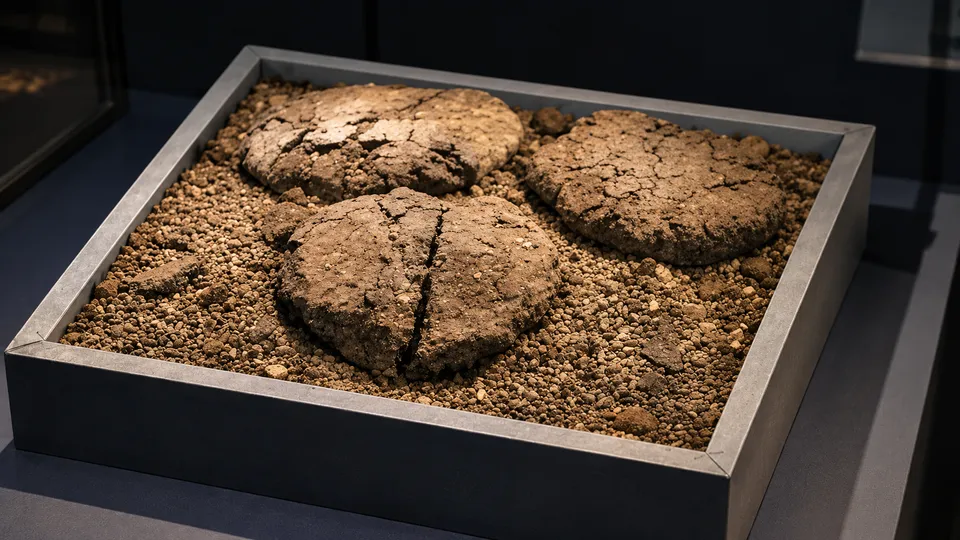
Eight loaves of bread, roughly 5,000 years old, turned up in 2025 in a burned-out room at Seyitömer Höyük, a mound in Kütahya province in western Türkiye. They were found wedged between the legs of a collapsed wooden shelf, mixed in with scorched wheat and lentils. The excavation, run by the Kütahya Museum Directorate under its director, Dr. Sevgi Gürdal, dates the room to the first quarter of the Early Bronze Age, as Arkeonews reported.
The mechanism is the interesting part. Ordinary bread does not survive five millennia; mold and bacteria finish it off within months, and even in dry soil the starches and gluten break down within a human lifetime. Fire changes that calculus only under specific conditions: when organic matter is heated in an oxygen-poor environment — buried under ash and collapsed debris rather than fully combusted in open air — it chars into carbon rather than burning to gas and smoke. Carbon is chemically inert to the microbes that eat starch. The result is a blackened but structurally intact loaf, and a storage shelf that becomes, 5,000 years later, the only archive of its own contents.
When the shelf collapsed during the fire, the contents were recovered all mixed together.
Gürdal’s account, carried by the state news agency Anadolu Agency, is that the room held a wall oven with a shelf above it, and that sacks or bags of grain and the loaves themselves sat on that shelf before the fire broke out. The fire burned through the shelf’s supports; the collapse scattered the stored food across the floor as the heat carbonized it. That sequence — storage, ignition, structural failure, charring — is why archaeologists have grain, legumes and bread from a single Early Bronze Age household rather than the usual residue of postholes and potsherds.
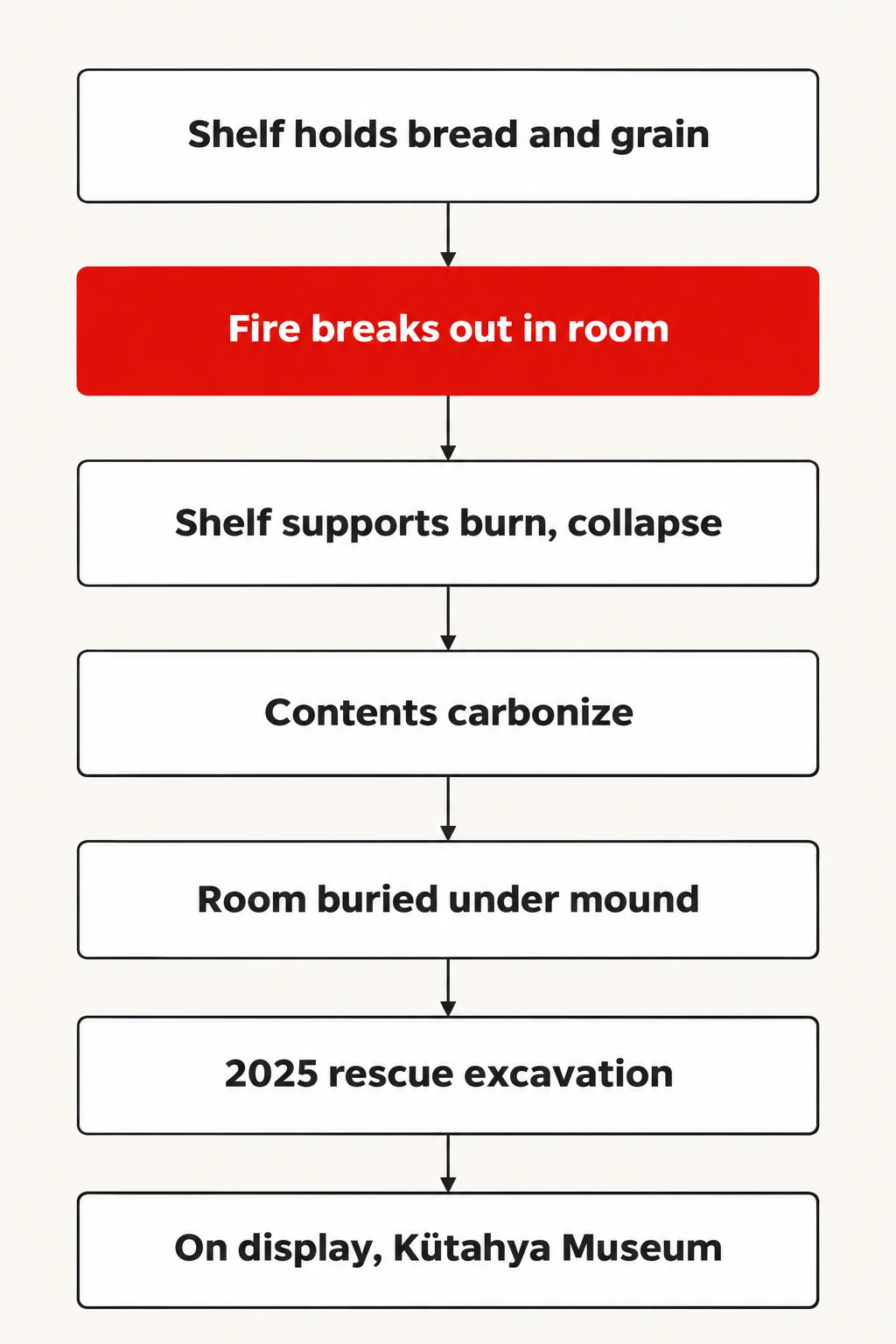
| From | To | How |
|---|---|---|
| Shelf holds bread and grain | Fire breaks out in room | |
| Fire breaks out in room | Shelf supports burn, collapse | |
| Shelf supports burn, collapse | Contents carbonize | |
| Contents carbonize | Room buried under mound | |
| Room buried under mound | 2025 rescue excavation | |
| 2025 rescue excavation | On display, Kütahya Museum |
What the excavation has not yet produced is the harder data: no published analysis of flour type, grind, leavening or loaf shape has accompanied the announcement. That matters because the same questions, asked of comparable Anatolian finds, have changed the story each time — see below. Until a lab report appears, “bread” here means carbonized dough recognizable by shape and context, not a characterized food sample.
A mound excavated only because it sits on coal
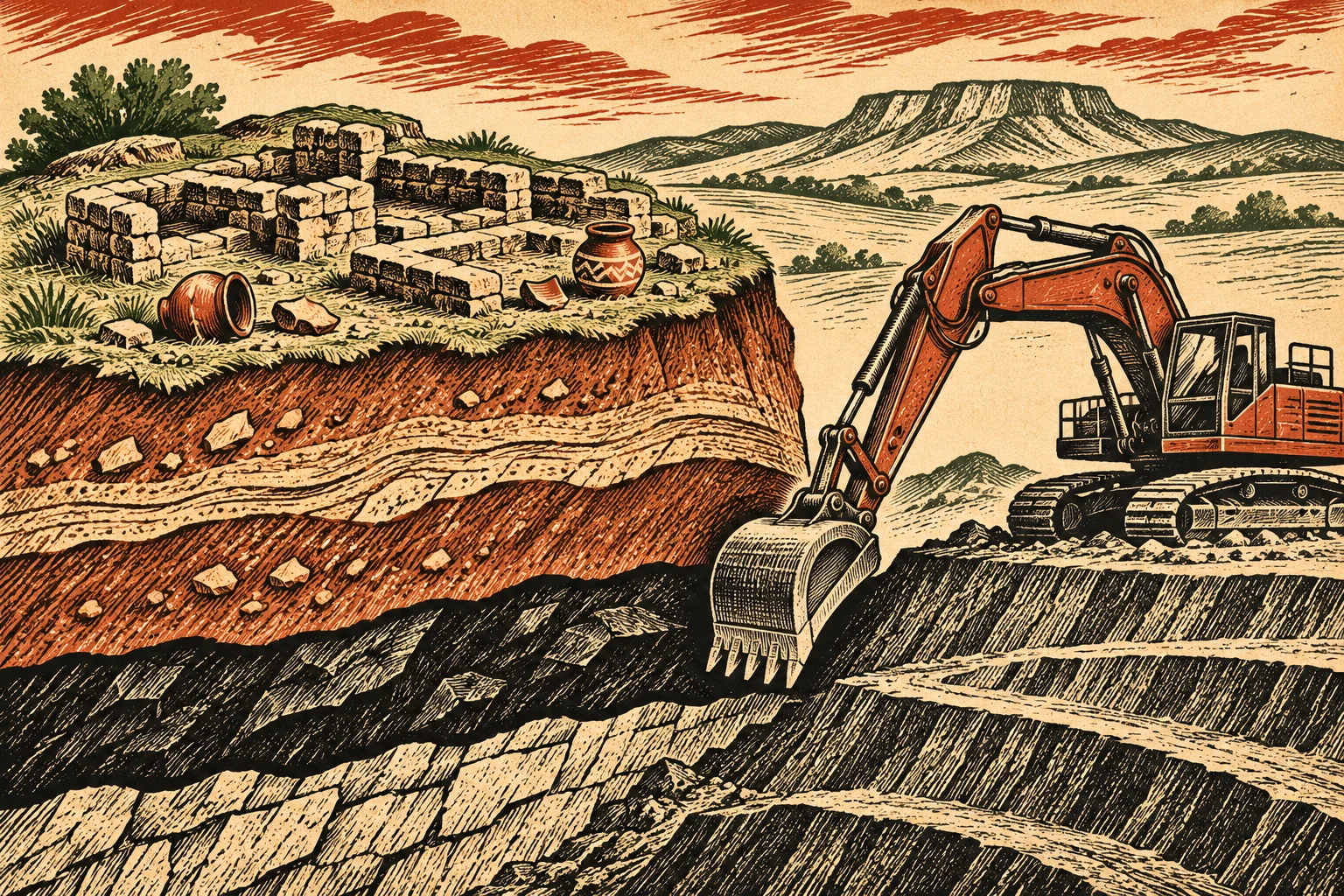
Seyitömer Höyük is not a small site. Before decades of adjacent lignite mining cut into it, the mound stood 26 meters high and measured 140 by 150 meters at its base, according to the dimensions Anadolu Agency reported from the excavation team. Occupation layers run from the third millennium BCE through the Achaemenid, Hellenistic and Roman periods — four thousand years of continuous settlement stacked in one hill, 25 to 26 kilometers northwest of Kütahya’s city center.
The only reason anyone is excavating it at all is the lignite seam underneath, which feeds a thermal power plant operated by a Çelikler Holding subsidiary. Rescue excavation — digging ahead of industrial destruction, not out of pure research interest — began in 1989 under the Eskişehir Museum Directorate, passed to the Afyonkarahisar Museum Directorate from 1990 to 1995, then to Kütahya Dumlupınar University’s archaeology department from 2006 to 2014 under a protocol with Turkish Coal Enterprises, the state coal company. That university-led phase alone recovered more than 17,000 artifacts, handed over to the Kütahya Museum Directorate. Since 2019 the Kütahya Museum Directorate, under Gürdal, has run the dig with Çelikler Holding — the mining company whose coal reserve is the reason the site is being destroyed — as sponsor.
A 2026 study by Semra Kaygısız in the Dumlupınar University Journal of Social Sciences, examining Middle Bronze Age architecture and door construction at the mound, separately flags the site’s carbonized wooden remains as archaeologically significant, as the journal’s listing shows. Fire, it turns out, keeps being Seyitömer’s best record-keeper: burned wood tells the architectural story the same way burned bread tells the dietary one.
Three Anatolian breads, three different accidents
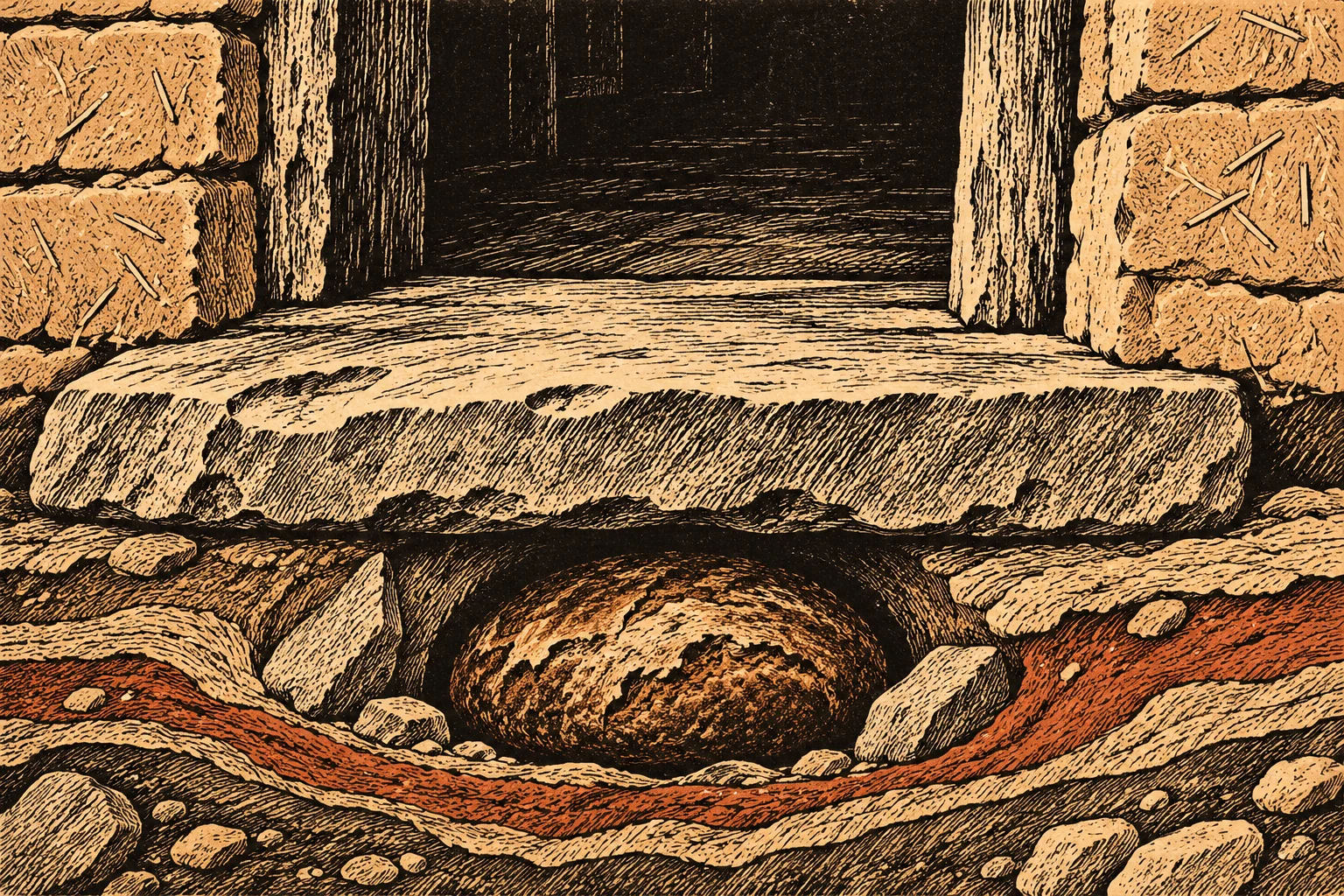
Seyitömer’s loaves are not Türkiye’s oldest bread, and the excavation makes no such claim. Two other Anatolian finds, both reported within the past two years, used entirely different preservation paths. At Küllüoba Höyük in Eskişehir province, roughly 70 kilometers from Seyitömer, excavators led by Prof. Murat Türkteki found a baked loaf deliberately buried under a house’s door threshold, dated to 3200–2800 BCE — a ritual deposit, not an accident, reported by Arkeofili. Eskişehir’s municipal bakery later reverse-engineered the recipe from lab data and now sells “Küllüoba Ekmeği” at its producer markets for 50 Turkish lira a loaf.
At Çatalhöyük in Konya province, researchers from Necmettin Erbakan University announced in March 2024 a find dated by radiocarbon to roughly 6,600 BCE — about 8,600 years old, some 3,600 years older than Seyitömer’s loaves — sealed and preserved under a layer of clay near an oven, as CNN reported. That sample was never baked: researchers described a porous, fermented dough with a finger mark pressed into it, which makes “world’s oldest bread” a claim that depends on counting unbaked, fermented dough as bread at all. rews covered a different ancient-bread survival last month, 700-year-old loaves stamped with crosses recovered from a Russian church — proof that bread keeps surfacing in the archaeological record by whatever accident of chemistry happens to be on offer.
The Küllüoba case shows what a published archaeometric analysis can add to a find like this: flour composition, fiber and gluten content, even a grounds-for-reproduction recipe, all derived in the lab rather than at the trowel’s edge. Seyitömer’s eight loaves have had no such treatment yet. The excavation has the shape of the evidence — a shelf, a fire, a household’s worth of carbonized food — but not yet the chemistry that would say what grain went into the dough, whether it was leavened, or how it was baked before the fire that, paradoxically, is the only reason anyone can ask the question now.