
Archaeologists excavating a ruined medieval church in Veliky Novgorod, Russia, have found three small loaves of bread charred and preserved by a fire centuries ago, with two still bearing the imprints of eight-pointed crosses.
The loaves came to light during digs conducted between 2021 and 2023 by a St. Petersburg State University expedition at the Church of the Dormition at the Marketplace, whose original building dates to 1135–1144. A study by Ivan Antipov and Anastasia Trushnikova, published in the journal Old Rus’: The Questions of Middle Ages, lays out the find, as Arkeonews reported.
The bread lay in the remains of a spiral staircase in the church’s northwestern corner, sealed under layers of burned debris and collapsed material from medieval fires. Each piece measured about 4.5 centimeters across and no more than 1.7 centimeters high, and weighed between 3.64 and 6.77 grams — light enough, with porous interiors, to suggest baked goods. One specimen kept its nearly round shape and a clear eight-pointed cross inside a circular medallion; a second preserved the design despite deformation; the third was more damaged.
Researchers first compared the objects with carbonized bread from Pompeii. Chemical analysis at the State Hermitage Museum in St. Petersburg then found traces of starch, backing the identification as flour-based. Two medieval coins from separate fire layers, along with construction evidence and chronicles, point to a recorded fire in 1385 as the one that baked the loaves into the record, with another blaze likely following in 1399.
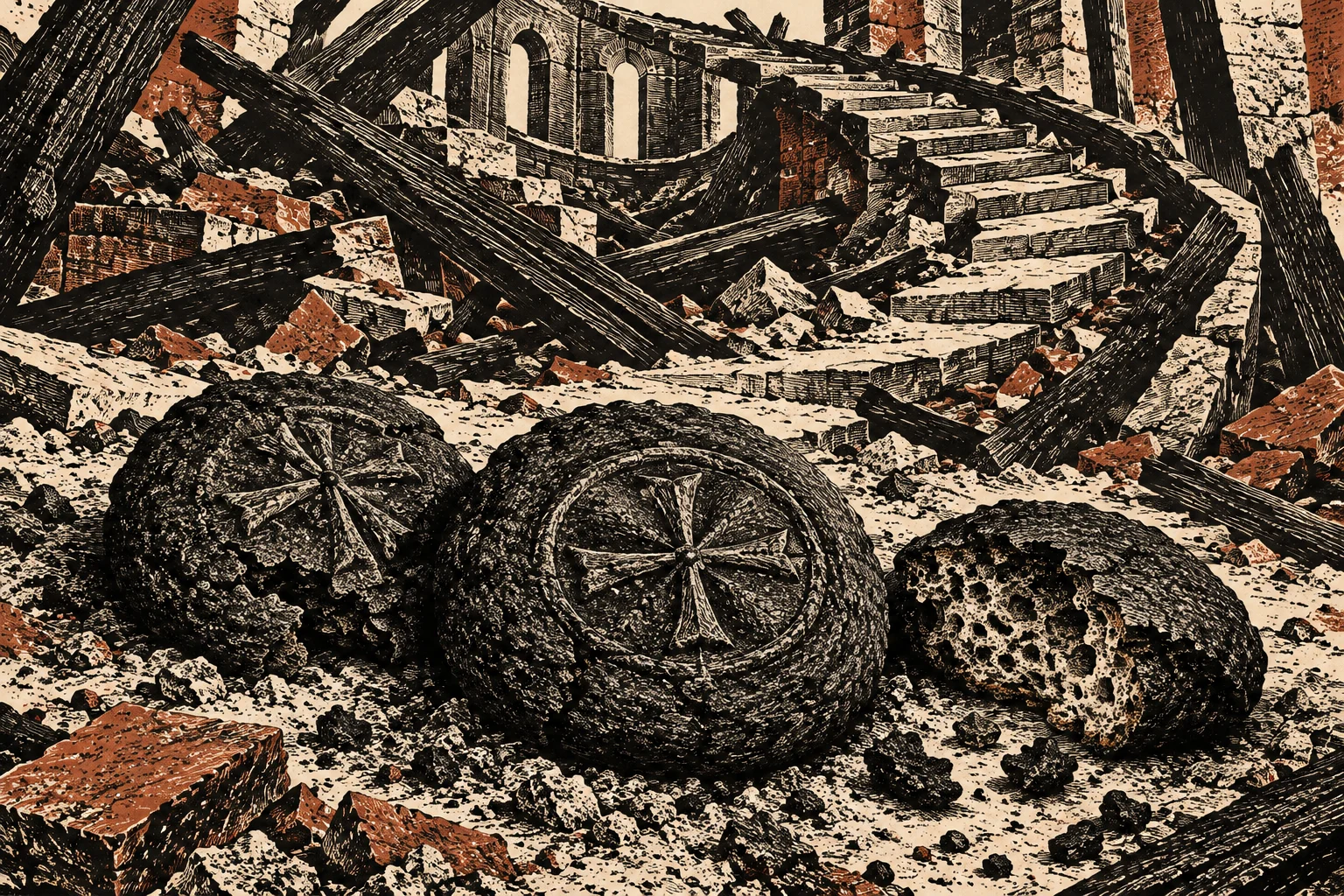
Mr. Antipov and Ms. Trushnikova identify the pieces as prosphora, the small loaves used in the Eastern Christian liturgy of the Eucharist, in which priests prepare the bread commemorating the Last Supper. Stamps pressed into the dough before baking mark the loaves with crosses or other Christian symbols. Wooden stamps survive at a number of medieval sites, but the bread itself almost never does; the authors say they know of no comparable prosphora finds from medieval Rus’.
The cross on the best-preserved loaf has decorative, plant-like extensions — a “flourishing cross” motif familiar from medieval Novgorod art and church decoration. The researchers compared the bread with 12 wooden stamps unearthed in earlier Novgorod excavations and found that seven carry versions of the same design, evidence of a recognizable local tradition. The stamps come in round, square and rectangular forms of varying size, suggesting worshippers used several formats of religious bread, a practice also described in Byzantine liturgical writings.
The arrangement of the find adds its own information. Alongside the loaves, the staircase contained fragments of bronze lamps, a book clasp, coins, grain, nutshells and traces of beeswax — a mix that suggests the space doubled as a storage area or sacristy rather than merely a route to the upper galleries. Medieval sources indicate that households often baked prosphora themselves, with specialized bakers and, by the late fourteenth century, the churches gradually taking on more of the work.