
Someone cut off a young woman’s head with a bladed weapon, probably from behind, sometime between 343 and 1 BCE. The skull was never recovered. On 16 November 2026, Belfast coroner Joe McCrisken ran the case anyway, at the Ulster Museum, asking the four questions a modern inquest asks of any death: who, when, where, how. As arkeonews reported, it is the first time a museum anywhere has staged a coronial-style hearing for a body this old.
The body surfaced in October 2023, pulled up by machinery at Bulrush Horticulture’s peat works near Bellaghy, County Londonderry. Peat preserves skin, nails and even a kidney well enough that the Police Service of Northern Ireland initially treated the find as a possible recent death, not an archaeological one. Radiocarbon dating settled that question: the remains are more than 2,000 years old, placing them in the Iron Age.
From a 13-to-17-year-old boy to a 15-to-22-year-old woman
The first read on the skeleton, according to National Museums NI, was a teenage boy aged 13 to 17. Further osteological work by Professor Eileen Murphy of Queen’s University Belfast reversed that: the pelvis and other skeletal markers indicate a female, and the museum’s February 2025 release revised the age range to 17 to 22, as Archaeology magazine noted at the time. The age band tightened again by the time of the coronial hearing, to 15 to 22. That two-step revision matters because sex is one of the first variables an osteologist assigns and one of the easier ones to get wrong on a skeleton with no skull: the pelvis survived, the cranium that would have offered a second check did not. Murphy’s examination of the neck vertebrae found cut marks consistent with a single sharp weapon, delivered from behind. Estimated stature: about 5 feet 6 inches, roughly 168 cm.
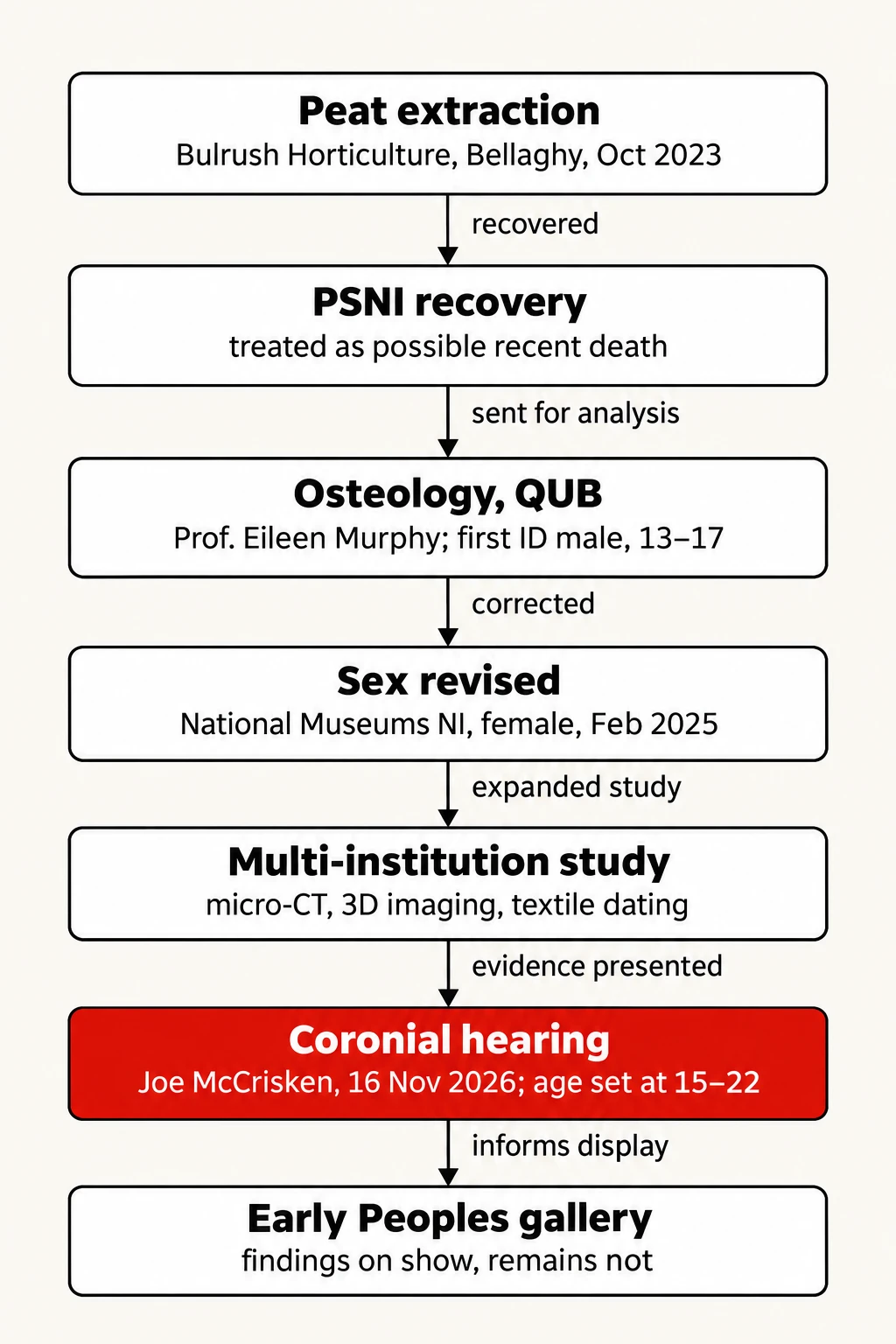
| From | To | How |
|---|---|---|
| Peat extraction (Bulrush Horticulture, Bellaghy, Oct 2023) | PSNI recovery (treated as possible recent death) | recovered |
| PSNI recovery (treated as possible recent death) | Osteology, QUB (Prof. Eileen Murphy; first ID male, 13–17) | sent for analysis |
| Osteology, QUB (Prof. Eileen Murphy; first ID male, 13–17) | Sex revised (National Museums NI, female, Feb 2025) | corrected |
| Sex revised (National Museums NI, female, Feb 2025) | Multi-institution study (micro-CT, 3D imaging, textile dating) | expanded study |
| Multi-institution study (micro-CT, 3D imaging, textile dating) | Coronial hearing (Joe McCrisken, 16 Nov 2026; age set at 15–22) | evidence presented |
| Coronial hearing (Joe McCrisken, 16 Nov 2026; age set at 15–22) | Early Peoples gallery (findings on show, remains not) | informs display |
Based on National Museums NI
A coroner for the already dead
The 16 November hearing was not a legal inquest; McCrisken has no jurisdiction over a death older than the state that would prosecute it. The Irish Times reported that the format was approved by Lady Chief Justice Dame Siobhán Keegan as a piece of judiciary outreach, built to the structure of a real inquest but run as an educational exercise. More than 60 people attended, including the PSNI officers who first recovered the remains and Bulrush Horticulture workers whose machinery found them. Evidence came from a research programme spanning ten institutions across Ireland, England and Denmark: Queen’s University Belfast, Trinity College Dublin, University College Dublin, the National Museum of Ireland, and the universities of Copenhagen, Glasgow, Bradford and Manchester, alongside National Museums NI and the PSNI.
The purpose of the exercise is not to impose modern legal conclusions upon the distant past, but to provide a framework through which the available evidence could be assessed and the story of a previously unknown young woman could be told.
That line, McCrisken’s closing remark as the Irish News reported it, is the honest limit of the exercise. The coroner’s finding: death by deliberate decapitation, most likely from behind, with a bladed weapon, age 15 to 22. Niamh Baker, curator of archaeology at the Ulster Museum, put the forensic read plainly to the BBC: “it would appear she was intentionally decapitated in the bog,” and no skull turned up despite further searching. What a coroner’s framework cannot supply, 2,300 years out, is motive or a suspect. The questions “who did this” and “why” are the two the hearing could not answer, and none of the ten institutions’ analyses changes that.
Four men and one woman
Ballymacombs More Woman joins a short list of named northwestern European bog bodies, and she is the only woman on it. Tollund Man, found in Denmark in 1950, died around 405–380 BCE, hanged. Grauballe Man, found nearby in 1952, died around 321–261 BCE with his throat cut. Clonycavan Man and Old Croghan Man, both pulled from Irish bogs during commercial peat-cutting in 2003, died around 392–201 BCE and 362–175 BCE respectively, the first killed by repeated blows to the head, the second stabbed, decapitated and dismembered. All four are male. National Museums NI says Ballymacombs More Woman is the first authenticated prehistoric bog body found in Northern Ireland and the first identified Iron Age bog-preserved female anywhere on the island of Ireland, a rarity the museum’s head of curatorial, Hannah Crowdy, called “incredibly rare” to the BBC.
Four of the five died violently and all four of the comparison cases are read by archaeologists as probable ritual killings rather than ordinary crime, mainly because the injuries are overdetermined: Old Croghan Man was stabbed, decapitated, dismembered and had his nipples cut, far more violence than killing requires. Ballymacombs More Woman’s single wound is comparatively restrained, which is itself a reason the ritual reading is a hypothesis and not a finding. The pattern across bog bodies generally is suggestive, not conclusive, a point also visible in how little a skeleton alone can say about violence, as a recent Viking-Age bone study and the unresolved case of a Neanderthal killed by a spear nobody can find both show: the wound tells you how, rarely why.
A fringe of plant fibre
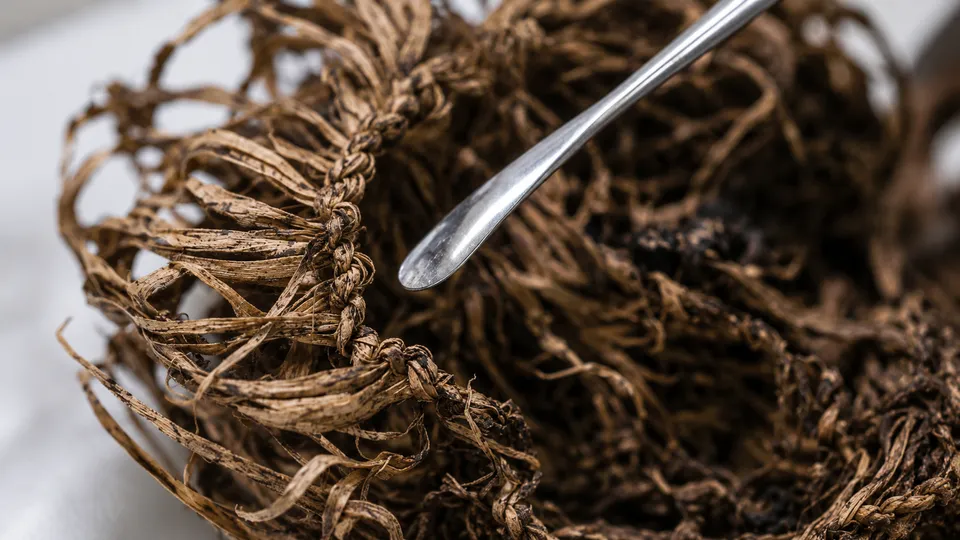
Beneath the woman’s knees, excavators recovered a woven plant-fibre object. Professor Susanna Harris and doctoral researcher Nysa Loudon at the University of Glasgow identified the technique as twining, producing a woven border with a loose fringe, and radiocarbon-dated the fibre to 363–160 BCE, a 203-year window that sits inside the body’s wider 342-year dating range. The two independent dates on two different materials landing in the same multi-century band is the kind of cross-check that makes a radiocarbon result more credible than either alone. What the object was, garment, ornament, or something else, the researchers have not determined.
National Museums NI will not put the remains on public display; the findings will instead reshape the Ulster Museum’s Early Peoples gallery, told through illustration and poetry rather than the body itself. More than 20 members of the Bellaghy Historical Society attended the hearing and have taken to calling her Áine, after a figure from Irish mythology, an informal name that sits alongside, not instead of, her official designation. The coroner’s hearing produced a cause of death with a stated mechanism and a weapon type. It did not produce a reason. Whether the next round of isotope or DNA work on the 342-year-wide date range ever narrows enough to separate ritual from crime as categories, rather than as a label chosen because the alternative lacks a story, is the open question the Early Peoples gallery will have to live with.