
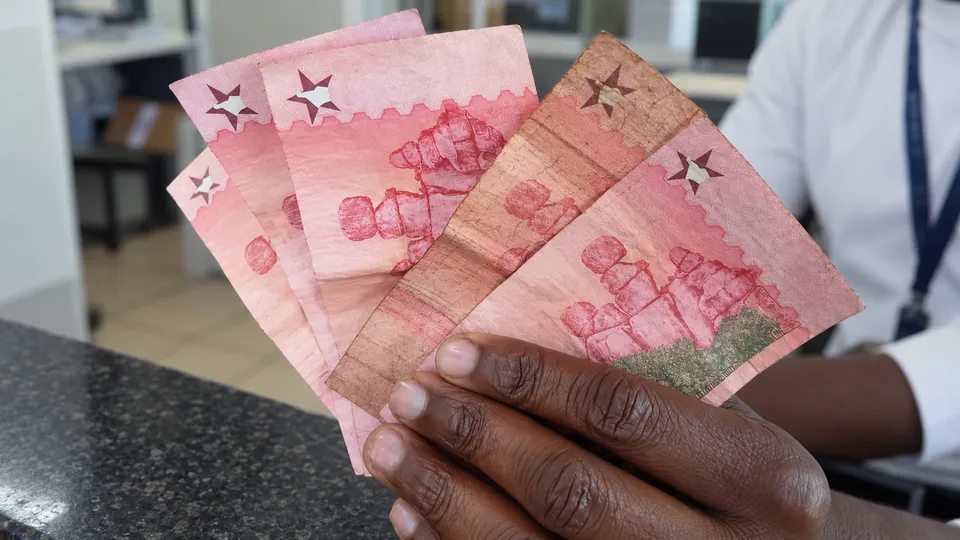
Zimbabwe’s Reserve Bank (RBZ) reported annual ZiG inflation of 3.7% in September 2026, a figure the IMF’s October 7 statement on the country’s monitoring programme confirms independently. Seventeen months earlier, in April 2025, the same metric stood at 85.7%. That is a genuine disinflation, not a press-release number: the IMF, which has no incentive to flatter a government it is auditing, says Zimbabwe’s economy grew 8.3% in 2025 and projects 5% growth for 2026, with the current account in surplus.
None of that has persuaded Zimbabweans to use the currency. Writing for Al Jazeera, Farai Mwakutuya reports that clothing retailer Sesedzai Chigumira has made only a handful of ZiG sales, and that primary school teacher Charles Mbwandarikwa exchanges the roughly one-third of his salary paid in ZiG for dollars immediately rather than hold it. The gap between a stabilising macro number and a population that won’t bank on it is the actual story here, and it has a mechanism.
The reserve math
The ZiG (Zimbabwe Gold) is not a currency board in the textbook sense, but it works on the same principle: the RBZ holds foreign currency and gold and sizes the ZiG money supply against that reserve, rather than printing to cover budget deficits, which is what produced the 2008 collapse. According to the RBZ’s own 2026 Monetary Policy Statement, reserves backing the currency grew from $276 million at the April 2024 launch to $1.3 billion by February 2026, including 4.2 tonnes of gold worth $738 million — itself up 250% from the 1.5 tonnes held at launch, funded partly by a rule requiring miners to pay half their royalties in physical minerals. By its mid-2026 review the RBZ put usable reserves at $1.7 billion, enough, it said, to cover domestic base money six times over.
A currency that halved twice
The exchange rate tells a rougher story than the inflation print. The ZiG opened trading at 13.56 to the dollar on April 8, 2024. By September it had lost roughly 80% of its value on the parallel market, and on September 27, 2024 the RBZ devalued the official rate by 43%, from 13.9 to 24.4 per dollar, while raising its policy rate to 35% from 20%. Governor John Mushayavanhu said the move would have, in Bloomberg’s report, “a critical shock-absorbing impact on the prevailing excess liquidity in the economy.” Within six months of launch the ZiG had lost half its value officially (27 to the dollar) and three-quarters on the black market (50 to the dollar).

The rate then held in the mid-to-high 20s through 2025 and into October 2026, when the official rate stood near 26.7 to the dollar. But the parallel-market cash rate was quoted as high as 40 to the dollar in early October — a premium of roughly 50%, up from about 20% reported in September. That premium is the market’s running vote on whether the RBZ’s reserves are as liquid as its statements suggest; it has never closed since the currency launched.
Why 2018 still sets the price of trust
Mbwandarikwa’s caution, as described in Al Jazeera’s reporting, is arithmetic, not superstition. Zimbabwe’s 2008 hyperinflation peaked at a monthly rate of 79.6 billion percent in November of that year, by the estimate of economists Steve Hanke and Alex Kwok — an annualised rate in the sextillions of percent that made the currency worthless and forced its abandonment in 2009 in favour of the US dollar. When Zimbabwe reintroduced a local currency in 2018 (bond notes, later the RTGS dollar), Mbwandarikwa’s ZiG-equivalent salary, he told Al Jazeera, fell from $540 to $40 by the end of that year — a 93% loss in twelve months. That is the base rate every subsequent currency announcement, ZiG included, gets measured against.
The transaction share nobody agrees on
How far de-dollarisation has actually gone depends on whom you ask and what they’re counting. Analysts at Equity Axis, citing RBZ data, say more than 80% of transactions and deposits are still conducted in US dollars. The RBZ’s own figures, relayed by Ecofin Agency, put ZiG at about 40% of daily transactions. The IMF’s September 2026 review put ZiG usage at “roughly 35 to 40 percent of domestic payments.” The IMF and Ecofin figures broadly agree with each other on payment volume; the Equity Axis figure, measuring deposits as well as transactions, implies a much smaller dollar retreat. Either reading leaves dollars as the majority or plurality of the economy — consistent with Chigumira’s handful of ZiG sales against a dollar-paying customer base.
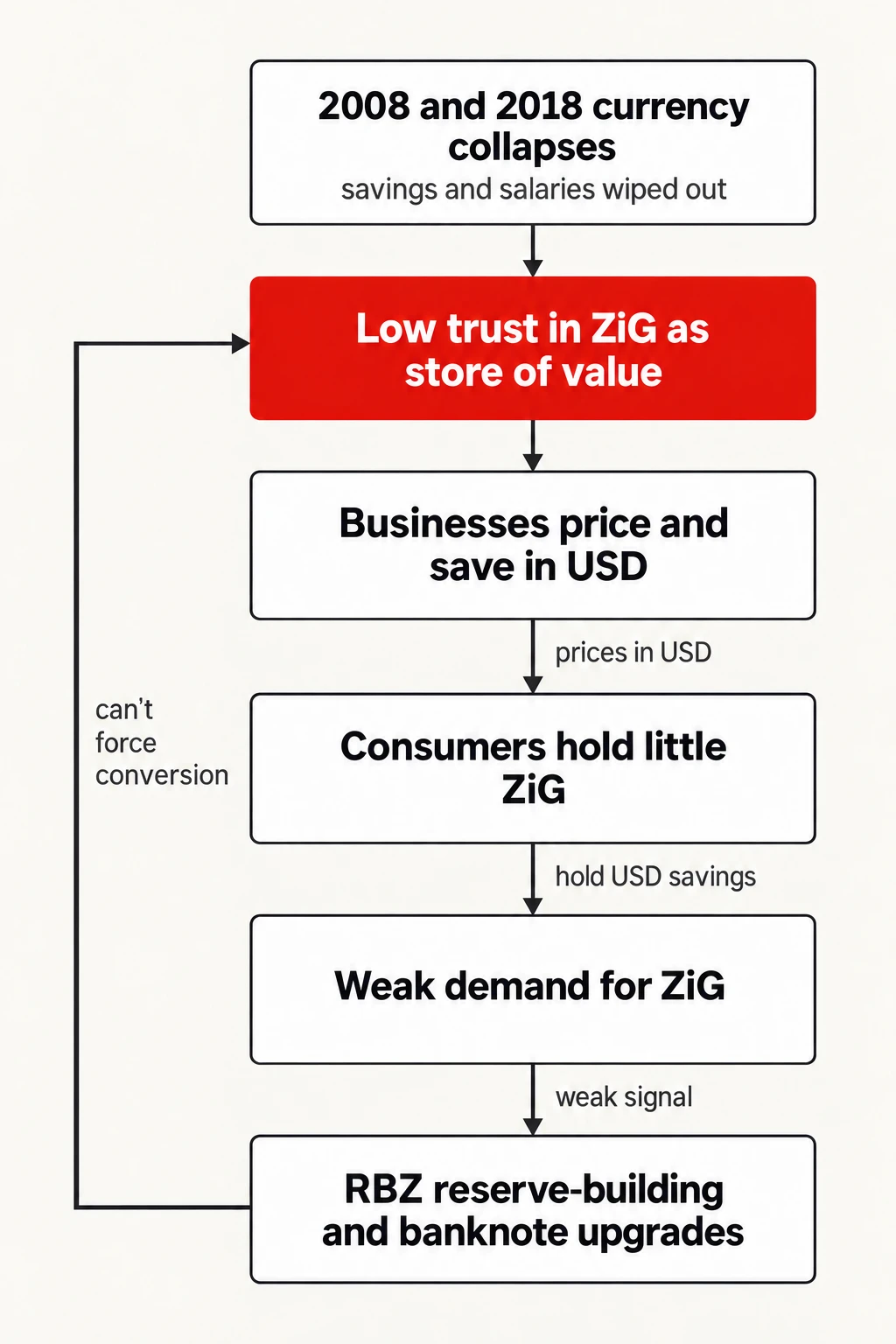
| From | To | How |
|---|---|---|
| 2008 and 2018 currency collapses (savings and salaries wiped out) | Low trust in ZiG as store of value | |
| Low trust in ZiG as store of value | Businesses price and save in USD | |
| Businesses price and save in USD | Consumers hold little ZiG | prices in USD |
| Consumers hold little ZiG | Weak demand for ZiG | hold USD savings |
| Weak demand for ZiG | RBZ reserve-building and banknote upgrades | weak signal |
| RBZ reserve-building and banknote upgrades | Low trust in ZiG as store of value | can't force conversion |
Based on Al Jazeera reporting; RBZ statements
Dropping the deadline
Zimbabwe had set 2030 as the date to end multicurrency use entirely. In early 2026 the RBZ dropped that fixed deadline and adopted a conditions-based framework instead, under its 2026–2030 Strategic Plan: import cover of three to six months (against roughly 1.5 months currently), inflation held low and stable, and the gap between official and parallel exchange rates kept under 30%. Closing the gap to the six-month benchmark would require about $4.7 billion more in reserves, by Equity Axis’s reckoning of RBZ figures — more than double the $1.7 billion the bank says it already holds. RBZ Director of Financial Surveillance Farai Masendu put the shift plainly: “it is not about a specific date such as 2030, but about meeting certain conditions. The process must be market-driven and not imposed.”
Alongside the policy reset, the RBZ issued an upgraded “BiG5” banknote series — animal-themed 10, 20 and 50 ZiG notes with intaglio printing, magnetic security threads and colour-shifting ink — into circulation from April 7, 2026. The upgrade followed the embarrassing failure of the original 2024 notes: of eight planned denominations, only two (the 10 and 20) were ever issued, and those faded and tore within months, undermining confidence in a currency that was already struggling to earn any.

Economist Cornelius Dube, quoted by Al Jazeera, frames the problem as one only time can solve: “History shows that it is possible to de-dollarise, though it’s not easy. It takes time.” His prescription is for policy to create incentives rather than force conversion, until businesses and consumers are genuinely indifferent between ZiG and dollars. The RBZ’s own test for that indifference is reserve cover. At 1.5 months against a stated target of three to six, and roughly $4.7 billion short of the top end, the arithmetic says the earliest the central bank’s own conditions could plausibly be met is measured in years, not the single-digit inflation prints it publishes every month.