
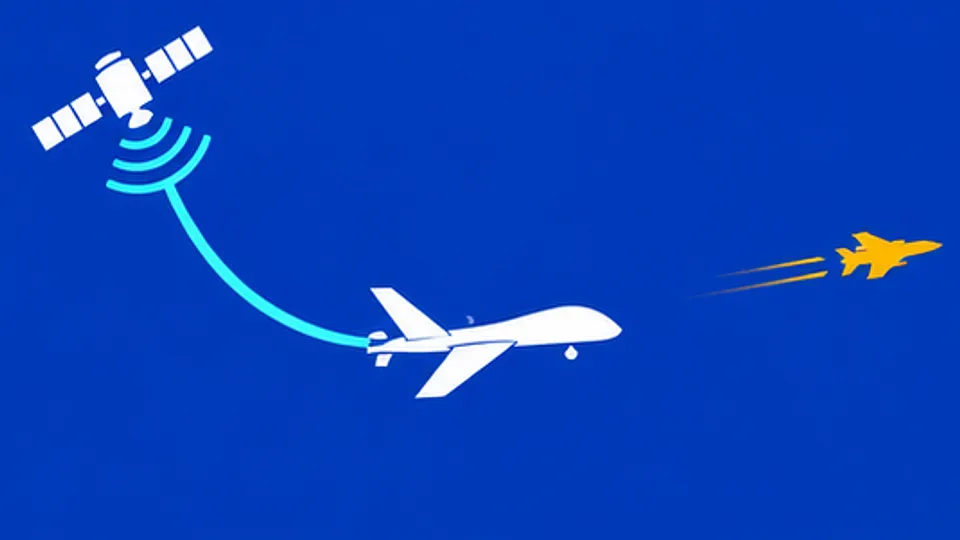
President Volodymyr Zelensky said on Thursday that speed limits on Starshield, the military version of SpaceX’s Starlink service, were back over Russian-occupied Ukraine, cutting off drones flying faster than 161 kilometers an hour.
SpaceX said that wasn’t so. “This is false. There has been no change,” the company’s media relations department told Ars Technica, which had asked for a response to Mr. Zelensky’s remarks.
Mr. Zelensky made the accusation in a speech at the European Political Community summit in Dublin. “The speed limit is back at 161 kilometers per hour,” he said, which is 100 miles an hour. Russia launches jet-powered Shahed drones from the occupied areas, he said, and Ukraine’s interceptor drones can’t catch them in time without that speed.
“Near the front line, we cannot use our aircraft. Only drone interceptors can operate there,” he said. “And without the speed we need, shooting down these Shaheds becomes much harder. This means more Russian strikes get through, and more of our people are killed, our civilians are killed, by Russia.”

The new limits come three weeks after the last ones were lifted. In mid-October, Ukrainian officials said SpaceX had abruptly capped Starlink and Starshield at roughly 160 kilometers an hour, amid friction with the Trump administration over Ukrainian strikes on Russian oil refineries. Service came back on Oct. 24, The Globe and Mail reported, though no one took responsibility for either the cap or its removal.
Kyiv says it doesn’t know why the limit is back. “We are trying to get the details from the American side, but so far we know very little,” Mr. Zelensky said. An official at Ukraine’s embassy in Washington told Reuters there had been no clarification from SpaceX or the Pentagon.
What bothered him most was where the cap applies. “If someone in America is making decisions that basically treat Ukrainian territory as if it is not Ukrainian, then this tells us where things are going,” he said. “We need to be clear and never recognize Russia’s occupation of Ukrainian territory in any way.”

In a post on X, he described a wider problem, saying units had seen “significant disruptions” to Starshield for several days along the entire front line as well as in the occupied territories. “These are not random errors, but systematic speed restrictions,” he said.
Senior Ukrainian officials told the Financial Times they believed the limits were meant to pressure Kyiv during U.S.-mediated talks with Russia in Abu Dhabi. Those talks ended Wednesday with a deal on a prisoner exchange, the first in nine months, but U.S. mediators said the two sides still disagreed on territory. One senior Ukrainian official told The FT that Washington appeared to want to strengthen Russia’s position.
The timing fed that suspicion. Steve Witkoff, the U.S. special envoy, and Jared Kushner, President Trump’s son-in-law, met President Vladimir Putin in Moscow on Thursday and were then set to fly to Ireland to meet Mr. Zelensky, The FT reported.

SpaceX holds several Pentagon contracts to supply Starshield to Ukraine, and the company says Washington makes the calls. Elon Musk, its chief executive, said last month that “Starshield systems are owned and controlled by the US government. Any limits on speed or usage are decided by the US military and ultimately POTUS.” Mr. Trump denied ordering the earlier limits, and Secretary of State Marco Rubio said the administration had “no foreknowledge” of the slowdown. The Pentagon’s inspector general has since turned down a request from U.S. senators to find out who gave the order.
Mr. Musk has also accused Ukraine of using the commercial Starlink service for offensive drone strikes, which he said broke its terms of service. A Ukrainian official denied that, saying earlier SpaceX limits already kept the military from using Starlink that way. The White House did not immediately respond to a request for comment from Ars Technica.
Thomas Regnier, a spokesman for the European Commission, said at a news conference that this wasn’t the first time Ukraine had faced Starshield disruptions. “These reports are deeply concerning and, if confirmed, unacceptable,” he said. “Starshield services must be restored urgently for Ukraine to keep its soldiers connected, to protect its citizens, and to defend its territory.”