

The death toll from the November 2 strike on a humanitarian aid point in Komyshuvakha, a village in Zaporizhzhia region, reached 55 on the morning of November 7, Ukraine’s State Emergency Service said, after rescue crews pulled nine more bodies from the rubble in the preceding 24 hours. Dozens more are still listed as missing. The toll has moved in a straight line upward since the strike: 26 dead the first evening, 33 by November 3, 40 by November 4, 53 by November 6, 55 by November 7 — a progression that tells you less about the attack’s severity, which was fixed the moment the bombs landed, than about how long it takes to dig a shelter two floors underground out of a collapsed building.
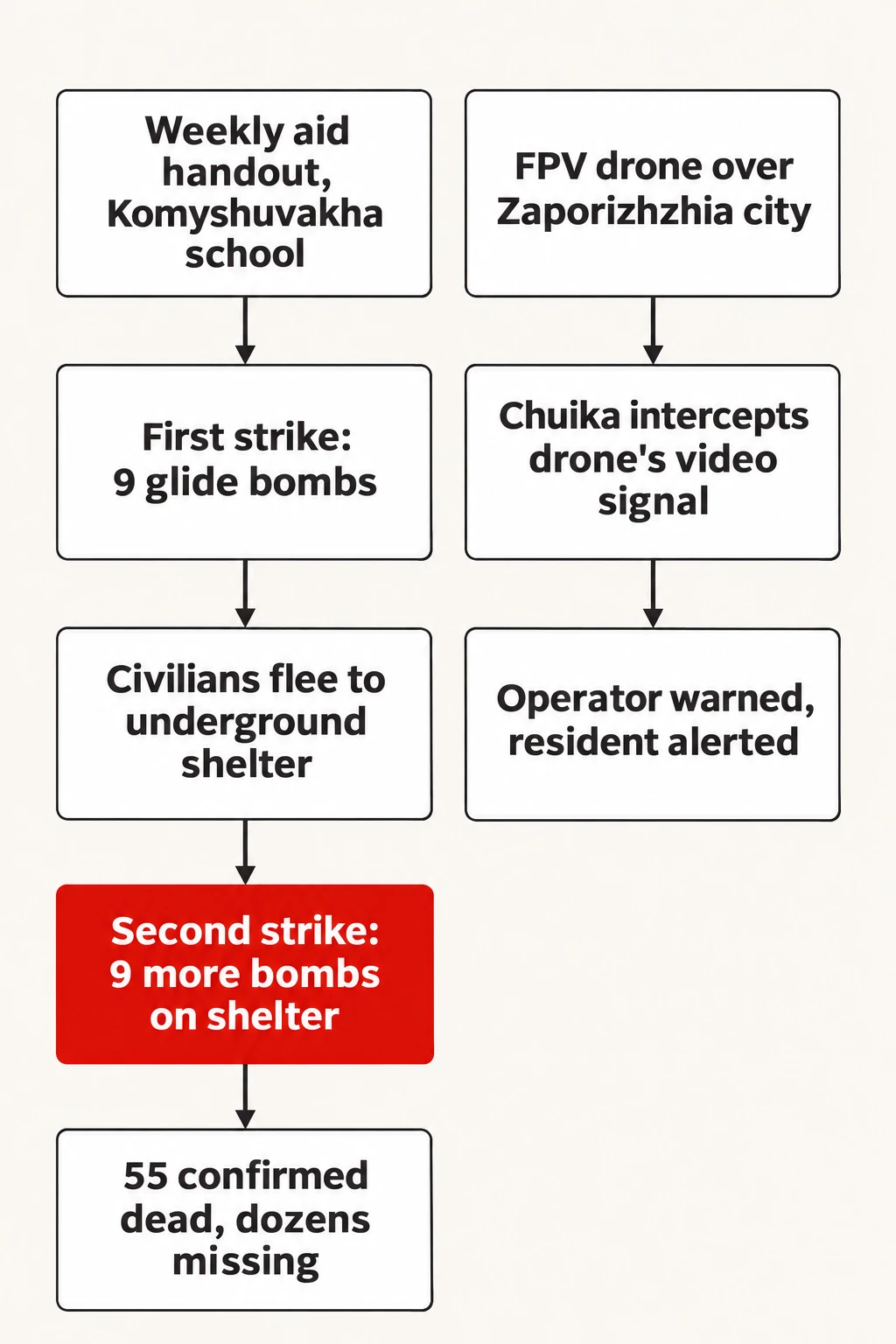
The mechanism was what Ukrainian officials call a double-tap: a first strike on the target, then a second on the people who come to help or shelter from the first. Zelenskyy described it on X as nine aerial bombs dropped on the school where aid was being distributed, followed by nine more on the underground shelter residents fled to. Ukraine’s military intelligence agency HUR says four Su-34 jets and six identified pilots carried out the bombing, under a strike plan it attributes to Colonel Fyodor Zubakov, head of the fire-engagement group at the Russian “Dnepr” group of forces headquarters, according to Kyiv Post. Reuters-verified bodycam footage from a police officer killed in the attack shows 15 to 20 civilians walking into the shelter after a radio warning that glide bombs were inbound; the recording ends as the ceiling comes down.

The weapon in both taps was the glide bomb: a free-fall aerial bomb fitted with pop-out wings and a guidance kit, dropped from a jet well outside the range of Ukrainian air defence and steered the rest of the way to the target. The UN Human Rights Monitoring Mission in Ukraine says glide bombs killed at least 478 civilians and wounded 2,667 in Ukraine over 2026 before this strike, 16% of all verified civilian casualties for the year. The mission’s head, Danielle Bell, said the aid distribution’s timing and location had been “well publicized” in advance and that Russian forces either knew about the gathering or failed to check, a combination she said meant the strike “seems to have violated the most fundamental principles of international humanitarian law.” The mission also noted a precedent: a drone had already hit the same village during an earlier aid handout on June 15, 2026, injuring four people and prompting the aid group involved to suspend deliveries there over safety.
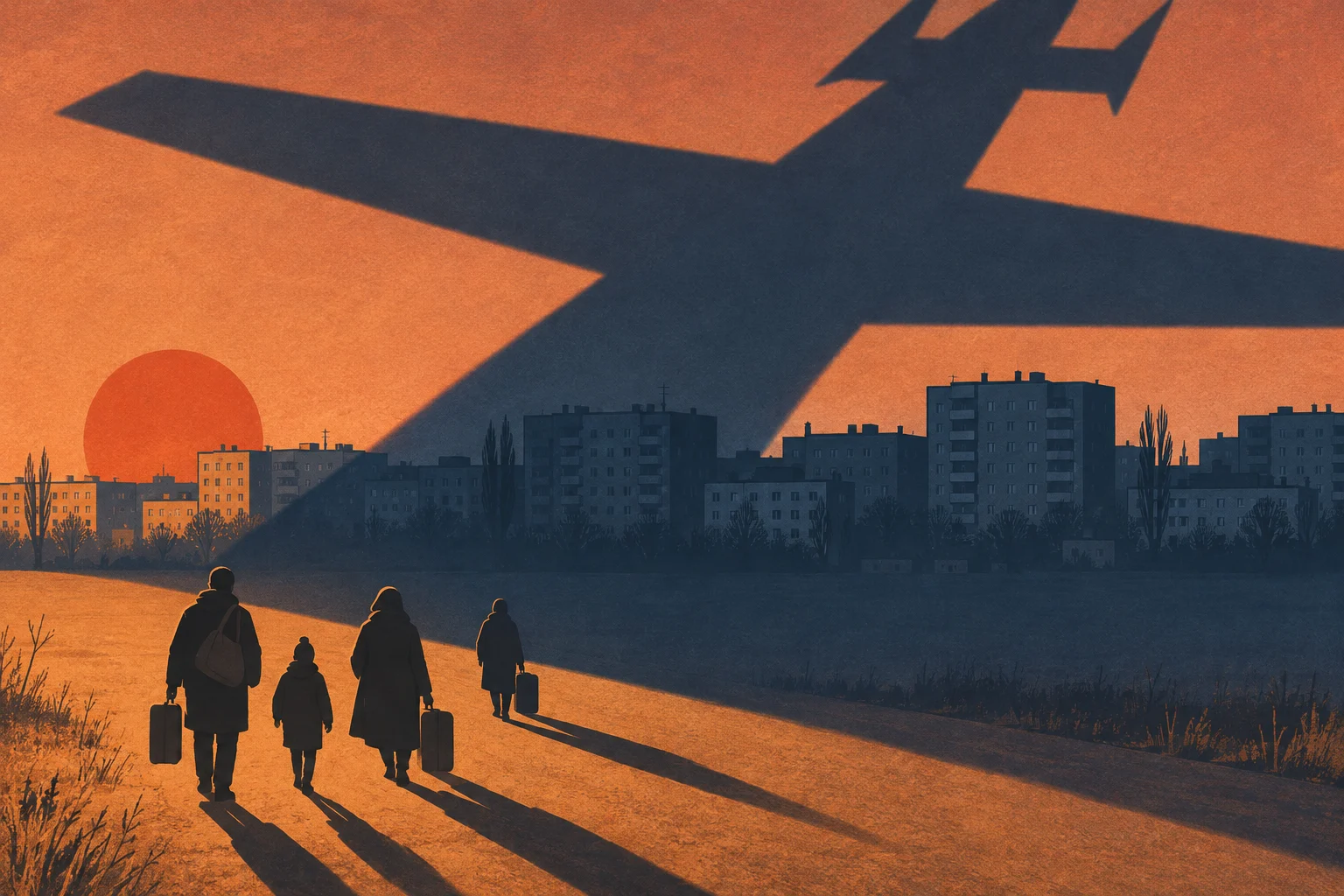
That history is the reason the Komyshuvakha toll matters for the region beyond the village itself, as Al Jazeera’s reporting from Zaporizhzhia city makes clear. The region once functioned as a landing point for people fleeing Mariupol and Melitopol, cities Russia took early in the war. It is no longer behaving like a rear area.
A drone war with its own detection layer
Volodymyr, interviewed by Al Jazeera, left Preobrazhenka, a village about 40km from Zaporizhzhia city, last week, after the number of remaining residents fell to eight. He was in a cellar when FPV drones — first-person-view quadcopters flown by an operator watching a live video feed, cheap enough to be used against single vehicles and individuals rather than saved for larger targets — attacked the village. “We were in the cellar when they started bombing us with drones,” he said. “As you can see, I was completely burned.” He is now in a displacement shelter in Zaporizhzhia city, one of roughly 161,000 registered internally displaced people the city is hosting, a population tracked by Ukraine’s registration system that regional officials say undercounts both arrivals and departures. Denys Knysh of the regional military administration told Al Jazeera the shelters may be relocated “if the situation gets worse,” and that tracking who is actually in the city has become unreliable: “The demographic in Google doesn’t correspond to the reality.”
Zaporizhzhia city’s response to the FPV threat is a piece of improvised counter-drone infrastructure called the Chuika — a device that intercepts the video signal an FPV drone transmits to its pilot, which both detects the drone’s presence and warns its operator that someone nearby has spotted it. Children in the city carry personal versions of the same detectors as routine equipment, per Al Jazeera’s reporting. The city has also strung anti-drone netting over streets in its Cosmos district and over businesses and filling stations along the Pryberezhna highway, and mounted jammers on the roofs of city buses — a response to attacks that already include at least one FPV drone hitting a bus directly. On the day Al Jazeera’s reporter was in the city, Russian “Banderol” cruise missiles — low-cost, jet-powered munitions — struck a shopping mall and the city’s main bridge.
| From | To | How |
|---|---|---|
| Weekly aid handout, Komyshuvakha school | First strike: 9 glide bombs | |
| First strike: 9 glide bombs | Civilians flee to underground shelter | |
| Civilians flee to underground shelter | Second strike: 9 more bombs on shelter | |
| Second strike: 9 more bombs on shelter | 55 confirmed dead, dozens missing | |
| FPV drone over Zaporizhzhia city | Chuika intercepts drone's video signal | |
| Chuika intercepts drone's video signal | Operator warned, resident alerted |
Based on Al Jazeera, Zelenskyy statement, UN Human Rights Monitoring Mission in Ukraine
None of this is isolated to one village or one week. Al Jazeera’s reporting on the national picture put the week ending November 6 at 2,346 drones and more than 80 missiles launched against Ukraine, with a single-day peak on November 3 of 370 drones and 76 missiles — a volume that makes Zaporizhzhia’s new defensive layer less a response to one attack than to a sustained rate of fire. Ukrainian officials have linked the intensifying long-range campaign to the run-up to US-brokered talks scheduled for Abu Dhabi on November 10–11, arguing that Moscow has an incentive to maximise pressure before negotiators sit down, not after.
The region’s population numbers show the slower version of the same pressure. World Population Review puts Zaporizhzhia city’s 2026 population at roughly 712,800, down about 3,600 over the past year, a decline of 0.5%. That looks modest against a war that has run since 2022, but it understates the churn: residents who leave for safety are replaced by people fleeing worse-hit settlements elsewhere in the oblast, which DeepState analysts estimate is roughly 75% under Russian occupation, according to Ukrainska Pravda’s reporting. Some of that occupied territory’s former population has effectively gone to zero: Stepnohirsk, in the same oblast, had an estimated 4,294 residents in 2022 and 28 left by 2026.
Restaurant terraces in Zaporizhzhia city still have their lights on, Al Jazeera reported, and some street life continues alongside the netting and the jammers. Alina, who works in a flower shop, told the outlet: “Of course I may have to leave, but I don’t want to.” Nataliia, at a filling station, described a drone passing overhead the same day she was interviewed: “It’s scary and dangerous, everything is flying around.” The open question is whether a city built a counter-drone layer fast enough to keep that normalcy intact, or whether Komyshuvakha’s second tap — the strike on the people who came to help after the first one — is the template for what reaches the city next.