
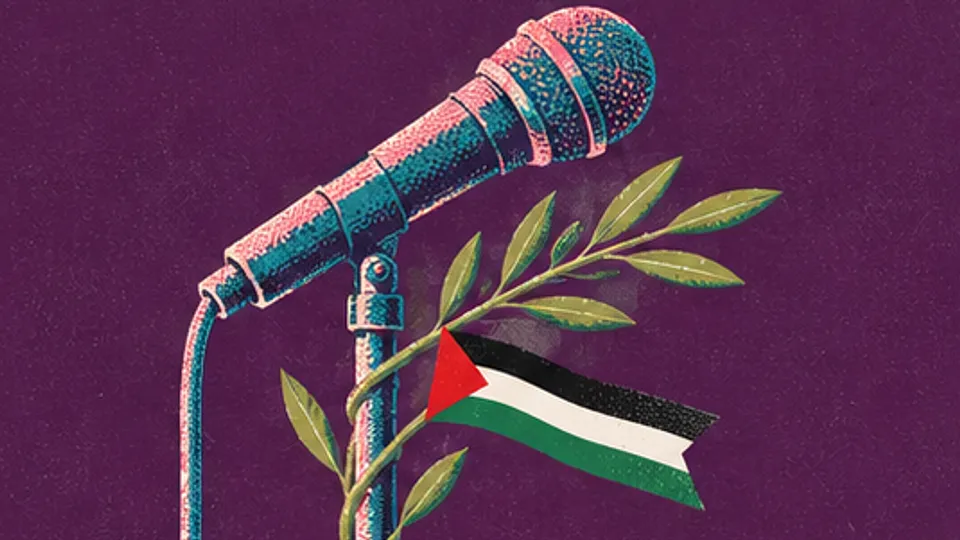
Here is a fun problem in the economics of live entertainment. If you own the stadium, you get a say in who performs in it. That is basically the whole theory of the case that Robert Kraft, the multibillionaire owner of the New England Patriots and Gillette Stadium, tested last month, when he moved to keep the rapper Macklemore off the stage at his venue. It worked. And then on Friday night, Zach Bryan — the 30-year-old country star, Oklahoma native and Navy veteran — walked onto that same stage at Gillette wearing a black T-shirt reading “Free Palestine,” with several members of his band in similar shirts, and played his show.
The shirt, per CBS News, also carried the phrase “An appeal to heaven” with a pine tree logo — a slogan dating to the Revolutionary War that appeared on Massachusetts’s official maritime flag until 1971, which is a level of regional historical layering that you have to respect. Bryan, who was playing the first of two Gillette shows closing out his With Heaven on Tour, reportedly did not mention the shirt from the stage. He did not have to. Fans filmed it, it went everywhere, and Macklemore posted a photo of Bryan on stage with the caption “Robert Kraft” plus a side-eye emoji and a Palestinian flag.
The background, briefly. Last month Macklemore shouted “Free Palestine” during his opening set for Ed Sheeran at MetLife Stadium in New Jersey, with footage from Gaza on the screen behind him. Kraft then called Sheeran, who was scheduled to play Gillette on September 25 and 26, to say the rapper would not be allowed to perform there. According to Macklemore’s account, Kraft had also “rallied some of the other stadium owners and collectively they gave him an ultimatum: if Macklemore stays on the tour, you will not be allowed to play in our venues.” Macklemore was dropped from the tour altogether, and every other opening act — Finneas, Lukas Graham, Aaron Rowe and Sheeran’s house band Beoga, per NBC News — quit in solidarity. Fans sought refunds. Then a nor’easter rolled in and Sheeran’s Foxborough shows were canceled anyway, which is a tidy metaphor someone will do something with.
Kraft’s position, in his own statement, was that Gillette has “a longstanding commitment to providing a welcoming environment for all guests and ensuring that events held at our venue do not provide a platform for hate speech,” and that Macklemore’s “recent actions, material shared from the stage during Ed Sheeran’s shows in New Jersey, and a broader history of antisemitic rhetoric and imagery” would “cross that line.” He added that he would “welcome the opportunity to sit down with Macklemore and discuss the facts, because ultimately our goal is the same – peace for all people, an end to suffering, and an end to all hate.” Kraft did not immediately return requests for comment about Bryan’s shirt; WBZ-TV said Gillette Stadium hadn’t responded to its inquiry either.
Leverage, and the lack of it
I think the interesting question here is structural. Notice who Kraft was able to remove and who, so far, he has not. Macklemore was an opening act. He was, as Sheeran was quick to point out in his own statement, not even Sheeran’s employee: “Macklemore coming off tour was the promoter’s decision, it was not mine. Macklemore’s contract for the tour was with the promoter, not me.” An opening act is a vendor. Vendors can be swapped. When the venues collectively threaten to lock the doors, the headliner has a fiduciary-ish problem — Sheeran said he would “never let down the fans who had made plans,” nor “abandon the touring crew and the other support acts and musicians who rely on me for work and to make a living” — and the opener is the cheapest thing in the whole chain to sacrifice.
Zach Bryan is a different kind of counterparty. He is the headliner. It is his tour, his name on the ticket, his two sold nights at a roughly 65,000-plus-seat stadium. There is no promoter sandwich to unwind, no opener slot to re-staff. The remedies available to a landlord who dislikes his tenant’s T-shirt, mid-lease, are limited, especially when the tenant’s show is the product being sold. Bryan knew this, presumably. Everybody in this story is acting on a reasonably precise understanding of their leverage, which is what makes it such a clean little case study.
Meanwhile the conflict has settled into a strange equilibrium of competitive philanthropy. Macklemore pledged $1 million to support Palestinians and publicly invited Kraft to match it. Kraft announced he planned “to commit $2 million to match his donation to aid in the region to fight this humanitarian crisis” — double, on behalf of the guy he banned, which is its own sentence — and said he had already talked to Sheeran about matching the singer’s own $2 million pledge. Macklemore then announced a Free Palestine Tour for this fall, with proceeds pledged to pro-Palestinian organizations, in Dublin, Paris and London on October 26, 29 and 30; he says all three dates sold out. Gillette, NBC News notes drily, is not among the stops.
The stakes underneath all of this are not small, and nobody involved pretends otherwise: Israel’s war in Gaza has killed more than 70,000 people there, according to local health authorities cited by NBC News, following the October 7, 2023, Hamas attacks that killed more than 1,200 people in Israel. Macklemore, for his part, has insisted that “Antisemitism is real” while arguing that criticizing Israel should not be conflated with Jew-hate, and framed his removal in power terms: “When the billionaire class can decide which voices are allowed on stage and which ones are too dangerous to hear, everyone should be paying attention.”
Bryan, it turns out, has practice at this exact maneuver — wading in, musically, where he is structurally hard to punish. Earlier this year he released “Bad News,” a song needling U.S. Immigration and Customs Enforcement — “This land’s your land/This land mine too/Is this all true, man?/Or is it just bad news?” — which the Boston Globe notes was condemned by then-Homeland Security Secretary Kristi Noem and written before two Americans, Renée Good and Alex Pretti, were killed by ICE agents in Minneapolis. Offstage, he has been buying up Jack Kerouac’s old haunts in Lowell, including a former church slated to become a Kerouac center and the 120-foot scroll of On the Road, purchased for a record price. A man of varied interests.
So: the venue owner drew a line, the headliner wore the line on his chest, and the show went on, with another one Saturday night. Kraft, who the Globe describes as having enlisted other NFL owners to ban Macklemore league-wide, now gets to decide whether a Grammy-winning country act in the middle of his own two-night stand crosses it too. The answer so far appears to be that some platforms are easier to de-platform than others.