
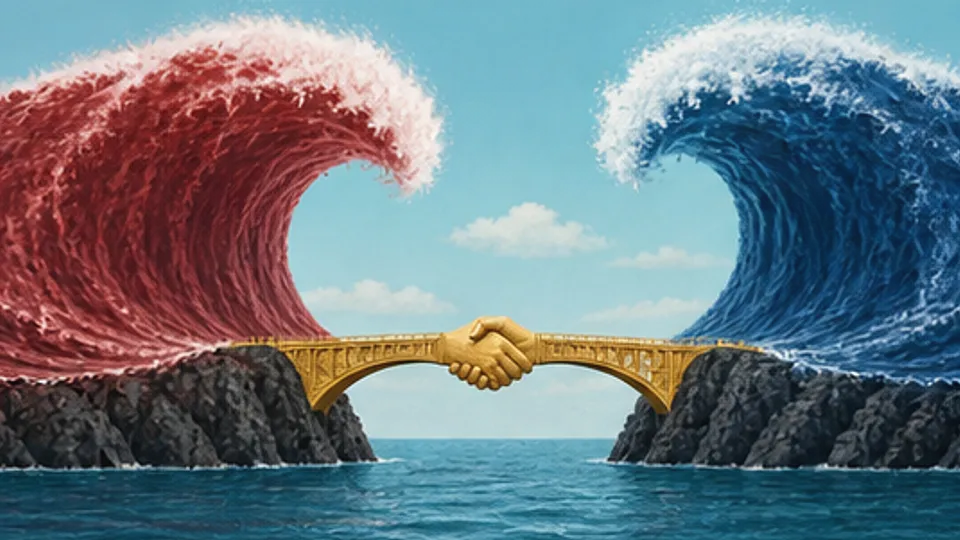
There is a phrase for what Xi Jinping came to Washington to prevent, and he said it himself, in the White House, with Donald Trump looking on. The Thucydides trap: the collision that comes, the Greek historian wrote, when a rising power meets an established one. Xi had used the phrase before, in Beijing in May, when he asked Trump how he planned to avoid it. On Thursday he returned to it, and said it could be overcome.
The terms, as he laid them out at the opening of the summit, were communication. “We should strengthen communication. China and the United States are different in national conditions, but through candid, in-depth and continued dialog, our two countries can understand each other better, seek common ground while shelving differences, and build up mutual trust,” he said. “We should coexist in peace.” The two militaries, he said, should keep up regular dialog and build mechanisms for crisis prevention. There was also a softer offer: 100,000 young Americans invited to visit China on student exchanges.
The context for all this candor is a period of intense competition over artificial intelligence and trade, with tariffs on both sides. Trump, who had earlier welcomed Xi and Peng Liyuan to the White House — noting that Xi is the first Chinese leader to make a second state visit to the US, after 2015 under Barack Obama — declared he had forged “a truly great friendship” with his guest. Their teams, he said, were working toward a more balanced trading relationship, including new market access for American farmers and ranchers. AI, which Trump calls “super intelligence,” a term he introduced at the UN General Assembly on Tuesday, would be discussed alongside trade and security.
The honoring had begun the evening before. Trump and the first lady met Xi and Peng on the tarmac at Joint Base Andrews, a red-carpet welcome of a kind, according to Al Jazeera, that no US president had extended to a visiting guest at the base in six decades. “He’s coming on our soil, and we need to welcome them with the most respect,” Melania Trump told Fox News, adding that the two men “have a great relationship.” Xi’s delegation, Chinese state broadcaster CCTV reported, included his closest aide Cai Qi and Foreign Minister Wang Yi.
Thursday’s pageantry — a military flyover, nearly 500 military personnel, the Marine silent drill platoon, the honor guard review, the small and expanded meetings — was documented in detail by South Korea’s Chosun Ilbo, whose correspondent clocked the visit: Xi arrived around 10 a.m. and stayed three hours and twenty-two minutes. Trump personally guided Xi through the White House, pausing at the gallery of presidential portraits. There he stopped before a photograph — the one mocking Joe Biden with a so-called autopen — and Xi, by the Chosun’s account, laughed: “haha.” It was the same photograph that had drawn criticism when Japan’s prime minister, Sanae Takaichi, burst out laughing at it in March. Trump pointed next to a photo of himself shaking Xi’s hand and offered, deadpan, “Who is that man? I don’t recognize him:” before adding, “We respect you,” and noting that the picture hangs all year.
He led Xi on to a newly built helipad on the South Lawn. Reporters from both countries shouted questions. Neither leader took any. What Trump offered instead was this: Xi, he said, is an expert on stone, and loves good granite. “We had a great meeting.”
Ivanka Trump and her daughter Arabella Kushner were spotted at the official welcome; the Chosun recalled that Arabella sang a Chinese folk song for Xi in April 2017, and that Trump carried to Beijing that year a video of her singing in Chinese and reciting the Three Character Classic. The Kim dynasty of gestures, one might call it, if it were not so plainly improvised.
Underneath the pomp, the machinery had already moved. The eleven-month trade truce, set to expire in November, was extended to January 10, buying negotiators time toward a broader deal. Whether that pause is optics or the beginning of something durable, Al Jazeera reported, divides analysts; the deeper strategic rivalry, its account noted, rolls on beneath the carpet. It was a rivalry that began in early 2025 with a 10 percent fentanyl-related US duty, Chinese levies on coal, LNG, crude oil and autos, restrictions on five rare-earth metals essential to defense manufacturing, and tariffs that climbed into triple digits before the October 2025 truce in South Korea. In May came a planned Board of Trade and Investment, Boeing purchases, farm goods. Then, earlier this year, a fresh 12.5 percent US tariff on goods from 60 partners, China included, over forced-labor allegations.
Taiwan sat at the top of the “four red lines” China’s ambassador to the US, Xie Feng, published on Wednesday. In December the administration approved an $11 billion arms sale to the island, the largest ever; a second package, worth some $14 billion, has been on hold for months, delayed after the May summit. Trump has described the arms sales as “a very good negotiating chip.” Beijing rejects any bargaining over what it calls a domestic issue. Still, William Yang of the International Crisis Group told the Guardian, Trump is seen in Beijing as a rare opening: “the Chinese side definitely feels that Trump is a rare US president that might offer a rare window of opportunity for them to influence American policy on Taiwan, specifically on defence support.”
On AI, the US has proposed a notification mechanism so each side alerts the other to any incident serious enough to threaten national security; Treasury Secretary Scott Bessent has floated a channel for major AI safety issues. Trump, the Guardian noted, has called safety warnings a “hoax.” “The question that’s going to raise is just how is it going to be operationalised, and will it be effective,” said Amanda Hsiao, China director at the Eurasia Group. “Because the US and China have had a long history of having crisis hotlines, and they haven’t always been effective.”
The prisoner file traveled with the presidents. Trump had raised the case of Pastor Ezra Jin in May; Jin, detained in the 2025 crackdown on underground churches, was freed in July. The White House assured Yufang Rong, wife of a US nuclear scientist imprisoned in China since late 2024, that Trump would ask Xi for her husband’s release. There is Min Zin, the Myanmar expert arrested in June. And there is Jimmy Lai, whose case Trump had promised on the campaign trail to resolve and conceded in May was “a tough one.” The climate emergency, so central when Obama hosted Xi in 2015 — Ne-Yo serenaded the couple at that state dinner, and Peng reportedly sang along — was expected to be skipped entirely this time.
The American public, meanwhile, has been quietly revising its own position. A Pew Research Center survey published Wednesday — 1,168 adults, polled September 14-20 — found the share of Americans holding a cold view of China down to 54 percent from 68 percent in 2021, with warm views up from 11 to 19 percent. A Chicago Council on Global Affairs survey found 57 percent favor engagement over limiting China’s power, and only 38 percent would send US troops to defend Taiwan against invasion, down from 52 percent in 2021. “There is appetite for engagement,” Ja-Ian Chong of the National University of Singapore told Time — while cautioning that “there remains a deep reservoir of apprehension.” Dylan Loh of Nanyang Technological University put it precisely: “The warming trend isn’t admiration but a moderation of threat perception, driven by a shift toward viewing China as a competitor rather than an immediate adversary as other crises take precedence.” The MAGA base disagrees — 63 percent prefer containment — and on Capitol Hill, Rep. John Moolenaar wrote the administration on September 18 urging restrictions on Beijing’s access to US AI and semiconductor technology.
Elsewhere on the day’s margins, Secretary of State Marco Rubio, fresh from meeting Sergey Lavrov on the UN sidelines, announced that Vladimir Putin had been invited to December’s G20 in Miami — an “opportunity,” Rubio called it, as Washington keeps a channel open on Ukraine. The other crises were taking precedence. The phrase does not specify which ones.
There was to be no joint press conference, no joint statement. Each capital would issue its own account for its own audience. Friday’s schedule was tea at the White House, a visit to the National Archives, then departure; Melania Trump and Peng Liyuan toured the Smithsonian’s National Museum of Asian Art. Before that, the state dinner, with the men who make the era’s hardware and its software — Tim Cook, Jensen Huang, Sam Altman — at the tables. And on the wall of the People’s House, hanging all year, the photograph of the handshake, and the man pointing at it, asking who it was.