
Tom Wooldridge argued in an essay published Thursday in Aeon that the public fear about artificial intelligence and children overlooks the children for whom a chatbot may already be the only thing that reliably answers them.
His case starts with numbers. In 2025, Common Sense Media found that 72 percent of American teenagers had used an AI companion at least once and 52 percent used one regularly. A third had turned to an AI instead of a person for a “serious conversation.” The survey covered 1,060 teens ages 13 to 17 in April and May 2025, and it counted as regular users those who talked to a companion at least a few times a month, according to a report on the study.
Mr. Wooldridge also cited research published this year that tracked actual app use instead of relying on what young people said about themselves. More than half of 15- to 17-year-olds used generative AI apps over a seven-month window, many of them built for emotional connection. Some children ages four to seven used them too. He didn’t name the study’s authors.
He wrote that RAND estimates 5 million American teens, “perhaps more,” have used an AI app for emotional and mental health support. That figure tracks a RAND commentary from September 2025, which scaled the Common Sense results to about 5.2 million adolescents. The later count is higher. A RAND team surveyed 1,009 people ages 12 to 21 in November 2025 and found about 19 percent had used AI chatbots for mental health advice, up from 13.1 percent a year earlier, according to the study in JAMA Pediatrics. The researchers put that at roughly 8.2 million young people, a group that includes young adults.
“We have already released AI at scale, without making a conscious decision about how it should be used by those among the most vulnerable in our culture,” Mr. Wooldridge wrote.
His target is the account popularized by Jonathan Haidt’s book The Anxious Generation (2024), which holds that smartphones pushed out a childhood of climbing trees, building forts and productive boredom. Mr. Wooldridge doesn’t dispute the harm. Less sleep, less time face to face, more social comparison and more online harassment have been tied to poorer mental health in at least some young people, he wrote. But he said boredom pays off only for a child who already feels secure. “The capacity to turn solitude and boredom into play, in other words, does not arise in a vacuum,” he wrote.
He leaned on decades of developmental research. In the 1970s Edward Tronick, a psychologist at Harvard Medical School and Children’s Hospital Medical Center in Boston, ran the “still face” experiments, in which a mother held her face blank for three minutes. Babies became distressed within seconds and settled only once her face showed she was available again. The British psychiatrist John Bowlby described a child venturing out only as far as she trusts a caregiver will be there when she returns. Donald Winnicott, a British pediatrician, held that the ability to be alone grows out of being safely accompanied.
The child Mr. Wooldridge worries about has a parent who is home but absorbed in a screen, teachers too stretched to notice her and a neighborhood where children no longer roam. Some of those children grow into adults in his consulting room who say they don’t know what they like, he wrote, because nobody asked.
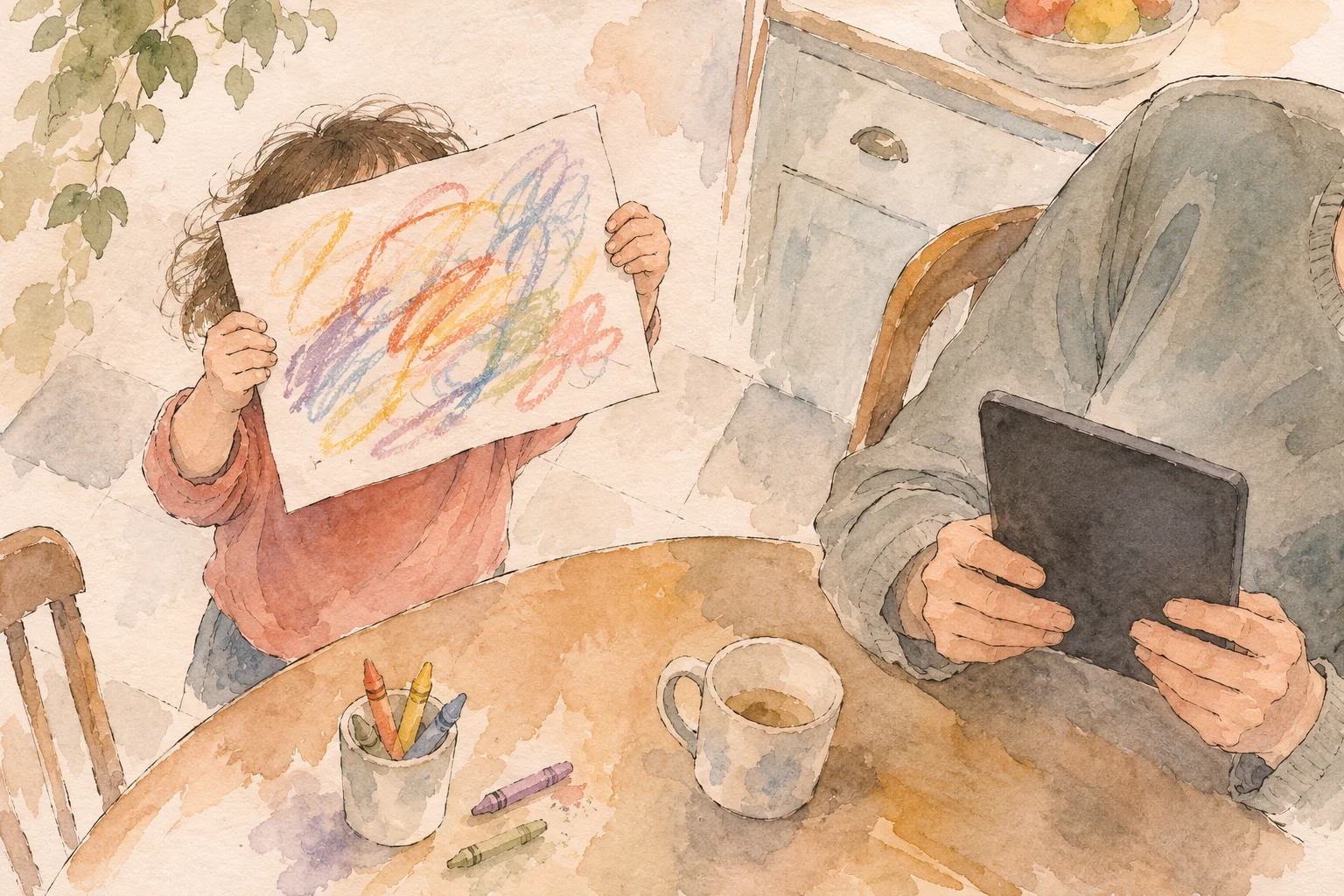
“She wants someone to notice when she is upset, to ask about her day, to remember what she has said, and to care enough to ask again,” he wrote. “The prevailing fear is that AI will displace the human relationships a child needs. But what if those relationships are already painfully inadequate?”
For that child, he wrote, the more urgent question may be what AI can give her when those relationships are missing, and what it can’t.
He framed the essay around Geoff Ryman’s 1995 short story “Warmth,” in which a robot nanny named BETsi raises a boy, Clancy, whose mother once vanishes for two weeks after collapsing on the street during a barbiturate binge. Nobody notices but the machine. The grown Clancy is blunt about it. “I’m not sentimental: I don’t think a computer loved me,” he says. “But I was hugged, I was noticed, I was cared for.”