
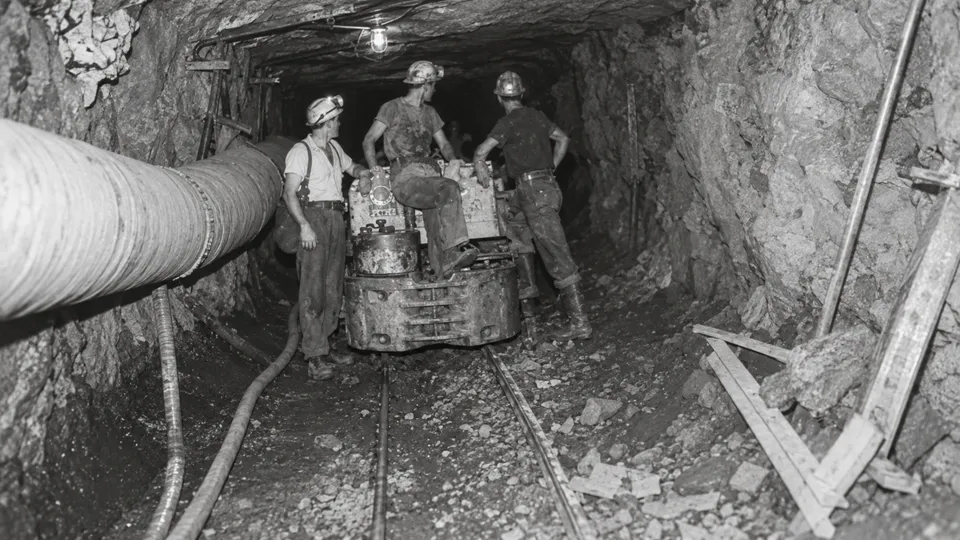
Wittenoom is not on the road signs. It has been taken off the official maps. Nobody lives there and going in is forbidden. It is a ghost town.
Once it was a settlement of prefabricated houses with a grocery store, two schools, a nursery, a hospital, a church, a bar, an open-air cinema, tennis courts, soccer and cricket fields, and its own police station. It grew around a mine in the Pilbara, a desert region of Western Australia, some 870 miles from Perth. The mine held crocidolite—blue asbestos. Since then more than 2,000 workers and residents of the town have died of diseases tied to the asbestos. Some died decades after they left. The people who live with it call it the “Australian Chernobyl.”
The men who dug the mine were largely European immigrants. After the war, millions left the poor countries of Europe. Spaniards went mostly to Germany, Switzerland, France and Belgium, and some crossed the Atlantic. A few went to Australia, where Fran desde 1958’ migration deal...
Operation Kangaroo
The Franco government struck a migration agreement with Australia that began in 1958 and sent about 8,000 Spaniards there. They called it Operation Kangaroo. The first harvested sugar cane. Later they worked in construction, tobacco, logging and mining. One company recruiting was Australian Blue Asbestos, a subsidiary of CSR, which had run the Wittenoom mine since 1943. Blue asbestos had been pulled from that ground since the 1930s, and through the 1940s, 1950s and early 1960s the mine worked at full capacity. The company saw a large business in a heat-resistant mineral that went into pipes, trains, ships and electrical installations. It never told the workers the mineral was dangerous. It was.
María Bernal and Daniel Écija met at an afternoon dance at the Círculo de Bellas Artes in Madrid on September 16, 1961. She was 20, a seamstress who lived in the porter’s apartment on Fúcar Street and cared for her sick father. He was 26 and had worked already in France and Germany. He asked her father for her hand. They married on September 20, 1962, and four days later they emigrated to Australia with one small suitcase between them and not a word of English.
María is 84 now. Alzheimer’s has taken many of her memories, but the journey remains. “I stuck close to my husband, like a little girl,” she says. “But I was proud. I had fallen in love with that man and trusted the future… even though it was so far away. In Spain we had nothing, neither of us.”
In Wittenoom they met another couple from Madrid, Milagros Barroso and Ramón de Juan, and the two families became close friends. Milagros came from Navamorcuende, in Toledo, widowed at 22 with a small child. In Madrid she had gone into domestic service and met Ramón, a driver for a senior official of the Franco regime and a widower with a daughter. He heard of the Australian dream while working in Germany. They crossed the world with the children each had brought to the marriage, Mercedes de Juan and Víctor Calvo, and their first child together, José.
Víctor is 72 and lives in Madrid. He was seven when the family sailed from Málaga in August 1962. “We left Málaga and it took us more than 20 days by ship to reach Australia. We passed through the Suez Canal… Phew, how hot it was there,” he says. “Spanish emigration at that time was like that: you clung to any opportunity to get by, like those who come to Spain today.”
He remembers the town still. “The plane was small, propeller-driven, and it shook a lot. We landed on a strip amid very, very red earth. There was dust everywhere. I had never seen so much dust. They took us to houses made of corrugated iron, wood and asbestos cement. That place was extremely isolated—the desert of deserts. There were all sorts of animals: snakes, tarantulas, huge lizards. Everything was so different from Spain it seemed unreal, like a dream.” The family arrived with trunks of warm clothes they would never use.
Daniel Écija worked eight-hour shifts. Ramón doubled his when he could, and many days worked sixteen. On Daniel’s first day there was an explosion, and several men died. “I think when he saw all that he wanted to leave as soon as possible,” his son recounts, “but my mother was pregnant and they had no money, so they stayed a few months.” In another story the father told, a piece of asbestos fell on his foot and the wound never closed. In a family portrait from those months he stands with the foot bandaged. “There were hardly any safety measures,” Víctor says. “There were many accidents and ambulances came all the time. That’s why there was a hospital in the camp.”
In that camp hospital two children, one from each family, were born in the same bed. One of them was Daniel Écija, born in Wittenoom 63 years ago and named for his father. He is now one of Spain’s best-known television producers, the creator of Médico de familia and Los Serrano. His sister Arantxa, 58, a director and producer, keeps the family’s memories.
The town is gone from the maps and no one may enter it. The dead are still counted.