
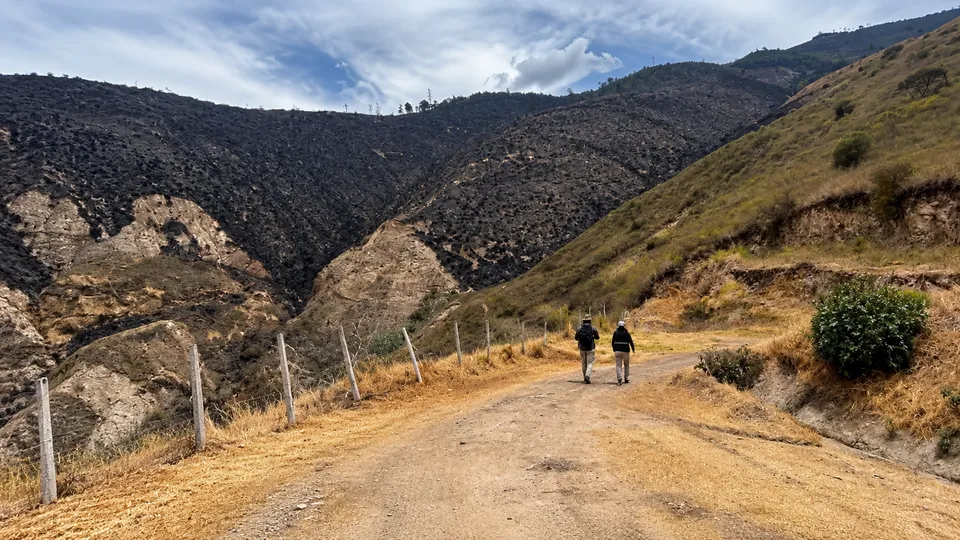
A wildfire that burned across Cerro Casitagua near Quito last month stripped away vegetation and exposed an archaeological feature no one had documented before: a stretch of steps carved directly into the rock, possibly from the Inca era.
Specialists from Quito’s Metropolitan Heritage Institute, known by its Spanish initials IMP, found the stairway while inspecting sites damaged by the fire, which burned across the mountain between Sept. 17 and 20. The team surveyed four known archaeological locations: Tagshima, Barrio Cuba Alto, Radioloma and Huiyachul, also called Uyachul.
Tagshima and Huiyachul showed no visible surface damage. Vegetation had burned at Barrio Cuba Alto without signs that archaeological material was harmed, and the ancient trail at Radioloma appeared to have escaped significant damage. Nearby, though, the fire had cleared the ground enough to reveal the rock-cut steps.
The location is what raised the Inca question. The steps stand close to the Radioloma culunco, an ancient pre-Hispanic trail in the Lulumbamba Valley, where archaeologists have recorded roads, fortified sites known as pucarás and settlement areas spanning thousands of years of occupation.
The surrounding landscape was certainly Inca territory. Pomasqui, on Quito’s northern side, held an important position during the Inca expansion into the northern Andes, and research indicates the Incas resettled Quechua-speaking mitimae communities in the valley. The nearby pucará of Rumicucho has been interpreted as part of that late 15th-century expansion, built high enough to control movement along interregional routes. A stairway beside an existing trail fits that picture, but it does not prove who carved it.
Casitagua’s history runs far deeper than the Incas. At Tagshima, on the mountain’s southern slope, earlier IMP excavations dated occupation to roughly 1500 to 500 B.C., turning up compacted floors, hearths, postholes, polished stone objects, decorated ceramics and animal remains. The site covers about 50 hectares above 3,000 meters of elevation. The steps could just as well belong to one of the communities that lived in the Lulumbamba and Pomasqui valleys long before the Inca state arrived.
The institute has announced no dating results, and it described the Inca attribution as a possibility rather than a conclusion. Lulumbamba’s remains run from the Preceramic era through the colonial period, so a fresh-cut set of steps offers few easy answers on its own.
Investigators now plan to determine when the stairway was carved, how far it extends and whether it formed part of the Radioloma route. Until that work is done, the find is an open question, one a fire happened to put in front of them.