
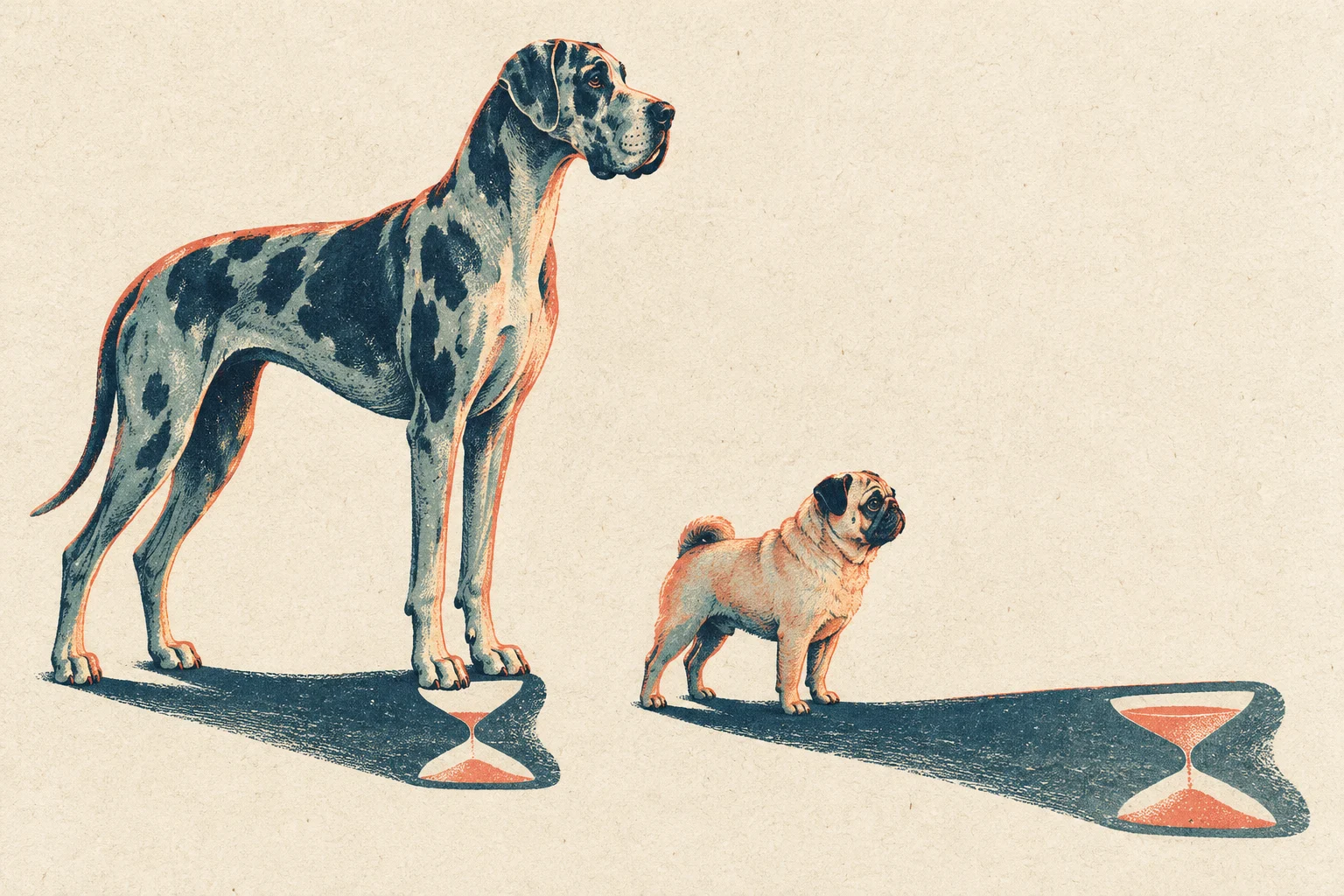
Every dog owner learns the rule sooner or later, and nobody likes it: the bigger the animal, the sooner it goes. The rule has exceptions, but a Great Dane generally does not live as long as a golden retriever, let alone a pug. Large dogs are also far more prone to the diseases of old age. Households keep this account without ever writing it down, and for a long time nobody could say what set the terms.
A team of biologists at Arizona State University now thinks it has found at least part of the answer. As Andrew Paul reported for Popular Science, the researchers argue in the journal Science that the link between size and lifespan probably runs through so-called jumping genes, which start to cause disorder in canine DNA as a dog ages. The university announced the findings on October 8 and described the work as one of the largest studies of its type.
A rule turned upside down
Across nature, size usually buys time. The university’s release notes that mice live a couple of years and some whales close to 200. Inside a single species the rule flips and the small tend to outlive the large. No species shows this more starkly than the dog.
“Dogs provide an extraordinary model for understanding aging because they show dramatic variation in lifespan within a single species.”
Those are the words of Noah Snyder-Mackler, an evolutionary biologist at ASU and the study’s senior author. There is a second reason dogs interest scientists. They have lived alongside people for more than 30,000 years and share our homes, our surroundings and many of our habits. If something in canine genes governs how fast a dog ages, it may also point to where to look in humans.
An archive of 864 dogs
The team used genetic data from 864 dogs held by the Dog Aging Project, a large collaborative study of companion animals, and mapped more than 3 million methylation sites, according to the university. An earlier preprint of the work was posted on bioRxiv in 2024. DNA methylation consists of chemical marks that control how genes are used without changing the DNA sequence itself. It belongs to the wider epigenome, which responds to outside pressures such as stress and diet, and it is one of the best-known markers of aging.
The study tracked how those marks change over a dog’s life and found that the most important changes were in one particular family of genetic material.
The guards grow tired
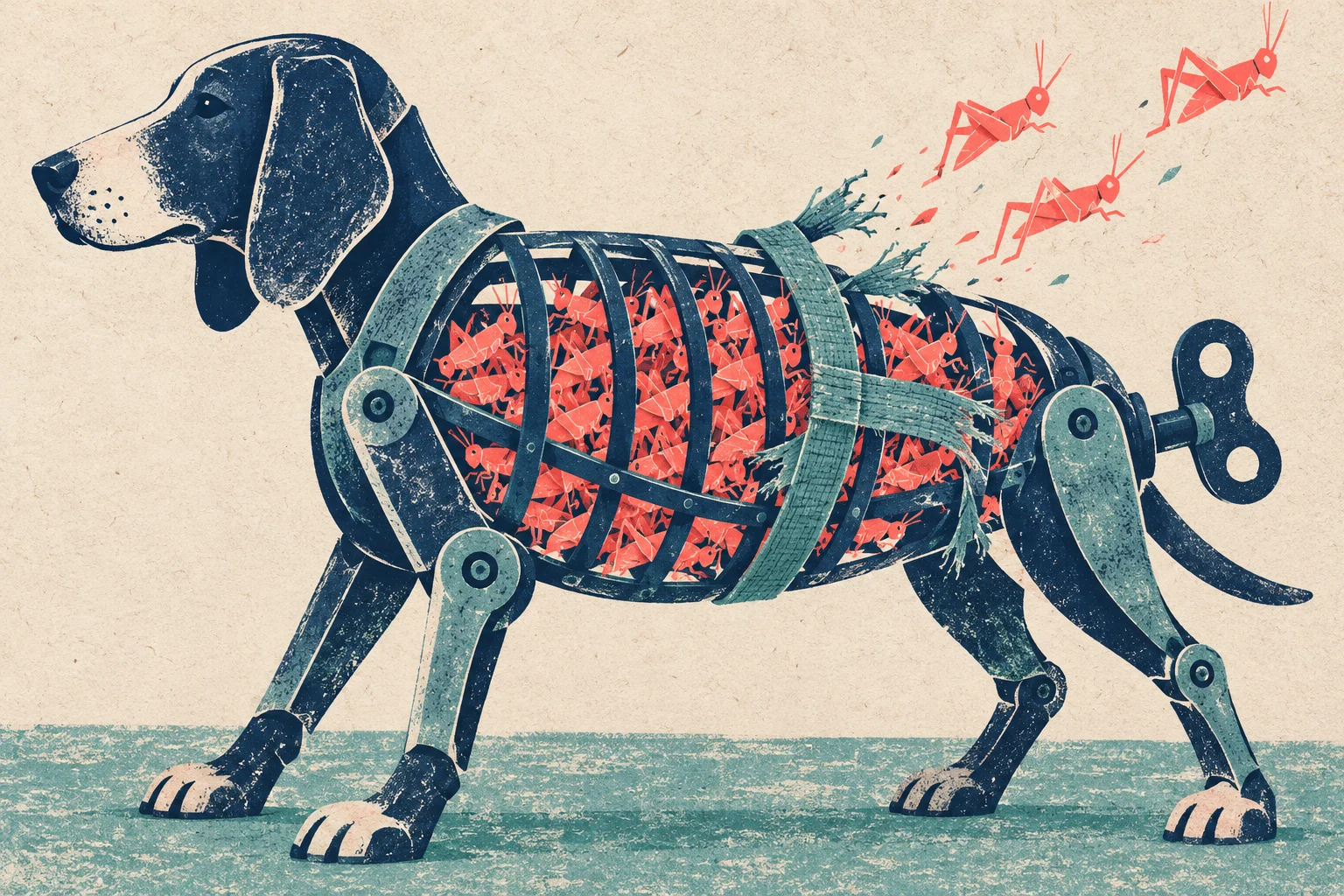
The family is the LINE1s, a class of transposable elements. They copy themselves and scatter the copies through the genome, jumping between chromosomes and damaging DNA along the way. In a young animal this does little harm, because methylation keeps them in check. With age that control weakens. Looser control means more damage: genetic instability, disease, cancer.
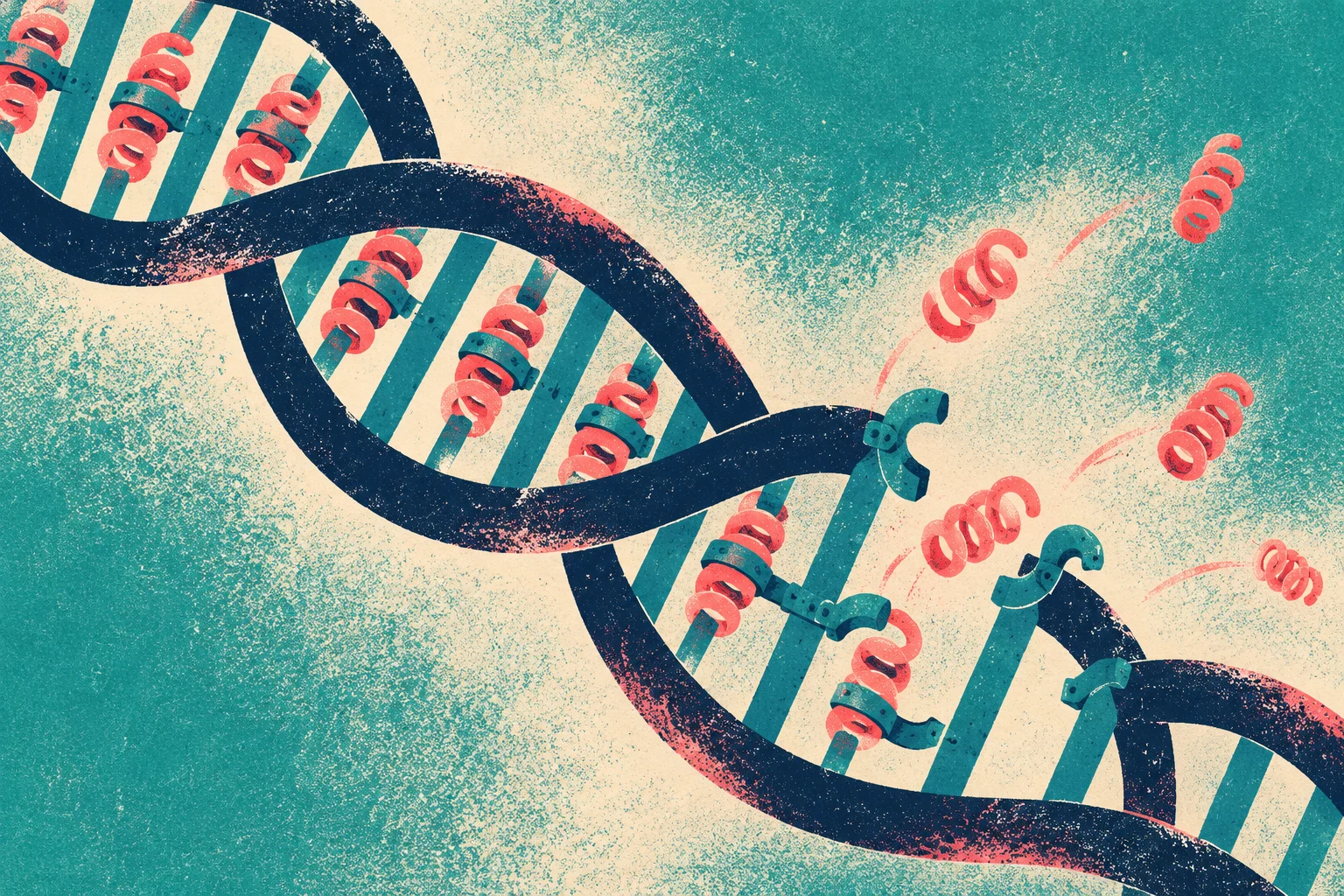
It is hard not to read this as a familiar story about order. Any settled system depends on something that keeps its restless elements contained, and decline often begins when that restraint wears out rather than with any single dramatic break. That is a reflection, not a finding. The finding is narrower, and it is measured.
More than 40 percent of the LINE1-related regions of the genome lose methylation as a dog ages. In bigger breeds the loss is much faster. Popular Science reports that larger dogs lost on average 35 percent more LINE1 methylation than smaller ones. The university’s release is more specific: giant breeds lost roughly 35 percent more LINE1 methylation per year than small breeds. The figure compares the rate of loss between breeds. It does not mean a large dog loses a third of its LINE1 methylation.
“What we found is that the epigenetic regulation of transposable elements—especially LINE1s—appears to be a major factor shaping how quickly different dogs age,” Snyder-Mackler said. His co-author Blaise Mariner, a genomicist at ASU, was more cautious about cause: “It suggests that faster aging in larger dogs may be driven, at least in part, by reduced control over these ‘jumping genes.’” In the university’s release Mariner called the result “one of the clearest molecular signatures we’ve seen that aligns with the well-known size-lifespan tradeoff in dogs.”
What the dogs cannot yet tell us
The study leaves the central question open. Nobody yet knows whether LINE1 activity makes animals age or whether it is a symptom of aging. What the work does establish is that these regions of the genome are central to biological aging and deserve close study.
There was also a result nobody expected. LINE1s on the X chromosome turned out to be more heavily methylated in males than in females, which suggests the elements may be more active in females. “This was an unexpected result,” said Brianah McCoy, a PhD researcher and co-lead on the study.
The researchers are already thinking about human health. If loss of control over these elements does drive aging, Snyder-Mackler said, “targeting these elements or the mechanisms that regulate them could be a promising avenue for future therapies to extend the health span in humans.” For now that is a possibility, not a treatment.
According to the university, Snyder-Mackler has two dogs of his own: Homer, who is seven, and Juno, who is four. The study cannot say how much time either of them has left.