
On January 1, 2024, a magnitude-7.6 earthquake hit the Noto Peninsula in Ishikawa Prefecture, the strongest to strike the region since Japanese records began in 1885. The Japan Meteorological Agency put the magnitude at 7.6; the US Geological Survey measured it at 7.5, a routine discrepancy that comes from using different seismic models and station networks. Either way, it killed 489 people within a year, according to a tally collated by the research outlet Nippon.com from national and Ishikawa prefectural government figures: 228 direct deaths and 261 more certified as disaster-related, mostly from hypothermia and the strain of life in evacuation shelters through a cold peninsula winter. Two people remained missing a year on. The earthquake damaged roughly 150,000 houses and caused an estimated ¥1.1–2.6 trillion ($7.4–17.6 billion) in losses, a range wide enough to tell you how hard this kind of damage is to price.
Noto’s small regional airport sits at the center of the recovery story now, because in July 2026 Ishikawa Prefecture and the Pokémon with You Foundation renamed it Noto Satoyama Pokémon with You Airport, the first airport anywhere to carry the Pokémon brand in its name, under an agreement that runs to September 2029. The foundation is not a marketing invention for this trip. The Pokémon Company set it up in 2011 after the Tohoku earthquake and tsunami, when it built Tohoku’s first Pokémon Center inside a Sendai skyscraper and ran morale visits with a person in a Pikachu suit. It kept the structure alive for later disasters, including Hawaii’s 2023 wildfires, and pledged ¥50 million (about $345,000) to Noto relief organizations days after the January 2024 quake, Gonintendo reported at the time.
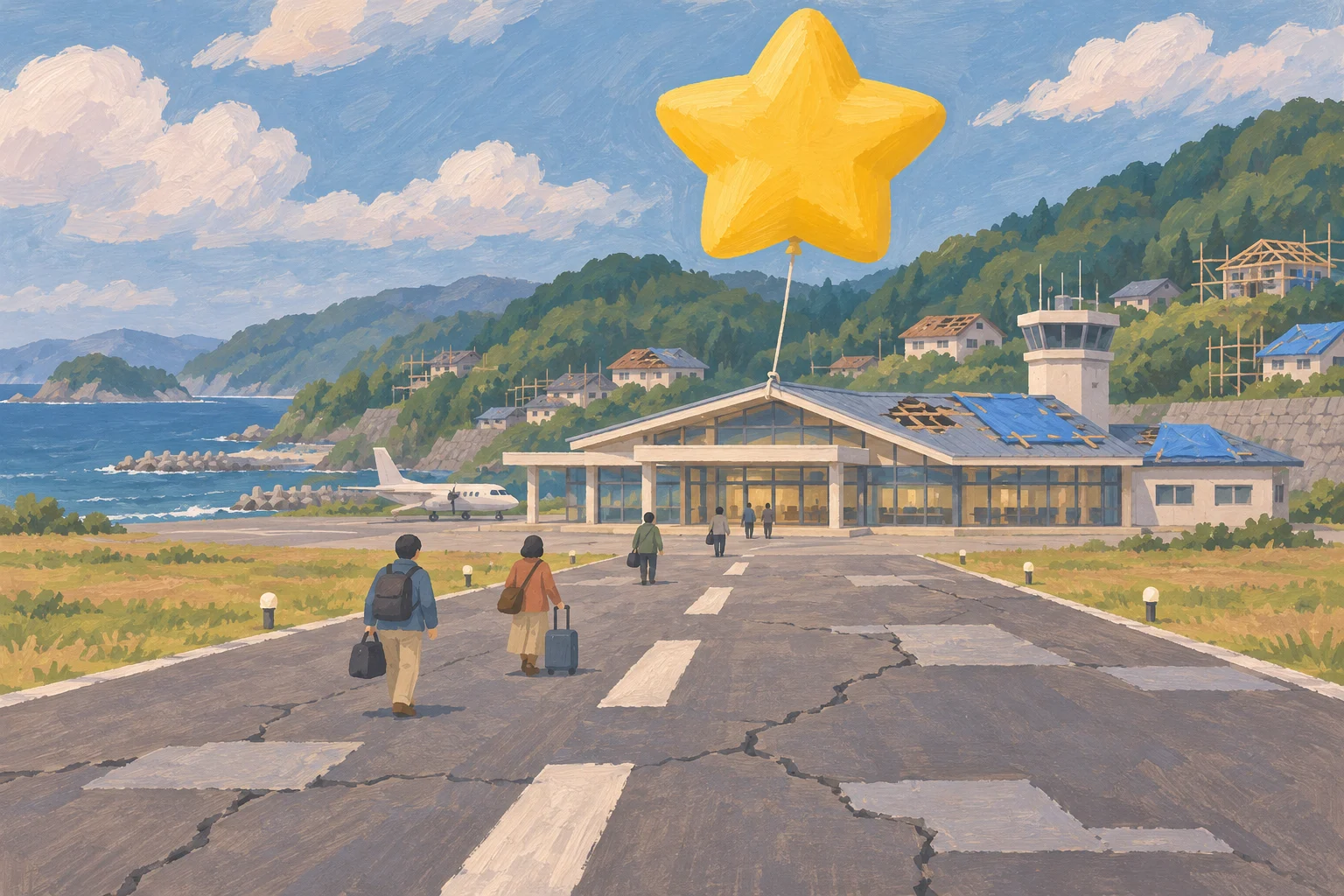
What changed at the airport
Noto Satoyama Airport is not a hub. It runs two round trips a day to Tokyo Haneda on All Nippon Airways, and before the earthquake it handled 137,428 passengers across the whole of 2023, according to Wikipedia’s sourced traffic data — about 376 people a day. The quake cut that to 52,817 for all of 2024, a 62% drop, as the airport ran at reduced capacity for months. Since the Pokémon rebrand in July, average daily traffic has nearly quadrupled year over year to about 3,220, Asia News Network reported, citing Ishikawa prefecture figures. That is roughly nine times the airport’s entire pre-quake daily average, and far more than two daily ANA round trips to Haneda could plausibly carry on their own; the figure almost certainly counts people visiting the terminal as a tourist attraction, not just departing passengers, which is itself the point of the makeover. One unnamed facility along the Pokémon trail, Asia News Network reported citing the same prefectural data, saw its visitor count rise 20-fold, though the report does not name the site or give a baseline number to check the multiple against.
Inside the terminal, the theming covers all 111 Pokémon of the Flying type catalogued as of May 2026 (excluding Mega Evolutions and regional forms), spread across departure-sign art, automatic-door graphics and a two-storey atrium built around an inflatable Pikachu. An observation deck called Pikachu no Satoyama arranges Pikachu figures into the shape of the terraced hillside landscape, or satoyama, that gives the region its name. The gift shops sell Pokémon-branded keychains, luggage tags and suitcase belts; the restaurant serves a Wajima-cider ice cream float named for the dragon-type Pokémon Salamence, flavored with sea salt sourced from nearby Hegura Island, as the BBC’s Adam Davidson described after visiting.
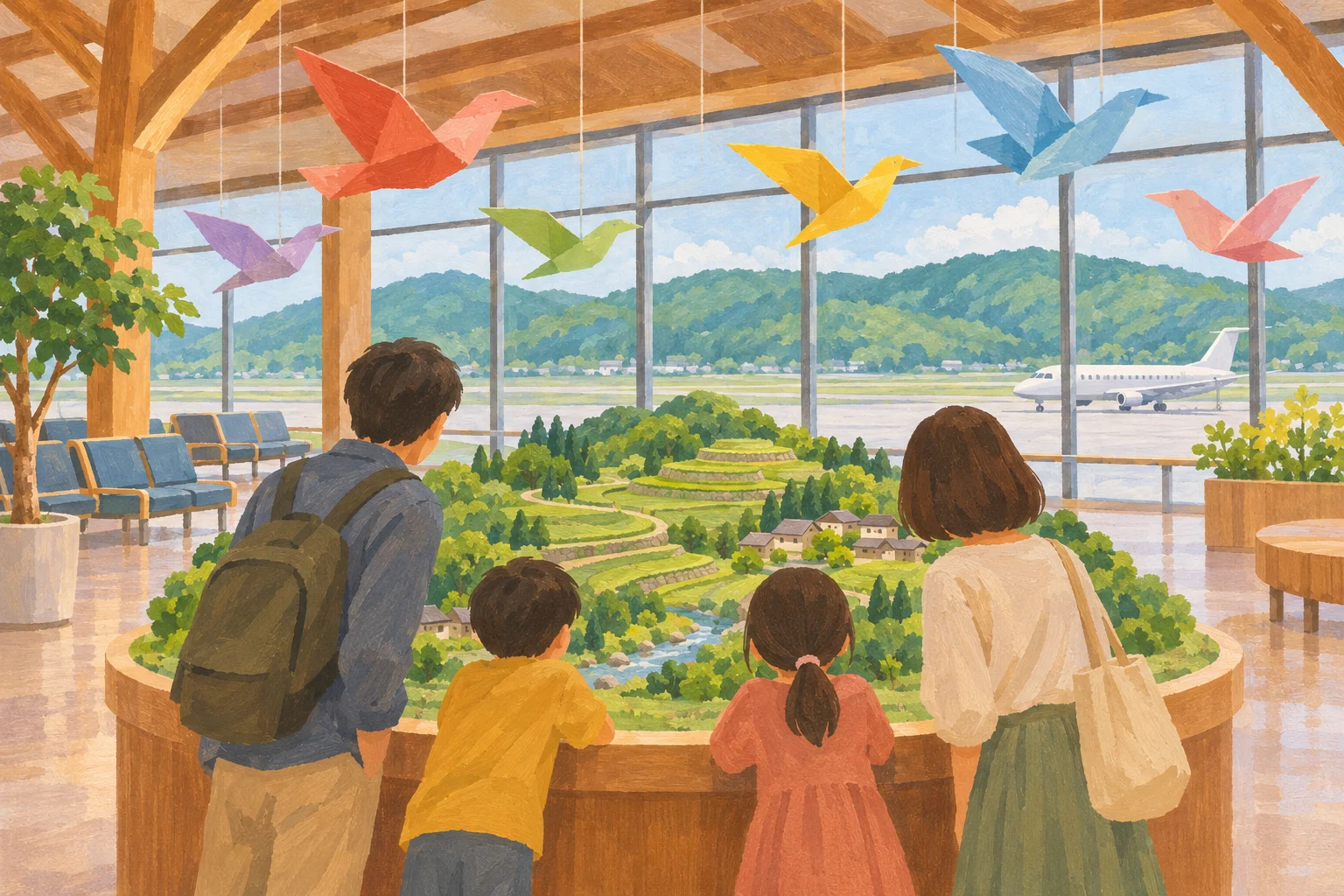
The trail beyond the runway
The airport is the anchor of a wider Pokémon Trail across the peninsula, run through 2027 and served by a dedicated bus (¥5,000 for adults, ¥2,500 for children) that makes five stops from Wakura Onsen. One stop is the Wakura Pokémon Footbath, which had been closed for more than two years after the quake cracked the underground pipes that carry the town’s hot-spring water; it reopened on May 12, 2026 with Pikachu, Psyduck and Poliwag statues lining the basin and a Gyarados-shaped spout feeding it. Another is the Shiroyone Senmaida rice terraces — senmaida means “a thousand paddies,” and the fields have been farmed since the Edo period — where statues of Fuecoco and Lucario now stand over terracing that predates the Pokémon franchise by roughly four centuries. A third stop puts a life-sized Sylveon monument on Mitsukejima, a rock island partly collapsed by the earthquake.
The business case for all this is specific and bounded. Noto drew about 7.7 million visitors a year before the quake; in 2025 the region took in 3.72 million, or 60% of that baseline, Asia News Network reported, citing the prefectural tourism division. A Pokémon with You Foundation official told the outlet, “We think this initiative will help bring back the vibrancy of the region.” That is a statement of intent, not a measured outcome: the 2025 figure predates the July 2026 airport rebrand, so the 60%-recovery number and the quadrupled airport traffic describe different periods and cannot yet be added together into a single after picture.
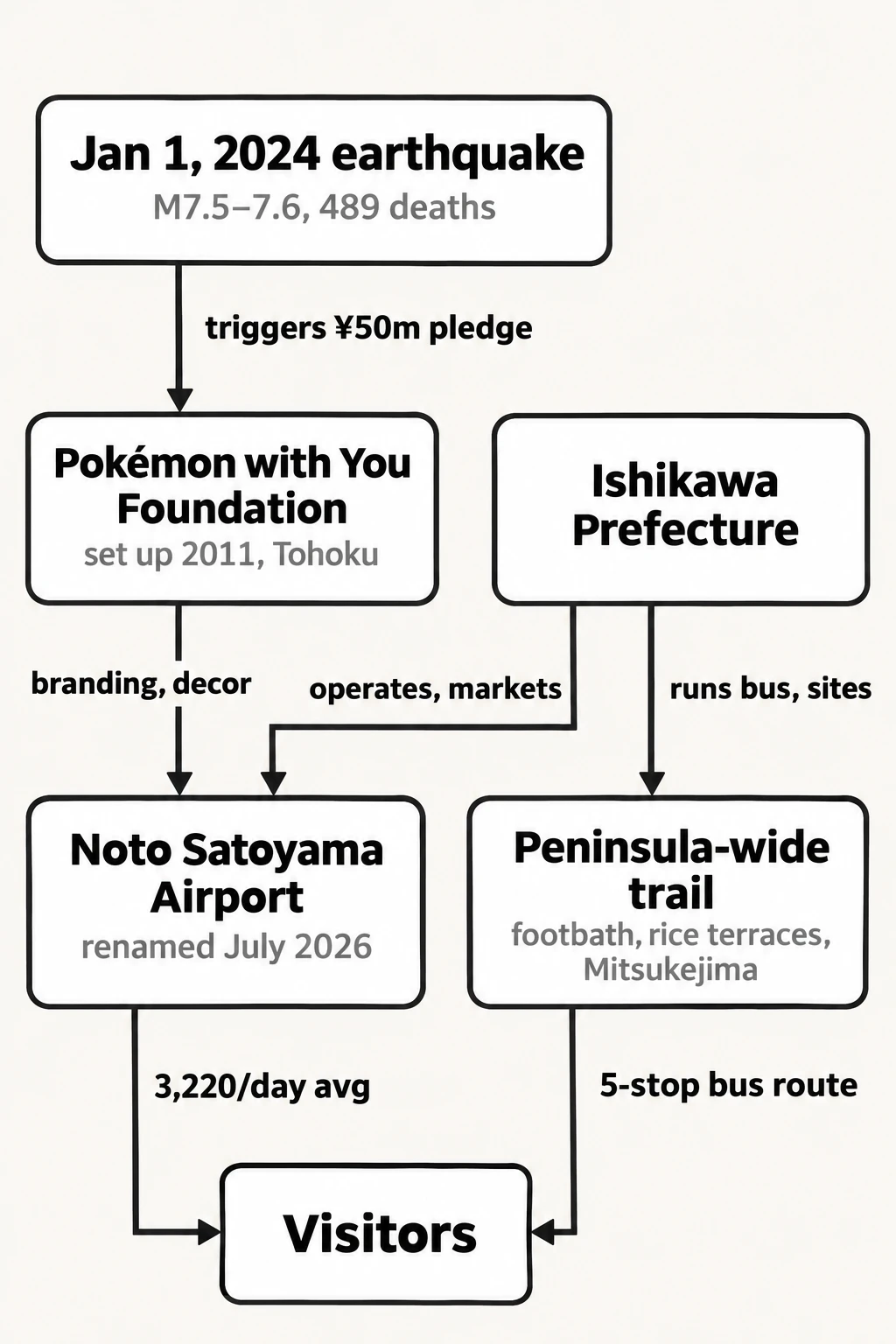
| From | To | How |
|---|---|---|
| Jan 1, 2024 earthquake (M7.5–7.6, 489 deaths) | Pokémon with You Foundation (set up 2011, Tohoku) | triggers ¥50m pledge |
| Pokémon with You Foundation (set up 2011, Tohoku) | Noto Satoyama Airport (renamed July 2026) | branding, decor |
| Ishikawa Prefecture | Noto Satoyama Airport (renamed July 2026) | operates, markets |
| Ishikawa Prefecture | Peninsula-wide trail (footbath, rice terraces, Mitsukejima) | runs bus, sites |
| Noto Satoyama Airport (renamed July 2026) | Visitors | 3,220/day avg |
| Peninsula-wide trail (footbath, rice terraces, Mitsukejima) | Visitors | 5-stop bus route |
What the scheme does not fix is visible from the Sosogi Coast, where the BBC’s reporting found heavy machinery still lining the shoreline and a taxi driver describing beaches, guesthouses and the Tarumi Waterfall’s surroundings as “completely wiped out.” Rie Namura, team leader at Ishikawa Prefecture’s international tourism division, told the BBC that the Noto with You partnership gives visitors, especially younger and international ones, a reason to see the region and put money into its recovery, while acknowledging there is “no way to control Mother Nature.” Shogo Horikawa, CEO of the Noto Milk ice cream shop in Wakura Onsen, which shut for four months after the quake, said some inns in the town remain closed, and expects visitor numbers to keep rising only as more of them reopen.
The agreement between Ishikawa Prefecture and the foundation runs to August 2027 for its comprehensive form, and the airport branding separately to September 2029. After that, the region has to hold whatever traffic the theming built without a cartoon mascot attached to it. The 60%-of-baseline tourism figure for 2025 and the airport’s post-rebrand traffic are the two numbers worth rechecking once a full year under the new name has passed; until then, Noto has a verified spike in people walking through one terminal and an unverified multiplier at one unnamed site, standing in for a recovery that the damage estimates alone put at up to $17.6 billion.