
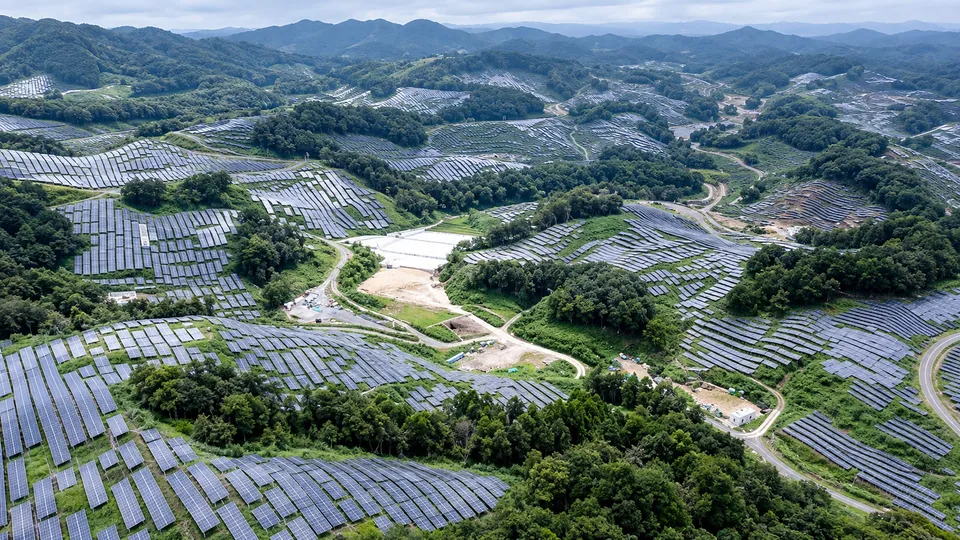
Few relics say 1980s Japan quite like the country-club golf course: an extravagant emblem of an economy that seemed to own the future. The future, it turns out, had other plans. Golf’s popularity has faded, the courses are closing, and Japan—mountainous, crowded and chronically short of land—is converting them into something the country now needs rather more: solar farms.
According to an analysis by Bloomberg, 9 percent of Japan’s utility-scale solar capacity already sits on former golf courses, and at least 10 percent of the big solar projects announced or under construction do too. The maths of the match is simple enough. Old courses offer developers cheap, flat, cleared land, often within reach of cities, and most were wired into the power grid long ago. In a country where almost every other hectare is either mountain, city or farm, that combination is close to priceless.
The boom in solar has an unhappy origin. After the Fukushima nuclear disaster of 2011, public outcry pushed the government to shut down dozens of reactors that had supplied a third of Japan’s electricity. To plug the gap it dangled generous incentives before solar developers, and the industry obliged with a wave of large installations.
Some of those went up on abandoned farmland—including, poignantly, fields around Fukushima itself, rendered unusable by radioactive contamination from the damaged plant. But many more were carved out of the forested foothills around Japanese cities. Clearing hillsides for panels displaced woodland and raised the risk of landslides, a serious matter in a wet, earthquake-prone country, and the backlash was swift. Golf courses sidestep all of that: nobody mourns a fairway, and nobody’s house sits at the bottom of one.
The conversion is also a neat piece of economic recycling. The courses were laid out when Japan was rich, confident and convinced that membership fees would keep rising for ever. Their quiet decline tracks the country’s more sober decades. Repurposing them as power stations turns a trophy of the bubble into a working asset of the energy transition.
None of this solves Japan’s energy problem on its own; solar still needs land, storage and grid capacity that the country is only slowly building. But as solutions go, it has the rare virtue of annoying almost nobody. The sand traps may never be missed at all.