
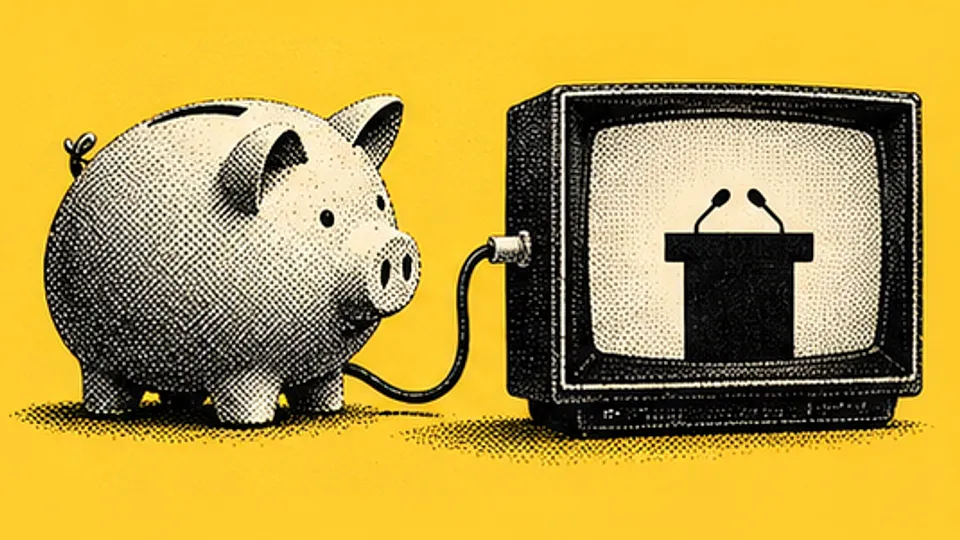
The White House is using taxpayer money to broadcast campaign-style television advertisements featuring U.S. President Donald Trump weeks before the midterm elections, CBC News reported on Tuesday.
The ads have run in prime slots on national and local television, including during last weekend’s NFL games, at a cost of at least $1.4 million so far, according to an analysis by advertising tracking firm AdImpact cited by CBC.
The spending is drawing criticism from Democrats and from senior Republicans. Senate Majority Leader John Thune told reporters on Capitol Hill on Monday: “I like the message, but it shouldn’t be paid for by taxpayer dollars.”
U.S. law forbids the use of government funds for “publicity and propaganda.” The White House denied the campaign was unlawful. “These public service announcements are unapologetically American,” it said in a statement. “The announcements are very clearly not campaign ads. President Trump is not on the ballot and there is no call to action.”
Trump is not up for re-election in the Nov. 3 vote, but he told the audience at this month’s Republican convention to “pretend that I’m on the ballot,” an appeal aimed at raising turnout for Republican candidates in close House and Senate races. The ads are running as Trump’s approval rating sits at an all-time low, with his party facing the possible loss of control of Congress for the remainder of his presidency, according to CBC.
The taxpayer money for the advertisements comes from U.S. Customs and Border Protection, an agency of the Department of Homeland Security, the Wall Street Journal reported on Tuesday.
Ads feature UFC chief, Mount Rushmore speech
The first ad opens with grainy black-and-white video of Trump as his voice says “Together we will defeat communism, socialism and Marxism in America.” The 30-second spot shows slides reading “Largest Tax Cuts in History” and “Reigniting American Manufacturing” while a choir repeats the title lyrics of Love Me, a song by musician JMSN, CBC reported.
It closes with footage of Trump alongside Dana White, chief executive of the Ultimate Fighting Championship, as the words “Paid for by the U.S. Government” appear on screen. “He’s the toughest, most resilient person that I’ve ever met, and nothing was going to stop him for fighting so hard for the country he loves,” White says in the voice-over, audio taken from his introduction of Trump at the 2024 Republican National Convention.
A second government-funded ad is nearly identical to a Trump campaign ad from 2024. “This is the final battle,” Trump says in it. “With you at my side, we will demolish the deep state, we will expel the warmongers from our government.”
A third ad, one minute long, uses footage from Trump’s speech at Mount Rushmore on July 3, the eve of the 250th anniversary of the Declaration of Independence. “We are the freest people on earth,” Trump says. “This is only the beginning of the golden age of America.”
Ethics lawyer raises impeachment
Richard Painter, who served as White House ethics lawyer during President George W. Bush’s second term, said the ads could amount to an impeachable offence because a president cannot use taxpayer money to campaign. “All three ads, they’re sheer propaganda,” Painter told the Associated Press. “This is increasingly looking like what authoritarian governments do to promote their leaders.”
Democratic lawmakers wrote to Trump’s chief of staff demanding the first ad be withdrawn. “If President Trump wants people to love him, he can pay for it himself,” the letter said, according to CBC. The lawmakers described the ads as “the sort of government propaganda one might expect in North Korea, not the United States of America” and “an egregious and utterly illegal misuse of Americans’ hard-earned tax dollars.”
Senate Democratic leader Chuck Schumer said on the Senate floor on Tuesday that the ads were “anything but” public service announcements. “They were pure propaganda,” he said. “Trump is getting you, American taxpayer, to use your dollars to pay for his political ads.”
Past administrations have spent public funds on public service advertising, including a $10 million vaccination campaign under President Joe Biden and television ads promoting health insurance subsidies during the Obama administration, CBC reported.
Scott Talan, a professor of communication at American University in Washington, described the ads’ message as “love Trump, love his policies” but questioned their effect. “I can’t imagine much movement,” he told CBC News. “People pretty much have their opinions formed.” He noted the ads ran heavily during professional and college football games.
The midterm elections take place on Nov. 3.