
In Columbia Heights, a Washington neighborhood, the alarms these days are whistles. When agents of Immigration and Customs Enforcement appear, residents blow them to warn the street, and they press chalk onto the wheels of unmarked vehicles so the cars can be recognized when they return. It is a poor arsenal, whistles and chalk. It is what a neighborhood has.
The raids have reached inside the century-old walls of the GALA Hispanic Theater, a pioneer of Spanish-language performance in the capital. “When things were really bad in this area, there was a time when we couldn’t leave the theater after the 10 p.m. rehearsal,” says Gustavo Ott, the Venezuelan-born artistic director. “We had to stay put until 5 a.m., with two actors who were crying the whole time.” The young Latinos studying acting under him, he says, have been followed home by ICE agents sent to arrest their parents.
The answer will be given from the stage, the only pulpit a theater owns. In June 2027 GALA will present Botiquín de mariachis de Columbia Heights — in English, Columbia Heights Mariachi Bar — by the Mexican playwright Jaime Chabaud: a portrait of resilience, hope and quiet resistance drawn from the street outside the door. “We’ve lived through major crises here,” Ott says.
A Garage, a Warehouse, a Convent School
GALA — the Grupo de Artistas Latinoamericanos — was founded in 1976 by Hugo and Rebecca Medrano, a theater director born in Argentina and an American dancer. Hugo had emigrated to Spain after Argentina’s 1966 military coup and found no wish to stay in a country just emerging from Franco’s dictatorship; he tried his luck in the United States and, unwilling to abandon the stage, built one. Spanish-language theater, in the Washington of the mid-seventies, by no means guaranteed success.
The company began in a garage in Adams Morgan, moved through a warehouse and a convent school, and at last reached its building in Columbia Heights: a house raised as a grand musical theater in the 1920s, later a cinema. In 1968, after the assassination of Martin Luther King Jr., when riots moved through what was then a predominantly African American neighborhood, the people who had grown up going there marked the building so it would not be burned. It survived, stood empty for years, and opened again — a survivor from a previous era, as old theaters tend to be.
Lorca, With Subtitles
Inside, three screens surround the stage — one to each side, one above — and from them falls a cascade of English. The reversal was the founding gesture: the non-Spanish-speaker must read, as generations of Latinos in America have had to read. “It’s magnificent,” says Rochelle Granat, an American seated in the theater’s bar. “I speak some Spanish, but the person accompanying me doesn’t. So, they can read the subtitles. It’s a way to promote Hispanic culture and it’s part of the Washington community.”
On Thursday, September 17, Álvaro García, a Colombian who has attended for three decades, came with his American wife and two fellow regulars. “It was a great opportunity for the Latino community to have access to theater. The fact that it’s in Spanish is what I like most,” he says. But the audience has turned over: about 30 percent now do not speak Spanish at all, among them younger generations of Latinos. When the theater staged The House of Bernarda Alba in January and February of this year, the hall filled with people who, as Ott marvels, came to read Lorca.
He insists the subtitles earn that reading. “We believe that the translation has to be of a high, literary standard. It can’t simply be an AI thing,” he says. “The audience has to feel pleasure because they’re reading something worthwhile.” Last year the English text for Lope de Vega’s Fuenteovejuna was written in verse. Adaptation, he says, is the key to survival: bilingual performances, English entering through musicals.
Garbo, Decorated by Both Sides
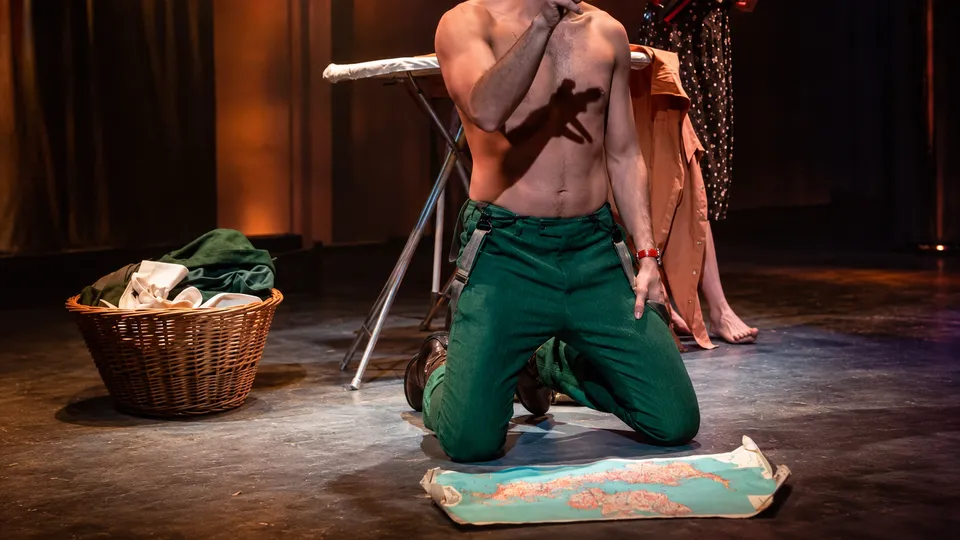
For those who need the English, the current offering is a bridge: Garbo: The Actor Who Saved the World, written by Ott and running until September 27. Garbo was the British code name of Juan Pujol — to the Germans he was Arabel — a Spaniard who, without any training, invented an entire phantom network of spies and convinced Berlin the Allied invasion would come at Pas-de-Calais, not Normandy. The Nazi army concentrated its resources in the wrong place. He was awarded the Iron Cross by the Nazis and made a Member of the Order of the British Empire. The story “resonates with the traditional American community that doesn’t speak Spanish,” Ott explains, “because they recognize elements of World War II.”
And the theater keeps planning against the calendar of power. The 2027-2028 season is already being chosen, with an eye on the 2028 presidential elections. “‘Confrontation,’ for example, might be one of the words we use,” Ott says. “We’ll also keep in mind that our community is constantly being persecuted, even around the theater. So, ‘persecution’ will be another one.” Fifty years from the garage in Adams Morgan, the repertoire has come to match the street: whistles at the door, chalk on the wheels, and on the stage, in Spanish with English above, the story of exactly that.