
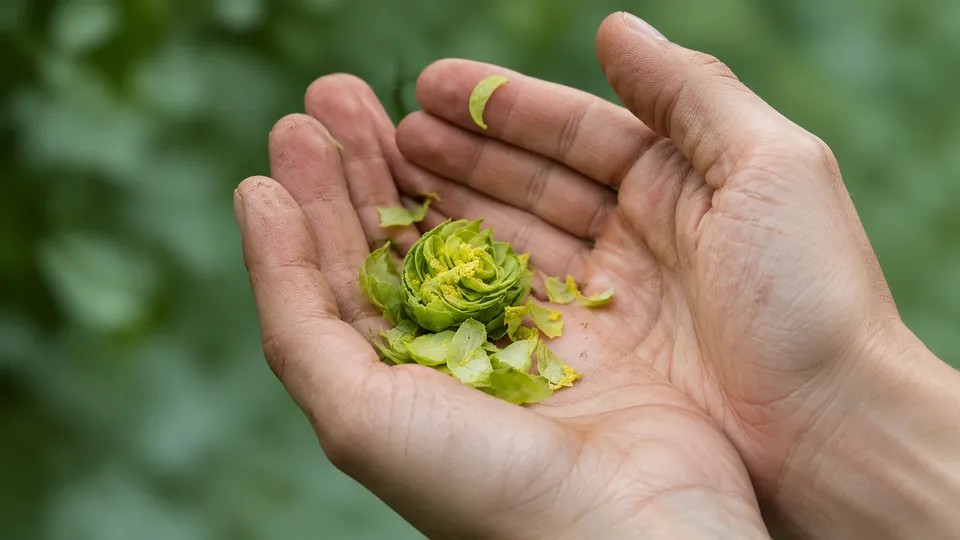
The fires of 2020 in Oregon burned more than a million acres, destroyed thousands of structures and killed 11 people. Public radio in Oregon has since counted more than 4,000 homes lost in a band running from Clackamas County down to the California border. That is the grief, and nothing in what follows lessens it. But fire also leaves something less visible: smoke that drifts far past the flames, settles across a whole region and soaks into whatever is growing there.
It reached the vineyards, which was expected, because winemakers had learned to fear smoke taint long before. It also reached the hops.
This matters beyond Oregon’s borders. The Pacific Northwest grows more than 95 percent of the hops harvested in the United States and about 40 percent of the world’s supply. A small green cone that flavors beer on every continent comes overwhelmingly from one corner of one country. When so much of a harvest lies in one place, a bad fire season in that place stops being local news.
A flower that keeps beer alive
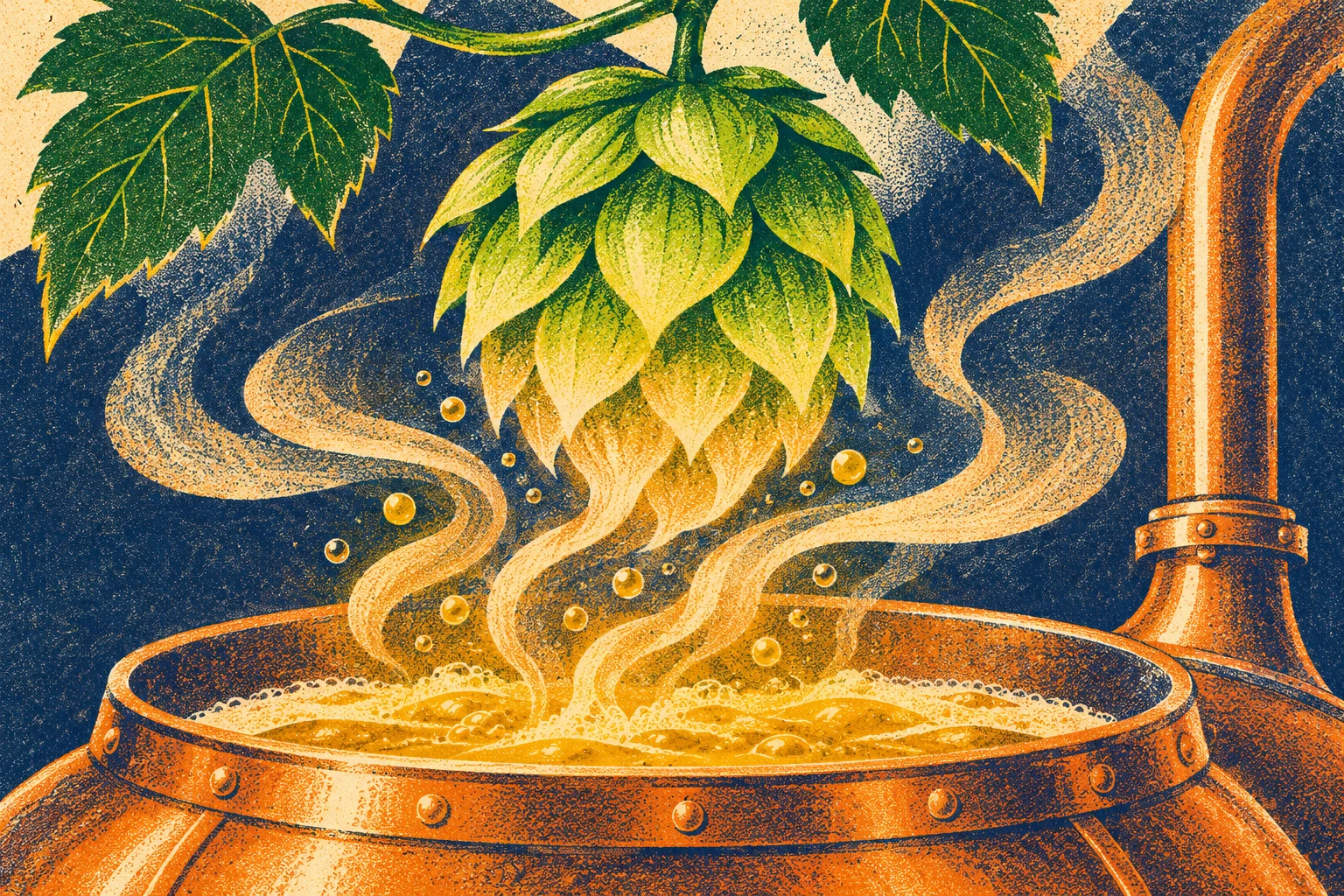
As Jennifer Ouellette reported for Ars Technica, every beer contains hops. They give flavor and they also hold off microbes, and without them beer spoils fast. The brewer steeps grain in hot water until its starch becomes sugar, then traditionally boils this liquid, the wort, with hops. In the boil some of the alpha acids in the resin rearrange into iso-alpha acids, and that rearrangement is where the bitterness comes from. Yeast follows, and the sugar becomes alcohol.
Craft brewers have increasingly added hops later as well, after fermentation, a practice called dry hopping and common in pale ales. Thomas Shellhammer, a fermentation scientist at Oregon State University, had already shown in 2018 what this could do. Hops are not the inert ingredient brewers long took them for. They carry starch enzymes that can restart fermentation in the bottle, which the trade calls “hop creep”. Pressure rises, and sometimes the glass gives way.
What the fire puts into the cone
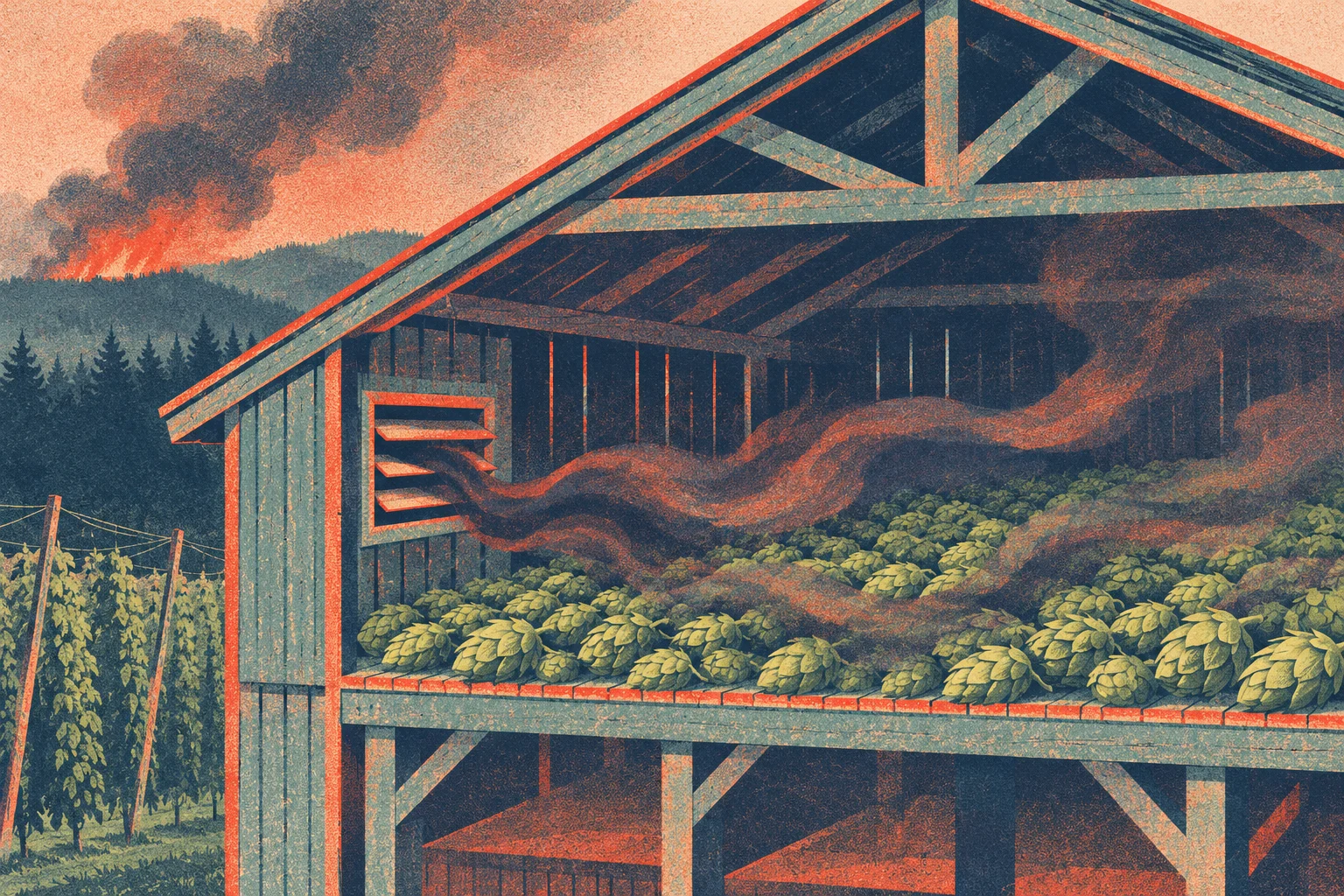
After 2020 Shellhammer turned to smoke. The chief offenders are volatile phenols, compounds released when the lignin in plant cells meets wildfire heat. In February 2026, in a paper in Food Research International that he wrote with Cade Jobe, a doctoral student, the Oregon State team reported that smoke reaching hops while they dry in the kiln raised their uptake of these phenols and changed their aroma a great deal. The most heavily affected hops smelled meaty, smoky and of artificial barbecue, and medicinal flavors have also been reported. The smoke drowned out the qualities brewers actually pay for: the citrus notes, the strength of the aroma.
The new work, published in the Journal of the American Society of Brewing Chemists and described in the university’s release as part of a wider project funded by the Hop Research Council, asks the practical question. If the crop is already tainted, can it still be used?
Smoke in a controlled room
Jobe and Shellhammer took Idaho-grown Cascade hops and smoked them in kilns, feeding wood pellets into the air intake, then dried them. A control batch was dried without smoke. They then brewed beers with tainted hops blended in at 25, 50 and 75 percent, plus one made entirely with tainted hops and one with none. Each version was made twice: once with the hops added to the boiling wort, once by dry hopping. Gas chromatography measured the phenols, and a panel of 24 blind tasters judged the beers.
In the dry-hopped beers the smoke came through. Phenol levels climbed as the share of tainted hops grew, and the tasters found stronger smoky aromas along with meaty, medicinal and artificial barbecue flavors. According to the university, smoke aroma on a 100-point scale rose from nine to 27 between beers dry-hopped without tainted hops and beers dry-hopped with nothing else.
In the boil the smoke disappeared. Tasters could not reliably tell a beer made entirely from smoke-affected hops apart from one made with none. The two accounts differ a little on the chemistry. Ars Technica says the boiled beers still showed the same rise in phenols. The university says levels went up with the tainted share either way but were substantially higher when hops went in after fermentation. In both versions the instruments found the smoke and the drinkers did not.
One can read this as a small lesson in how damage hides. The same contamination, entering at a different hour, either fills the glass or goes unnoticed. That is a reflection, not a finding, but the brewer’s calendar turns out to matter as much as the fire’s.

Half, and no more
The authors’ advice is modest. When dry hopping, blend tainted hops with clean ones and keep the tainted share under 50 percent. That way growers can still sell a smoke-touched harvest and brewers can still buy it, and a wildfire costs the trade less.
These findings suggest blending smaller amounts of smoke-affected hops with unaffected hops may be a practical way to use those hops.
That was Shellhammer in the university’s release. Jobe described the demand behind the work: “Hop growers and brewers are looking for guidance on whether and how to use smoke-affected hops. This research begins to provide some practical information to help hop growers and brewers understand how smoky hops impact beer so that they can make the best decisions.”
The authors acknowledge the limits. The exact ratios still need confirming and the results need repeating. Smoke in a kiln is not smoke in a field, where the plant is still alive and metabolizing, and a later paper is meant to cover that kind of exposure. Nobody has yet asked ordinary drinkers, rather than a trained panel, whether they would accept a blended beer. The results probably do not carry over to wine either. Its fermentation works differently, and grapes make up nearly all of what goes into a wine, while hops are only a small part of a beer.
So the grape grower facing smoke has no such way out. The hop grower may have one, provided the brewer adds the hops in the boil, or in the right proportion.