

Less than 7 percent of the water ice in the debris disk around Beta Pictoris is crystalline. The other 93-plus percent is amorphous: water molecules frozen into a disordered, glass-like arrangement instead of the ordered lattice that ice normally forms when it freezes slowly at moderate temperatures. That ratio is the central result of a paper published in Science on November 14, covered by Jacek Krywko at Ars Technica, and it matters because the two ice structures point to two different histories for the same molecule.
The diagnostic is a spectral line, not a picture. Crystalline water ice produces a sharp absorption feature just above 3 micrometers, a so-called Fresnel peak, because its molecules sit in a regular, repeating lattice that interacts with infrared light in a specific way. Amorphous ice, lacking that structure, produces a broader, featureless absorption instead. Webb’s NIRSpec integral field spectrograph, pointed at the Beta Pictoris disk under a Cycle 4 observing program led by Sarah Betti of the Space Telescope Science Institute, found almost none of that sharp peak. The team, writing in Science, put the crystalline fraction at under 7 percent.
That’s a surprising number given where the ice is sitting. Models of debris disks predict the opposite: ice exposed to a young star’s light and heat for millions of years should mostly crystallize, the way slush left on a warm windowsill eventually turns to clear ice rather than frost. Amorphous ice only survives below about 100 kelvin, or minus 173 degrees Celsius. Above that, or under sustained bombardment from ultraviolet photons, cosmic rays or stellar wind particles, the molecules anneal into the crystal form. For the disk’s ice to stay mostly amorphous despite sitting that close to starlight for that long, the simplest explanation is that it didn’t form there at all. The team concludes it most likely condensed in the interstellar medium, before the star and its planets existed, and was simply swept up into the planetesimals that built the disk.
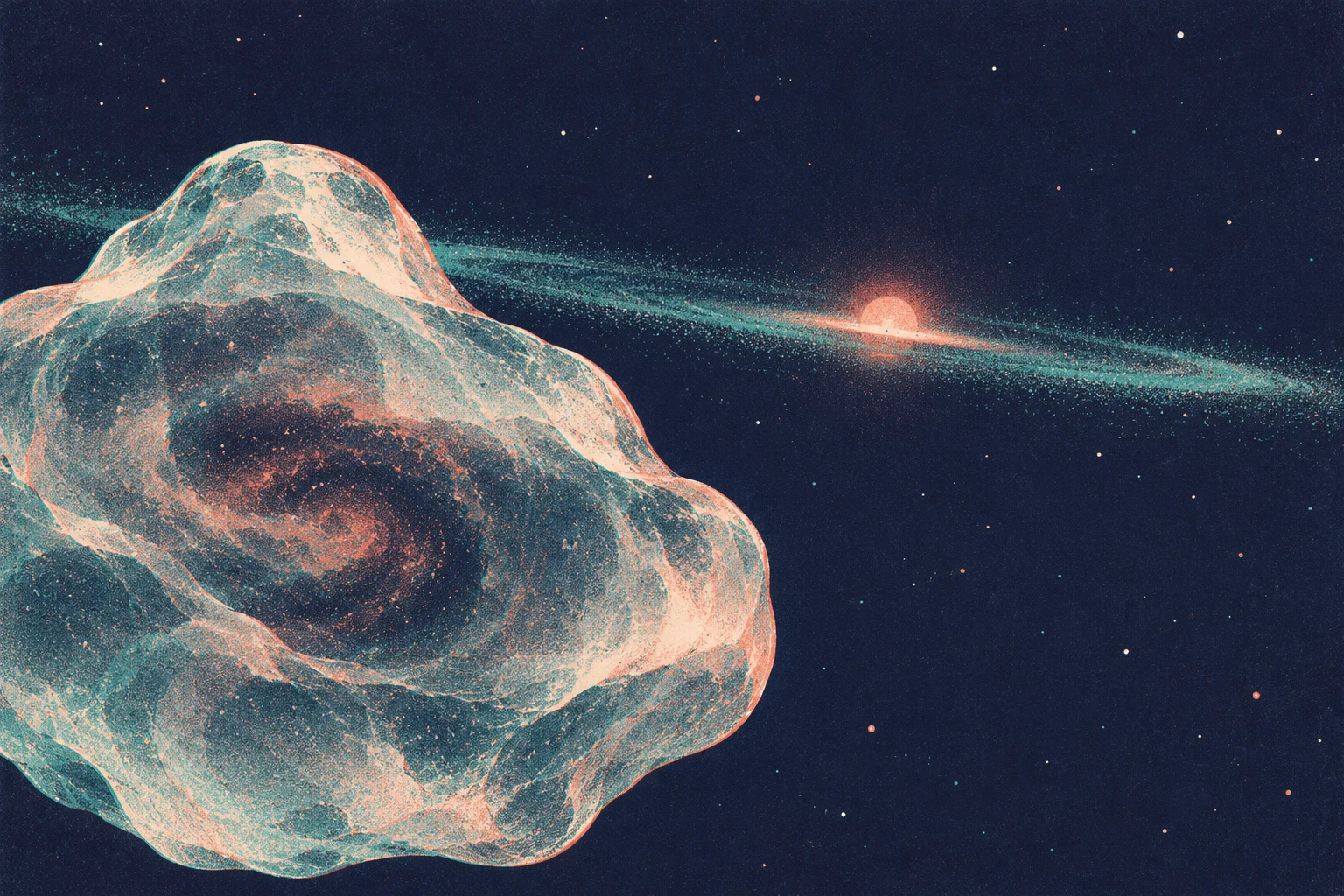
Beta Pictoris is a convenient place to test that idea because it has been watched longer than almost any other planetary system. Its dust excess was first picked up by the IRAS satellite in 1983, and the disk itself became the first debris disk ever directly imaged, by Brad Smith and Richard Terrile in 1984, using a coronagraph to block the star’s glare. The system, 63.4 light-years away and about 23 million years old, orbits a star roughly 1.75 times the mass of the Sun, and because the disk happens to be seen almost exactly edge-on from Earth, decades of instruments have had an unusually clean view into it.
The same spectra turned up a second ice: carbon dioxide, mixed directly into the water ice rather than sitting in separate grains. The team puts the ratio at slightly more than one CO2 molecule for every ten water molecules, around 11 percent of the total ice by that count. That fraction sits inside the range already measured in solar system comets and in disks around other young stars, which is one more point in favor of a shared, generic recipe for icy material rather than something unique to Beta Pictoris.
Why the ice hasn’t all been cooked off
A single population of ancient, interstellar ice sitting untouched in the disk would be one story. What the team actually found is ice spread fairly evenly across the whole disk, which is harder to explain, because starlight should be destroying the amorphous structure fastest at the surface and nearest the star. The paper’s answer is that the disk is continually resupplying itself. Planetesimals — the comet- and asteroid-sized bodies that make up the disk — collide often enough to keep breaking open fresh material, including ice that had been buried deep enough inside a body to be shielded from radiation. Each collision exposes that shielded ice as fine dust, which Webb can then detect, replacing what starlight has degraded elsewhere. Earlier infrared imaging of the disk had already turned up circumstantial evidence for this kind of violence: a curved, lopsided streak of dust in the disk’s southwestern arm, reported in a 2024 analysis as debris from a collision roughly halfway out from the star.
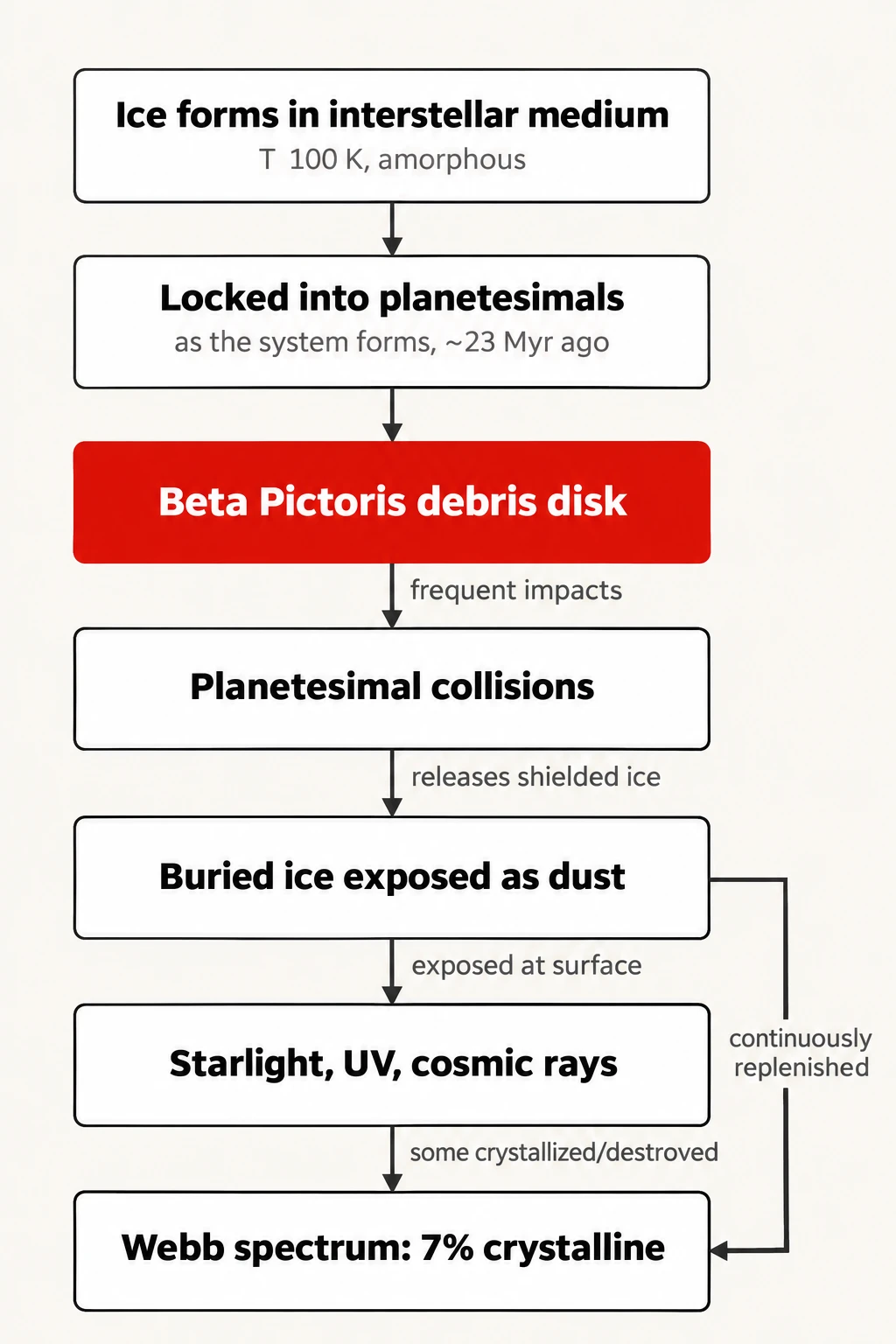
| From | To | How |
|---|---|---|
| Ice forms in interstellar medium (T < 100 K, amorphous) | Locked into planetesimals (as the system forms, ~23 Myr ago) | |
| Locked into planetesimals (as the system forms, ~23 Myr ago) | Beta Pictoris debris disk | |
| Beta Pictoris debris disk | Planetesimal collisions | frequent impacts |
| Planetesimal collisions | Buried ice exposed as dust | releases shielded ice |
| Buried ice exposed as dust | Starlight, UV, cosmic rays | exposed at surface |
| Starlight, UV, cosmic rays | Webb spectrum: <7% crystalline | some crystallized/destroyed |
| Buried ice exposed as dust | Webb spectrum: <7% crystalline | continuously replenished |
Based on Betti et al., Science, 2026
That mechanism also supplies an answer to a separate puzzle: where the disk’s carbon monoxide gas comes from. Colliding icy bodies releasing CO as they break apart fits the pattern. What the paper doesn’t nail down is the exact crystalline fraction below that under-7-percent ceiling, or whether other ices are hiding, unresolved, inside the same spectral feature. Less than 7 percent is an upper bound from the data, not a measured value with its own error bars reported in the coverage.
A tale of two disks
Beta Pictoris isn’t the only debris disk Webb has fingerprinted for ice, and the other case came out the opposite way. In May 2025, a team led by Chen Xie of Johns Hopkins University reported in Nature, via a Space Telescope Science Institute release, the first confirmed detection of water ice around a Sun-like star, HD 181327, 155 light-years away. That ice showed the sharp 3.1-micron Fresnel peak, the signature of a crystalline lattice, and its abundance varied steeply with distance from the star: a water-ice mass fraction of about 0.1 percent at roughly 85 astronomical units out, rising to about 21 percent at roughly 113 AU, with almost none detected closest to the star, where ultraviolet light is strongest. Xie described HD 181327 as “a very active system” with “regular, ongoing collisions,” the same basic mechanism invoked for Beta Pictoris, but there the ice that survives is crystalline rather than amorphous.

The table is the whole sample. Two debris disks, two outcomes, each consistent with the same collision mechanism producing a different net result depending on how cold, how old, or how exposed the ice ends up being. That’s not enough data to say which outcome is typical. For interstellar, amorphous ice to turn out to be the default starting material for rocky, water-bearing planets generally, as the Beta Pictoris team’s framing implies, would require a larger survey of debris disks showing the same pattern, not just Beta Pictoris’s one data point sitting next to HD 181327’s contrary one.
The constraint right now is instrument time: resolving the 3-micron water feature and the 4-micron CO2 feature well enough to separate amorphous from crystalline requires integral field spectroscopy of a kind Webb can do on only a handful of targets per cycle. A 2026 NASA probe-mission study for a successor far-infrared observatory, PRIMA, already lists the Beta Pictoris 3-micron detection as a benchmark for what a wider survey could extend to more systems. Whether amorphous, pre-stellar ice turns out to be the rule or the exception is a question with an answer, just not yet one with a sample size bigger than two.