
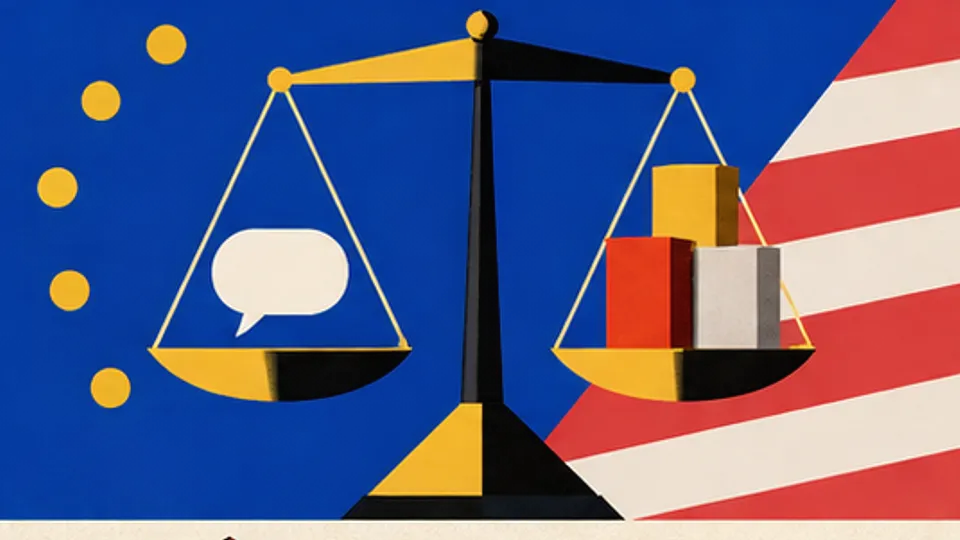
Here is a fun problem in corporate arithmetic. Imagine one man owns a social network, an artificial-intelligence company and a rocket company. A foreign regulator fines the social network, and computes the fine partly from the revenue of the other companies. The man objects: those are entirely separate businesses! Also, at various points along the way, he merges the social network into the AI company and has the rocket company buy the AI company ahead of its stock-market listing. So: separate, but also one company. Depending, as always, on which characterization is more expensive.
You have guessed the man. Last December the European Commission fined X €120 million for breaching its transparency obligations under the Digital Services Act — the first non-compliance decision under the bloc’s flagship platform law, after a two-year investigation. This week the U.S. Justice Department weighed in on Elon Musk’s side, saying Brussels had overreached.
The DOJ’s objections are two, and they are worth separating. The first is personal: the DSA process, it said, improperly “extended legal scrutiny to Mr. Musk himself as a private individual and implicated entirely separate and unrelated American corporate entities under his ownership.” The second is mathematical: the Commission, the DOJ asserted, calculated the fine based on the combined global annual revenue of other companies Musk controls, rather than what X actually earned inside the EU’s jurisdiction.
That second objection is where the arithmetic gets interesting, because the “entirely separate and unrelated” entities have been on a journey. In March 2025, X was merged into xAI, Musk’s AI company. xAI was subsequently acquired by SpaceX, his rocket maker, ahead of SpaceX’s public listing in June of this year. So the revenue the EU allegedly used to size a fine on X belongs to companies that X has since formally joined — a fact that neither side’s framing fully captures. The EU’s implicit theory is that a corporate empire is one balance sheet; the DOJ’s is that it is many; the merger history suggests it is whatever is convenient on a given day. SpaceX declined to comment, per the Financial Times.
The politics are not subtle. Several senior administration figures, including Vice President JD Vance, have publicly criticized the fine, and Musk is one of the largest donors to President Trump and his favored Republican candidates ahead of the midterm elections. The DOJ statement therefore functions simultaneously as a legal position about EU jurisdiction and as a loyalty demonstration, and there is no particular reason it cannot be both.
None of this resolves the underlying case. The EU is separately investigating X over other potential DSA breaches, including whether the company assessed and mitigated the risks of integrating its Grok chatbot into the platform for EU users. And the transatlantic fight is broader than Musk: Apple is appealing a €500 million fine under the related Digital Markets Act over anti-competitive conduct in its app store. Trump has called the EU’s penalties “overseas extortion” and “a form of taxation,” and his interest is not new — in his first term he tried, without success, to intervene in Apple’s challenge to a €13 billion Irish tax bill.
The genuinely unresolved question is jurisdictional: whose revenue is a platform? If a regulator can only reach the local earnings of the entity that misbehaved, then any sufficiently determined billionaire can make the punishable part of the empire small. If the regulator can reach the whole empire, then it is, in effect, fining rockets for tweets. Brussels picked the second option, Washington objects, and the appeals will now decide which theory of a conglomerate is legally real. The companies, one notes, have already made their own choice: they merged.