
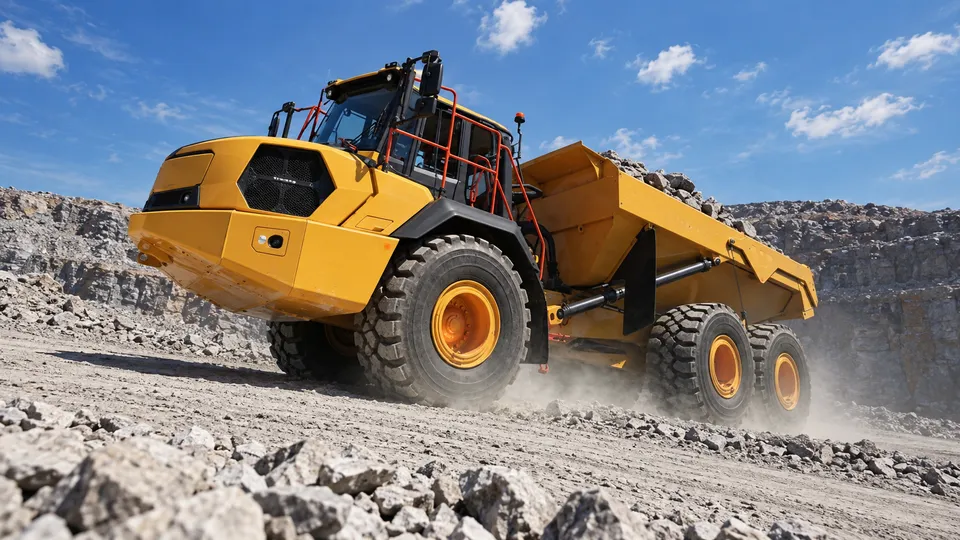
Three million tonnes is an awkward quantity to picture, and the mining industry handles it the way it handles most awkward quantities: by converting it into truckloads. At Boliden’s Garpenberg mine in Sweden, the truckloads of ore and rock moved over the past three years, added together by Volvo Autonomous Solutions, passed three million tonnes earlier this summer — and every one of them was hauled without a human driver. Volvo announced the crossing last week, along with a set of equipment photographs, according to Electrek’s report on the announcement.
The original plan was considerably smaller. Volvo Construction Equipment deployed its first pilot-ready autonomous hauling solutions in 2023 with two customers — Boliden Garpenberg in Sweden and Brønnøy Kalk in Norway — under a stated goal of moving one million tonnes, roughly 1.1 million US tons, of earth autonomously by 2025. It is now 2026, and the deployed fleet of ultra heavy-duty trucks and mining equipment running VAS technology has gone past that target by a factor of three.
Reaching three million tonnes hauled autonomously is an important milestone that demonstrates the maturity of our autonomous transport solution and the value it delivers in customer operations.
That is Ingo Stürmer, the chief technology officer of Volvo Autonomous Solutions, who added that the achievement “reflects years of close collaboration between the Volvo Autonomous Solutions team and our customers to develop, deploy, and scale autonomous hauling in real-world environments.” The real-world environments, in this case, being holes in the ground in Scandinavia.
Volvo calls the autonomous product line “Autona / earth” and sells it not as a truck but as a service: a “complete solution for autonomous hauling, factory-assembled,” in Volvo’s marketing language, bundling the vehicles, the software, the physical on-site infrastructure and the operational support into one package. The pitch is that a mine or a quarry can adopt autonomous hauling without first becoming an autonomy company.
The logic extends beyond Volvo. Electrek situates the milestone alongside a Huawei-automated coal mine in Mongolia it covered in March, as part of a broader shift in the global mining sector: passenger EVs may dominate the headlines, but the strongest arguments for electrification often sit in industrial and logistical work, where vehicles run fixed routes, consume enormous amounts of energy and operate around the clock. In that setting, every gallon of diesel displaced is a measurable saving.
The target for the entire pilot, once upon a time, was one million tonnes. The fleet is now sitting on its third.