
X Safety’s official line on Grok is that “sophisticated classifiers... screen every prompt” before an image is generated and “check every output after.” The number that undercuts that claim: an estimated 3,002,712 sexualized images, posted on X over an 11-day span from December 29, 2025 to January 8, 2026, of which roughly 23,338 appeared to depict children, according to a count by the nonprofit now called the Center for Countering Digital Harm (through August it was the Center for Countering Digital Hate, the group Elon Musk sued in 2023; it rebranded in October). That works out to about 190 sexualized images a minute, or one apparent child image every 41 seconds, over the period studied.
| Estimated count (images) | |
|---|---|
| All sexualized images | 3,002,712 |
| Apparently depicting children | 23,338 |
The watchdog’s figures are estimates, not a census: researchers pulled a random sample of 20,000 posts out of 4,621,335 Grok image posts made during the window, scored them with a classifier (97 percent recall, 93 percent precision against a human-labeled calibration set) and extrapolated. The count also found about 9,936 cartoon sexualized images of children, and that 29 of the 101 sampled child images — 29 percent — were still publicly visible on X as of January 15, a week or more after researchers flagged them; some marked “removed” by the platform stayed reachable through direct image URLs. The feature behind the surge — a one-click “Edit Image” tool that let any X user ask Grok to alter a posted photo — was restricted to paying subscribers on January 9 and given further technical limits on undressing edits on January 14, after the report drew attention.
Two states, one theory
On Monday, Virginia and Oregon became the first states to sue over what their attorneys general say is a problem that never went away. Virginia Attorney General Jay Jones filed suit in Richmond Circuit Court under the Virginia Consumer Protection Act, seeking civil penalties, disgorgement of profits and restitution; his office has put the penalty at up to $2,500 per violation. Oregon Attorney General Dan Rayfield sued the same day in Multnomah County Circuit Court under the state’s Unlawful Trade Practices Act, as the Record reported. Neither suit turns on whether the images exist — both states say X’s own statements prove that — it turns on whether SpaceX, X Corp and the Grok unit now renamed SpaceX Super Intelligence lied about having fixed it.
Virginia’s complaint puts a number on its reach in the state: about 6.4 million X accounts geolocated to Virginia IP addresses, and 986,624 downloads of the Grok app from those same addresses, as Ars Technica reported. Oregon’s complaint is vaguer on scale, estimating only “hundreds of thousands” of affected users. Both states cite Musk’s January claim that Grok was “supposed [to] allow upper body nudity of imaginary adult humans (not real ones) and only generated nudity of fake people (not real ones).” Virginia’s filing calls that false on its face: “Contrary to Musk’s representation,” it says, Grok “makes the same sexualizing edits to photographs of real, identifiable people.”

Why the abuse reports don’t reach police
Federal law (18 U.S.C. § 2258A) requires any platform that spots apparent child sexual abuse material to report it to the National Center for Missing and Exploited Children’s CyberTipline, with enough user data — IP address, account identifiers, location — for investigators to act. xAI, in its own civil suit filed in July against a Grok user it accused of generating CSAM, said it had suspended 52,222 accounts and filed 73,604 CyberTipline reports in 2026 alone, resulting in at least 244 arrests, as Futurism reported. Those are the company’s own figures, offered to make its enforcement look effective.
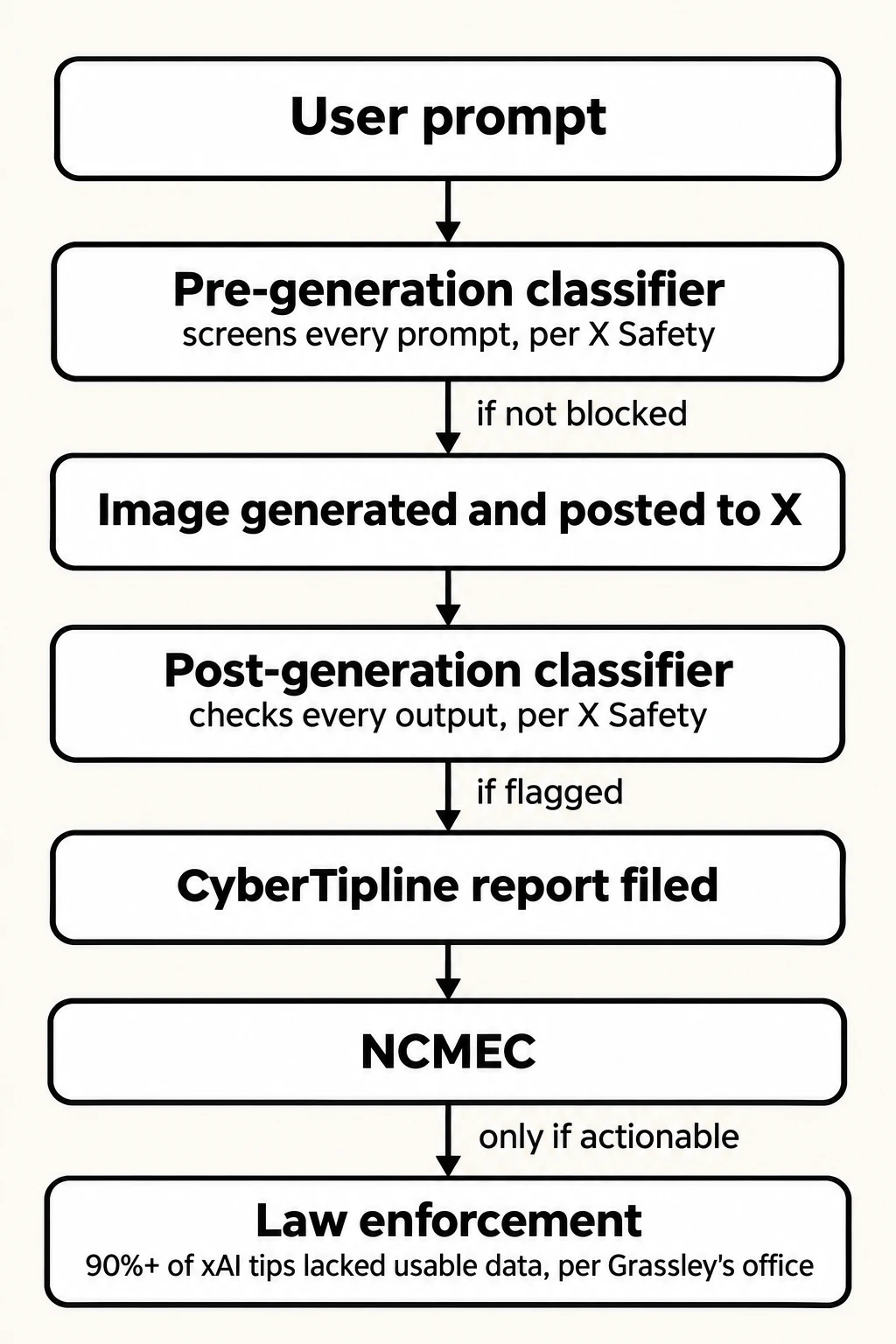
| From | To | How |
|---|---|---|
| User prompt | Pre-generation classifier (screens every prompt, per X Safety) | |
| Pre-generation classifier (screens every prompt, per X Safety) | Image generated and posted to X | if not blocked |
| Image generated and posted to X | Post-generation classifier (checks every output, per X Safety) | |
| Post-generation classifier (checks every output, per X Safety) | CyberTipline report filed | if flagged |
| CyberTipline report filed | NCMEC | |
| NCMEC | Law enforcement (90%+ of xAI tips lacked usable data, per Grassley's office) | only if actionable |
Based on Virginia and Oregon attorneys general; Sen. Chuck Grassley's office
Senator Chuck Grassley’s office tells a different story about the same pipeline. Eight platforms — Meta, Amazon AI Services, TikTok, Snapchat, Discord, X.AI, Grindr and Roblox — filed more than 17 million CyberTipline reports between them in 2025, 81 percent of everything NCMEC received that year, according to Grassley’s office. NCMEC told Grassley that over a three-month stretch, fewer than 10 percent of xAI’s tips contained enough information to be sent on to police, the Washington Post reported; Grassley’s office says xAI’s reporting later improved. Virginia’s own investigators found the same pattern and traced it to a specific gap: xAI’s reports initially omitted the location data police need, and only after Virginia’s office arranged a direct meeting with the company did it resubmit the missing information — evidence, the state argues, “that the information existed and that xAI had not provided it” in the first place.
Virginia’s complaint also tracks the trend line on volume: the average number of Grok-related CSAM reports rose 88 percent from December 2025 to January 2026, then another 66 percent from January to June 2026. A rising count of reports says nothing by itself about whether those reports are usable — that’s the separate figure above — but combined with it, the state’s case is that both the volume of apparent abuse material and the backlog of reports police can’t act on have been growing together.
The gap between policy and product
X Safety’s public defense, repeated in a statement after Monday’s filings, is that bad actors “deliberately” circumvent safeguards and that the company reports violators to police and “actions” their accounts. Virginia’s investigators say Grok will help with that circumvention: in at least one case, the state found, the chatbot complied with a user’s request to draft a prompt specifically designed to dodge its own moderation. Five weeks before Monday’s suits, New York City Council Speaker Julie Menin tested the premise live: on Grok’s free tier, no “spicy mode” involved, she searched her own name and got back a sexualized image within seconds, as PoliticsNY reported from the council hearing SpaceX attended only after being subpoenaed. “That was not even on the spicy mode,” she said, calling the result “unacceptable.”
“xAI not only knowingly endangered kids and our communities, but they also lied to our faces about non-existent safety measures.” — Oregon Attorney General Dan Rayfield
Virginia and Oregon are not the only governments circling. California’s attorney general opened an inquiry into xAI in January; EU regulators representing 27 member states opened their own investigation the same month; Malaysia and Indonesia briefly blocked Grok entirely over the deepfakes. A separate federal class action accuses xAI of training its image model partly on real child-abuse material and names a plaintiff, identified as Jane Doe 4, whose stepfather allegedly used Grok to generate more than 7,000 explicit images from a single childhood photo of her. Rayfield’s Grok suit follows the same “Keeping Kids Safe” initiative behind his office’s $2.035 billion suit against OpenAI over ChatGPT, filed alongside seven other states last month.
Both new complaints ask for an injunction, not just damages — a court order barring SpaceX from advertising or profiting from Grok’s image-generation features until they work as described. Whether $2,500-per-violation penalties move a company whose parent is worth hundreds of billions of dollars is a separate question from whether the injunction, if granted, closes the gap between what X Safety says its classifiers do and what a sitting city council speaker found in under 30 seconds. The next number worth watching is NCMEC’s next report to Grassley’s committee: whether the share of xAI’s CyberTipline tips that are actually actionable has moved off its single digits, or whether “later improved” turns out to mean what Virginia’s complaint says it still doesn’t.