
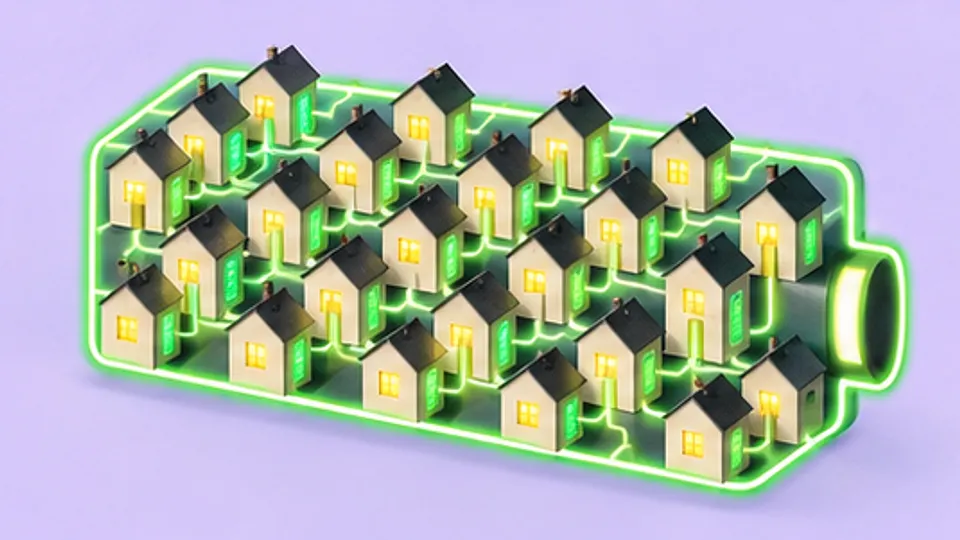
A network of batteries installed in thousands of homes by Vermont’s largest utility has become the state’s biggest source of power, replacing oil, diesel and natural gas plants built to meet peak demand, the BBC reported.
More than 5,500 Vermont households have battery systems under a programme run by Green Mountain Power, which serves over 75% of the state. The utility installs two batteries in a home for $55 (£41) a month on a 10-year lease, and says it can tap the batteries when the grid needs them while customers keep reserve power for outages.
The systems form what is known as a virtual power plant: software links home batteries, rooftop solar panels, smart thermostats and other devices into one coordinated resource that reduces demand on the grid at peak times. The company says about 50% of homes in the programme with batteries also have solar panels. Similar projects are being built from Germany to China, the BBC reported.
Pollyanna Bladyka of Springfield, in eastern Vermont, enrolled in 2024 after repeated outages and was considering a generator costing $12,000 (£9,000) before an electrician told her about the lease scheme. She has not lost power since. “I’d like to say I did it for the environment, but I did it for myself,” she told the BBC. “But I don’t mind helping.”
Homeowners say the batteries have removed the risk of outages, a serious concern in a rural state with extreme winter cold. Megan Browning, who has two home batteries and rooftop solar, said that when a severe windstorm downed a power line near her home and neighbours lost electricity, she “didn’t even notice a flicker.” Bladyka’s batteries can run her home for about two days if use of appliances is kept to a minimum.
Green Mountain Power began the programme as a pilot in 2017, and Kate Peters, a virtual power plant expert at the Boston-based consultancy The Brattle Group, said it may be among the largest battery programmes in the United States. Enrolment rose in 2023 when state regulators lifted a cap, with over 2,500 people signing up since. The utility aims to eliminate all power outages by 2030, using batteries alongside measures such as burying power lines.
The utility said the virtual power plant has effectively replaced the peaker plants it once used for high-demand periods, though four still run occasionally at the request of the regional grid operator and it hopes to close them. “We believe in a two-way grid,” chief executive Mari McClure said. “With technology nowadays, we can create a distributed, decentralised model that’s much more affordable and much safer. Customers really become consumers and producers.”
Green Mountain Power told the BBC the system saved customers $11 million (£8 million) last year. The US Department of Energy estimated in a 2023 report that virtual power plants could save the country more than $10 billion (£7.4 billion) a year by 2030. “A virtual power plant is a way for a utility to pay people to provide some of the services that they usually pay big companies to provide for the grid,” said Ben Hertz-Shargel, president of the New Jersey Board of Public Utilities.
Barriers remain. Jen Downing, a former Energy Department official and lead author of the 2023 report, said a “backwards financial incentive structure” discourages utilities from using such systems. “Utilities don’t have much incentive to harness demand flexibility because they make more money if they just build stuff,” she said, calling it the main national issue. Massachusetts, Illinois and New Jersey are pressing utilities to buy capacity from virtual power plants, and states and technology companies are considering them to free grid space for data centres.
Green Mountain Power plans to offer energy storage to nearly all of its roughly 300,000 customers and to more than double the size of its virtual power plant by 2034, McClure said. It also wants to connect Vermont’s electric vehicle batteries to the grid, a concept known as vehicle-to-grid. Downing said that is not yet cost-effective for most consumer EVs. McClure said she once powered her rural home for five days during an outage using the battery in her Ford F-150 Lightning truck.