
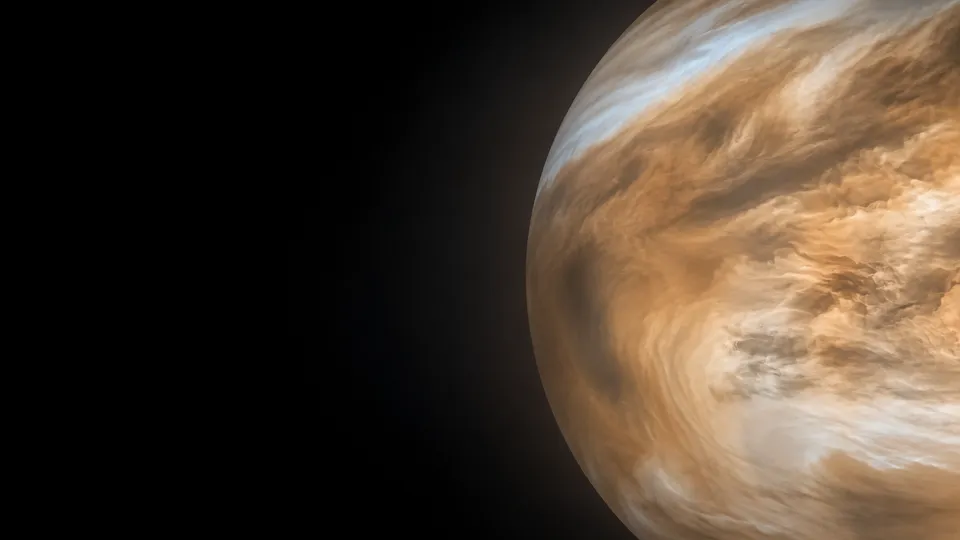
A yellowish haze near the floor of Venus’ atmosphere, unexplained since probes first saw it in the 1970s, is dust left by meteorites that burn up on arrival rather than volcanic ash, Japanese researchers reported this week.
The Soviet Venera landers and NASA’s Pioneer Venus probes detected the “lower haze” decades ago and sent back some of the first images of the planet. Volcanic ash was long the leading suspect. Venus is the most volcanically active planet in the solar system, a picture the Magellan spacecraft began building in the early 1990s, and recent studies suggest it is more active still. But Hiroki Karyu, a planetary scientist at Tohoku University in Sendai, Japan, and his team ruled out both volcanic ash and surface dust. Even much larger influxes of either, they found, would not interact with the atmosphere’s sulfur in the right way to form the haze.
Working with a microphysical model, the kind used to study how clouds and precipitation form, the team traced a different chain and published the results in the journal Nature Astronomy. Meteorites pulled in by Venus’ gravity burn up from friction and shed a trail of particles in their wake. Droplets of sulfuric acid condense around them, much as water condenses on dust to build Earth’s clouds. Rather than gaining more droplets, several particles clump into larger clusters and the condensates grow heavy enough to sink. In the lower atmosphere, at temperatures reaching 100 degrees Celsius (212 degrees Fahrenheit), the acid evaporates. The particles left behind are the haze.
“The continuous influx of cosmic dust is sufficient to sustain this lower haze layer with the particle size distribution observed by the entry probes,” Mr. Karyu said in the study. “These haze particles of cosmic origin act as efficient condensation nuclei, promoting cloud formation in the main cloud deck even far from their initial source.”
The model also settled a second puzzle. Something in Venus’ skies absorbs ultraviolet light, and no one had pinned down what. Meteorites often carry magnesium, silicon and iron, but the first two absorb ultraviolet poorly. Iron was a better suspect. The Venera and Vega probes had detected atmospheric iron, and the mass spectrometer aboard the Pioneer Venus Large Probe had found iron sulfate, discoveries that went unexplained for decades. In the new model, iron sulfate matched the haze’s observed properties.
Not every particle follows the same route. At 40 to 50 kilometers above the surface (about 25 to 31 miles), high-energy particles hit what is called a nucleation barrier, and sulfuric acid cannot condense on them. Convection carries those particles into the upper cloud layer, where they cool enough to be folded into sulfuric acid particles, behavior that earlier observations had hinted at and the team says is now better supported.
The findings reach beyond Venus, the authors wrote. On gas giants, particles that cannot evaporate, including meteorite debris, might settle on the outer layers of clouds, and the same microphysical processes could shape hazes on Jupiter, Saturn and Neptune.
“As on Venus, observing the metal layers in the atmosphere of the outer planets would help [determine] the deposition rates of [metals] within their atmospheres and, by extension, the resulting haze abundances,” Mr. Karyu said. “These effects establish cosmic dust as an essential component of planetary climates, a role that is also likely to be important for exoplanets.”