
On Sunday in Caracas, the Unitary Democratic Platform (PUD), Venezuela’s largest opposition coalition, voted to “recognise and support the leadership” of exiled Nobel Peace Prize laureate Maria Corina Machado, as Al Jazeera reported. That vote is less interesting than its timing. It landed four days after a separate, US-backed negotiating table opened its third round in a Caracas hotel between a different opposition delegation and the government Machado is trying to unseat. Nine and a half months after the United States captured Nicolás Maduro, Venezuela now has two competing transition documents and zero election dates.
A 14-point document, read aloud
The PUD’s text, titled the National Agreement for the Recovery of the Republic, was read publicly by Biagio Pilieri, a leader of the Convergencia party and a former political prisoner himself, according to Cibercuba’s account. Its 14 points include recognition of Machado and 2024 presidential candidate Edmundo González Urrutia as the opposition’s leaders, recognition of the National Assembly elected in 2015 (chavismo’s last loss at the ballot box), a ban on indefinite re-election, separation of party and state, lifting of candidacy disqualifications — the kind that barred Machado herself — and the release of political prisoners, of whom Foro Penal counted roughly 322 still held when the document was read. Machado joined the Caracas session remotely, from her exile in Panama, and said she would not interfere in the official talks track, according to France 24’s AFP dispatch. She called the agreement “the most powerful, most potent and most necessary” and said she remained “grateful” to Donald Trump for “opening a door” toward democracy.
Two tables, one country
The talks Machado says she isn’t interfering with are the ones that actually matter to Washington. That process, installed under US State Department sponsorship, pairs Jorge Rodríguez — president of the National Assembly and brother of acting president Delcy Rodríguez — against Dinorah Figuera, who leads the delegation of the 2015-elected opposition Assembly. Its third round opened October 14 at Caracas’s Meliá hotel, with the renewal of the Supreme Court as its stated agenda, per Tag24’s reporting. Five days earlier, Secretary of State Marco Rubio received Figuera in the State Department’s Treaty Room and pledged, in Cibercuba’s account of the meeting, “full backing” from the top of the US government. Machado was not in that room. On October 16, two days before her coalition read out its own agreement, she publicly complained that Washington had excluded her from the Figuera-Rodríguez process, as Rio Times reported.
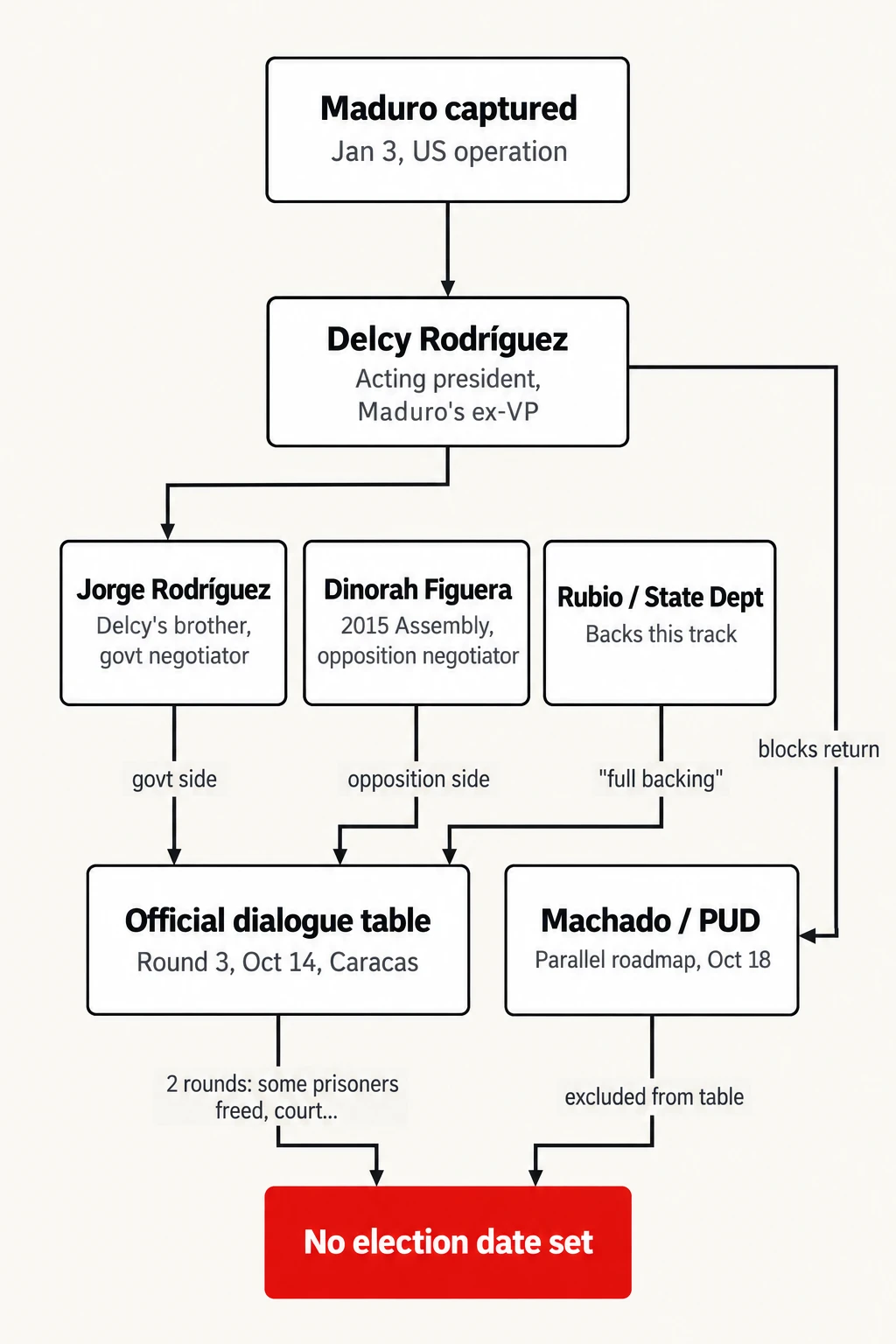
| From | To | How |
|---|---|---|
| Maduro captured (Jan 3, US operation) | Delcy Rodríguez (Acting president, Maduro's ex-VP) | |
| Delcy Rodríguez (Acting president, Maduro's ex-VP) | Jorge Rodríguez (Delcy's brother, govt negotiator) | |
| Jorge Rodríguez (Delcy's brother, govt negotiator) | Official dialogue table (Round 3, Oct 14, Caracas) | govt side |
| Dinorah Figuera (2015 Assembly, opposition negotiator) | Official dialogue table (Round 3, Oct 14, Caracas) | opposition side |
| Rubio / State Dept (Backs this track) | Official dialogue table (Round 3, Oct 14, Caracas) | "full backing" |
| Official dialogue table (Round 3, Oct 14, Caracas) | No election date set | 2 rounds: some prisoners freed, court… |
| Delcy Rodríguez (Acting president, Maduro's ex-VP) | Machado / PUD (Parallel roadmap, Oct 18) | blocks return |
| Machado / PUD (Parallel roadmap, Oct 18) | No election date set | excluded from table |
What the two rounds before this one actually produced, by the negotiators’ own account: the freeing of some political prisoners, the lifting of government blocks on opposition media websites, and the start of a Supreme Court restructuring — results both sides cited after the Rubio-Figuera meeting. None of it comes with a public tally that both the government and independent monitors agree on.
The prisoner count nobody agrees on
That disagreement has a track record. Foro Penal, the Venezuelan NGO that has tracked detentions since before Maduro’s fall, confirmed 9 releases on January 8, the day Rodríguez’s government began freeing prisoners; the government claimed an “important number” without a figure. By January 12 Foro Penal had confirmed 41 against a government claim of 116; by January 26, 250 confirmed against a government claim of 808 since the previous December, according to a tally compiled from reporting on Wikipedia. By March 8, Foro Penal’s confirmed cumulative total reached 621 since January 8, against a pre-2026 estimate of roughly 700 to 800 political prisoners overall. The United Nations Fact-Finding Mission on Venezuela counted 87 new politically motivated arrests since January 3 over the same period — the releases run alongside fresh detentions, not instead of them.
| Foro Penal confirmed (people) | |
|---|---|
| Jan 8 | 9 |
| Jan 12 | 41 |
| Jan 17 | 139 |
| Jan 23 | 154 |
| Jan 26 | 250 |
| Mar 8 | 621 |
Source: Foro Penal, compiled via Wikipedia. Government's own claimed totals ran higher at every checkpoint and are not plotted
Blocked at the border
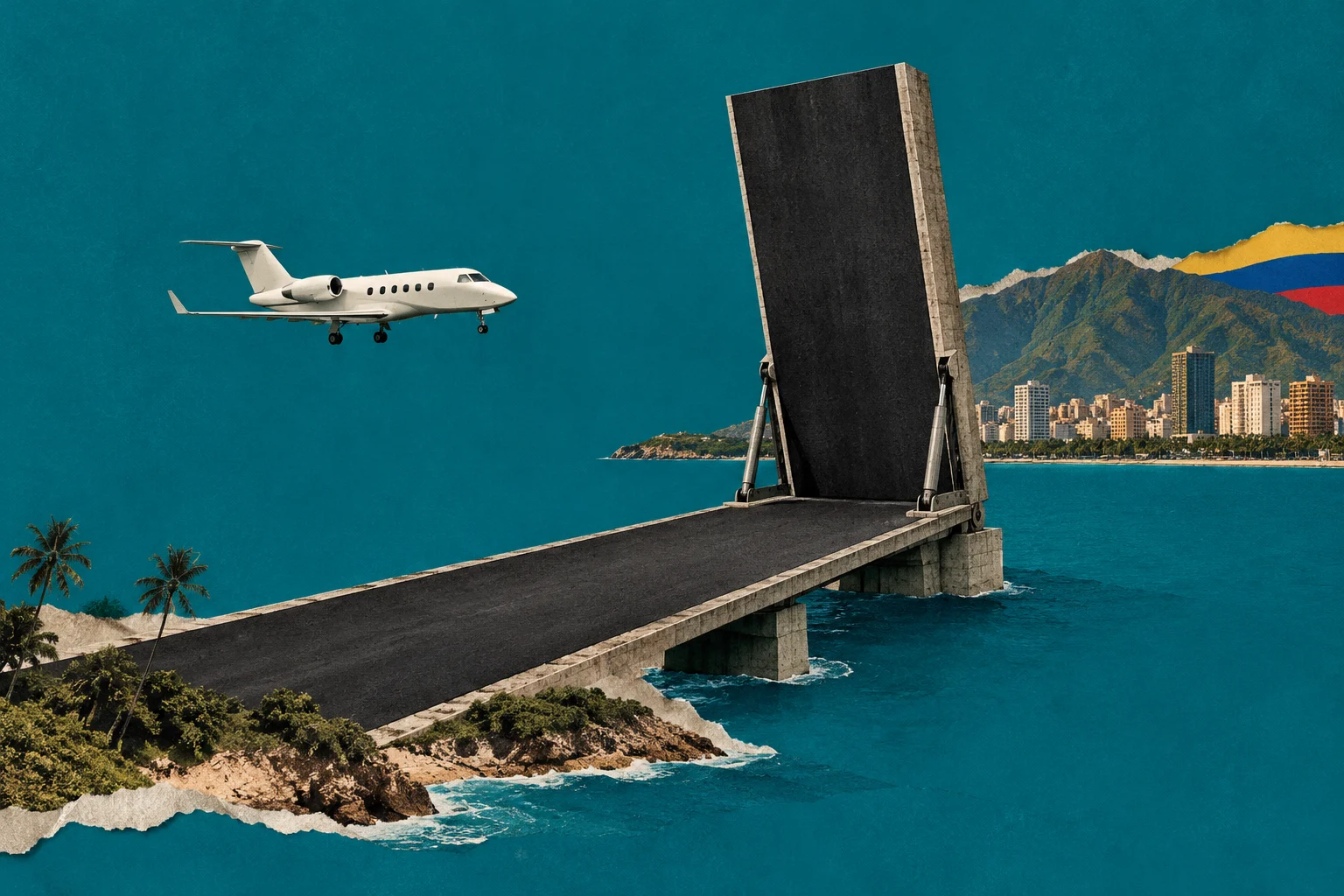
Machado’s own return is a separate, smaller-scale version of the same confirmed-versus-claimed gap. Her party, Vente Venezuela, says she has tried to re-enter the country at least seven times since going into exile and been blocked every time. The most documented attempt came in July, when US officials discovered she planned to fly by private plane from Virginia to Curaçao and cross by boat — the same route she used to leave the country in December to collect her Nobel Prize in Oslo. Dutch authorities revoked landing clearance for that flight, and a subsequent attempt to book a commercial flight from Panama also failed. Trump administration officials were unsparing about her timing, which came after deadly earthquakes in Venezuela that July: “It’s political opportunism and it’s grotesque,” one senior administration official told Axios, a characterization echoed by four other officials in the same report. Delcy Rodríguez has separately warned that Machado “will have to answer” if she sets foot back in the country. The State Department told Congress on July 15 that it would not itself block her return, since she remains a Venezuelan citizen with the legal right to travel home; it has simply declined to help her get there.
Machado’s current disqualification dates to January 2024, when Venezuelan courts upheld a 15-year ban on her holding public office, after she won the opposition’s primary that October with the largest vote share of any candidate. González stood in her place in 2024; Maduro claimed a third term, opposition-collected vote tallies indicated González had won, and Washington recognized González as president-elect rather than Maduro. Machado received the 2025 Nobel Peace Prize for her role in that campaign and handed the medal to Trump during a January 2026 visit to Washington, shortly after Maduro’s capture.
A date, eventually
Machado has pressed publicly for a fixed election date, writing in an opinion piece that “the next strategic step is to set a date for the presidential elections within the next year,” and that “my return is urgent,” per Cibercuba’s coverage of that op-ed. One figure now circulating among her allies, originally floated by US Senator Bernie Moreno, is July 24, 2027. Republican allies including Representative Carlos Giménez and Senator Ted Cruz have called for a vote no later than mid-2027. Rubio, for his part, has described the transition as running through phases — stabilization, economic recovery, then political transition — without committing to when phase three begins.
Two sets of Venezuelan opposition figures have now each produced their own transition plan: one with Washington’s direct backing and a seat at a real negotiating table, the other with a Nobel Prize, a 14-point document, and a leader who still cannot get a flight to land. Round four of the official talks, and whatever answer the State Department eventually gives on a date, will show which document was worth more.