
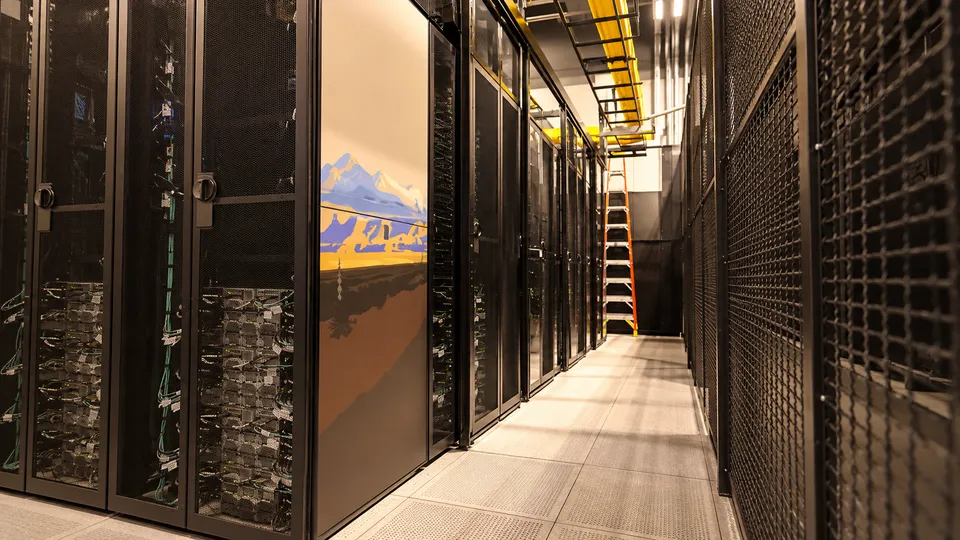
Redtail, the University of Utah’s new AI supercomputer, runs on 264 Nvidia H200 GPUs spread across 33 HPE Cray XD670 nodes. It cost $50 million over five years and placed 159th in the world on the June 2026 Top500 list of publicly benchmarked supercomputers, with a Linpack result of 12.85 petaflops — 12.85 quadrillion 64-bit floating-point operations a second, measured on dense matrix math, not on the lower-precision arithmetic that dominates actual neural-network training. The university said the result puts Redtail fifth among U.S. public university systems, behind Texas A&M, UT Austin, the University of Illinois Urbana-Champaign and the University of Florida, according to the University of Utah.
Top500, published twice a year since 1993, ranks machines purely on HPL: how fast they solve a dense system of linear equations in double precision. Its companion, Green500, ranks the same 500 systems by floating-point operations per watt on that same run. A separate University of Utah release put Redtail at No. 76 on the June 2026 Green500 — the university’s first appearance ever on that list, and its first Top500 appearance since 2009, in 18 total appearances over the list’s history. Neither benchmark measures the bfloat16 or FP8 throughput an H200 actually spends most of its cycles on when training or serving a transformer model; HPL survives as the industry yardstick mainly because every vendor reports it the same way.
The rank itself is moving under everyone’s feet. Top500’s own highlights for the June 2026 list put the minimum Linpack score needed to crack the Top100 at 21.85 petaflops — nearly double Redtail’s entire result, and up 5.3-fold from 4.12 petaflops in June 2021. The bar to make the list at all, the No. 500 cutoff, rose far more slowly over the same five years, from 1.51 to 2.66 petaflops, a 76% increase. Combined Linpack throughput across all 500 listed machines reached 18.73 exaflops in June 2026, up from 2.79 exaflops in June 2021: the middle and top of the list absorbed almost all of that growth while the floor barely moved.
That compression explains why a newer, faster-per-chip system debuts so far down the list. The closest comparison is the University of Florida’s HiPerGator AI, which the University of Florida reported debuted at No. 22 on the June 2021 Top500 with 17.2 petaflops of Linpack across 1,142 Nvidia A100 GPUs, and No. 2 on that June’s Green500 at 29.52 gigaflops per watt. Redtail’s per-GPU Linpack throughput is markedly higher — 48.7 teraflops per H200 against 15.1 teraflops per A100, a 3.2-fold gain across two chip generations — but a quarter of the GPU count, in a field that grew around it, leaves Redtail more than six times further down the rankings. Florida hasn’t stood still either: its trustees approved a $24-million-plus upgrade to 504 Nvidia Blackwell B200 GPUs in late 2024 — a full chip generation ahead of Redtail’s Hopper-based H200s, installed before Redtail had broken ground.
Redtail’s $50 million comes from a five-year public-private partnership: the Utah Legislature approved a one-time $15 million appropriation, the Huntsman Family Foundation and Brynn Ballard and Peter Huntsman contributed privately in an amount the university hasn’t disclosed, and HPE supplied the hardware under a technology partnership with Nvidia. Manish Parashar, the university’s chief AI officer, said the project went from first conversations to a running machine in 18 months. Nvidia co-founder Chris Malachowsky, who also backed Florida’s HiPerGator, told the university’s October 6 symposium that Utah’s combination of state support and infrastructure sets it apart.
I hold up Utah as an example. You’re out in the lead, and run, don’t walk.

Bill Miller, the university’s senior director for research computing, said Redtail “uses the same architecture as leading companies such as OpenAI and Anthropic.” That’s true only loosely: a cluster of Nvidia GPUs linked by InfiniBand and running CUDA, PyTorch and NCCL is the standard recipe for GPU computing generally, not a frontier-lab-specific design. The scale gap is the part that framing elides. Nvidia’s own account of xAI’s Colossus site in Memphis puts its GPU count above 220,000 Nvidia H100, H200 and GB200 accelerators — more than 800 times Redtail’s 264. Frontier labs now train on clusters sized in the hundreds of thousands of GPUs; Redtail is sized, deliberately, to serve classroom and departmental workloads across a state, not to pretrain a frontier model.
What the machine is actually for
The university’s Center for High Performance Computing, part of the Scientific Computing and Imaging Institute, will run Redtail, extending access first to Utah’s public colleges and universities and later to state government, K-12 schools and private industry, with statewide connectivity from the Utah Education and Telehealth Network. The university opened a call for projects in July and named its first 21 funded “challenge projects” ahead of the October symposium, spanning environmental forecasting to disease diagnosis; ARUP Laboratories was added to a second cohort to train a foundation model for clinical flow cytometry. Huntsman Cancer Institute chief executive Bradley Cairns told the symposium the institute has identified more inherited-cancer genes than any other university and expects Redtail to extend that work into cancer genetics.
Redtail sits inside a broader program, One-U Responsible AI, which the university says has supported more than 60 researchers and students since launching in 2023. In the year to October 2026 it added 12 new faculty fellows and seven postdoctoral fellows, and says it will bring in a record 13 more fellows in 2027; it ran a second annual hackathon and a new AI-ethics workshop series, and continues to back the Utah Responsible AI Community Consortium. The October 6 symposium drew more than 250 attendees, 22 research talks and 50 posters — a record for the event, by the university’s own count.
The computing sits alongside a state policy push branded Pro-Human AI, run from the Department of Commerce’s Office of Artificial Intelligence Policy under Commissioner Margaret Busse. The office runs a regulatory sandbox that lets companies seek temporary relief from state rules to test AI products, added a healthcare pillar with six outside evaluators in October, and days after the symposium Governor Spencer Cox signed an executive order directing state agencies to apply the same framework when choosing AI tools.
University leaders say they’re also working to link Redtail to federal programs: NASA, the Department of Energy’s Genesis Mission, and the National Science Foundation’s National AI Research Resource. The last of those is itself unfinished — NAIRR has run as a pilot since January 2024, and NSF’s solicitation to convert it into a permanent operations center was still open this month. Fifty million dollars over five years is a rounding error against the capital spending Wall Street is now underwriting across the industry; Bain and McKinsey’s own estimates put the industry’s funding need in the trillions, and national research funders elsewhere are struggling to keep pace with much smaller asks.
Full user operations are due by late fall 2026. Whether Utah funds a second generation of GPUs the way Florida followed its A100 cluster with Blackwell B200s three years later is the number to watch next.