
The International Criminal Court has 18 judges. By Friday, the United States had at some point designated 17 of its judges and prosecutors for sanctions since February 2025, according to UPI’s count of the cumulative designations. What changed on October 9 is the target: not an official, but the institution itself, for the first time. Secretary of State Marco Rubio announced the move in a video address, saying Washington would “ban transactions with this rogue court, cutting off their resources and crippling its ability to operate against us,” as both Al Jazeera and RTÉ reported.
The legal machinery behind that sentence is Executive Order 14203, signed by President Donald Trump on February 6, 2025, which invokes the International Emergency Economic Powers Act, the National Emergencies Act and a visa provision of the Immigration and Nationality Act, according to the order’s text summarized on Wikipedia. Designation under IEEPA puts a target on the Treasury’s Specially Designated Nationals list. For an individual, that means US banks freeze any accounts they can find and US email and cloud providers cut service: Chief Prosecutor Karim Khan lost both within a week of his February 13, 2025 designation, per the Treasury’s own sanctions record. For an institution, the same mechanism blocks any assets the ICC holds in US jurisdiction and bars US persons and companies from transacting with it at all, with a six-month window to unwind existing business, the State Department’s October 9 fact sheet and statement say. Because most cross-border dollar payments clear through US correspondent banks regardless of who is paying whom, the practical reach of a US designation extends well past anyone physically in America.
A fifteen-month ratchet
Friday’s action is the sixth step in an escalation that has run since the order was signed. OFAC put Khan on the SDN list on February 13, 2025. Implementing regulations followed on July 1, 2025, codified as 31 CFR Part 528. On August 18, 2025, the administration designated Court President Tomoko Akane and senior trial lawyer Abdoulaye Seyé; by that point, by one tally reported alongside the EO’s record, the US had sanctioned nine of the court’s 18 judges, both deputy prosecutors and its former chief prosecutor. On September 4, 2025, sanctions extended to UN Special Rapporteur Francesca Albanese and three Palestinian rights groups, Al-Haq, Al Mezan and the Palestinian Center for Human Rights. Two more judges, Georgia’s Gocha Lordkipanidze and Mongolia’s Erdenebalsuren Damdin, were added on December 18, 2025. Friday’s designation of the court as a legal entity is the first to bypass individual officials altogether.
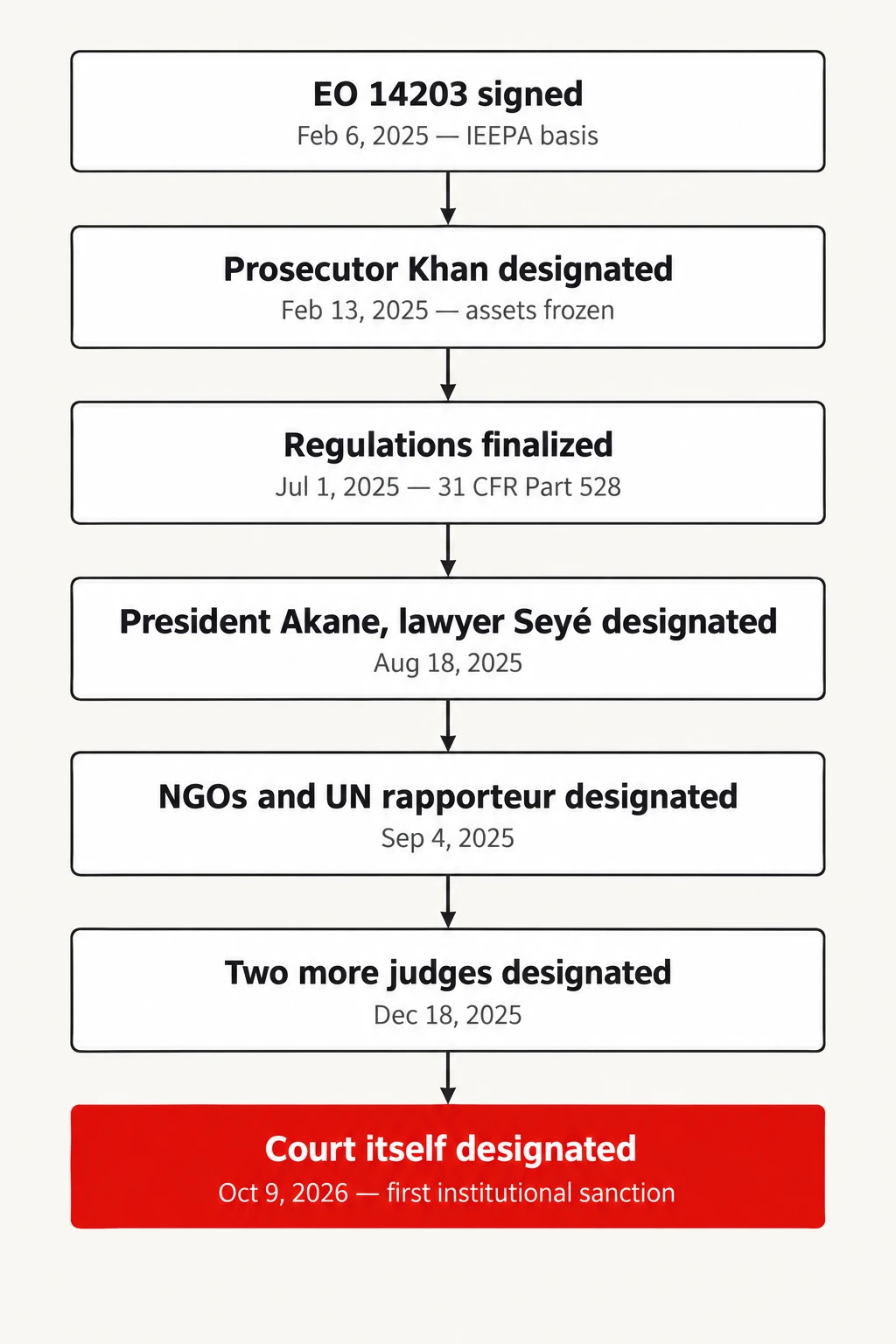
| From | To | How |
|---|---|---|
| EO 14203 signed (Feb 6, 2025 — IEEPA basis) | Prosecutor Khan designated (Feb 13, 2025 — assets frozen) | |
| Prosecutor Khan designated (Feb 13, 2025 — assets frozen) | Regulations finalized (Jul 1, 2025 — 31 CFR Part 528) | |
| Regulations finalized (Jul 1, 2025 — 31 CFR Part 528) | President Akane, lawyer Seyé designated (Aug 18, 2025) | |
| President Akane, lawyer Seyé designated (Aug 18, 2025) | NGOs and UN rapporteur designated (Sep 4, 2025) | |
| NGOs and UN rapporteur designated (Sep 4, 2025) | Two more judges designated (Dec 18, 2025) | |
| Two more judges designated (Dec 18, 2025) | Court itself designated (Oct 9, 2026 — first institutional sanction) |
Based on US Department of State; US Treasury OFAC; Wikipedia summary of Executive Order 14203
The timing lands two days after Rubio delivered a speech on the rule of law in front of the Acropolis in Athens, as both CBC and RTÉ noted, and hours after the Nobel committee gave its Peace Prize to Navi Pillay, the 85-year-old South African jurist who sat on the ICC, the Rwanda tribunal and the UN human rights post before chairing the inquiry that found Israel had committed genocide in Gaza, according to the Nobel committee’s own citation. Trump has made no secret of wanting the prize himself; he did not get it. Pillay, accepting in Nuremberg, joked that “if you clap a little bit more I may share this prize with Trump,” and said the award was for “all of the survivors of international crimes” and the “defenders of international justice,” adding that “we are living through an era when international law and human rights are under significant political attack.”
In his statement, Rubio framed the sanctions as bipartisan in spirit if not in execution: “Both parties agree on this, but only President Trump has the resolve to take the action needed to end this threat once and for all,” he said, as RTÉ and CBC both quoted. “Either the ICC will end its threats, or we will end the ICC.” He called on allies to follow suit: “If they do not, the United States will continue its campaign to dismantle the ICC, piece by piece, until Americans are threatened no longer.”
The court’s response, in a statement reported by Al Jazeera and the ICC itself, called the move “an attempt to obstruct the course of justice” and “an assault on the rule of law and on the very foundations of the international legal order which strikes at the simple principle that no one stands above the law.” Deputy Prosecutor Nazhat Shameem Khan said the sanctions “are intended to undermine the rule of law internationally and the work that an independent judicial institution is doing.” President Akane said the court would “continue to fully discharge its mandate, with independence and impartiality, acting only on the basis of the law and the evidence, for the sake of the countless victims of grave crimes,” and framed the stakes beyond The Hague: “This is not just about defending a single institution, but about safeguarding the international order grounded upon the rule of law. History will judge this moment.”
Allies without a blocking plan, yet
Eight governments issued a joint statement the same afternoon: Canada, Denmark, Germany, France, Italy, Japan, the Netherlands and the United Kingdom, all of them Rome Statute members and several of them US treaty allies. “If put into effect, these sanctions will have a significant impact on the Court’s work, its dedicated staff and their families,” the statement read, as both RTÉ and CBC reported. “They work every day to bring those accused of the most serious international crimes to justice and to support their victims.” Dutch Foreign Minister Tom Berendsen called the move “a deeply regrettable step” on social media, adding, “We stand firm in defence of the court.” UN Secretary-General António Guterres, through spokesman Stéphane Dujarric, went further: “Today’s decision marks a serious blow to our collective pursuit of international criminal justice, of which the ICC is a key pillar,” with Guterres “deeply alarmed by the expected impact of today’s sanctions on the International Criminal Court as a whole,” including its capacity to handle cases referred by the UN Security Council itself.
The Netherlands, as the court’s host, has spent weeks preparing its one real lever: the EU’s blocking statute, Council Regulation 2271/96, which nullifies the legal effect of designated foreign sanctions inside the EU and bars European companies from complying with them. Berendsen has called it the “nuclear option” and said the Netherlands has asked Brussels to have it ready to deploy quickly if needed, according to CBC. The statute has a track record: the EU invoked it in 2018 against US sanctions on Iran, and the result showed its limit as much as its force. Brussels could declare the US measures null in EU law, but it could not stop European banks from complying anyway, out of fear of being cut off from the dollar-clearing system that underpins global finance. Whether a blocking statute changes the ICC’s practical access to IT contractors, banks or detention-facility services in the Netherlands is the open question Brussels has not had to answer yet.
The exit queue
The sanctions arrive as the court’s membership is already thinning. Of the ICC’s 125 states parties, 11 have filed withdrawal notices in 2026, three of which were later rescinded, according to reporting on the Assembly of States Parties’ own tally. Venezuela and Chad both filed in late July 2026, each accusing the court of a bias toward prosecuting Africans and Latin Americans; their withdrawals take effect a year after notice, in July 2027, under the Rome Statute’s own rules, during which both remain bound by existing obligations. Nauru’s president told the UN General Assembly on September 23, 2026 that his country, which uses the Indigenous name Naoero in that forum, would leave over the court’s “increasing irrelevance.” Burkina Faso, Mali and Niger, all under military juntas, have also moved to withdraw. Trump had urged members at the UN General Assembly to “officially resign from this rogue institution immediately”; by that measure, the campaign has peeled off a handful of mostly adversarial or junta-led governments, not the treaty allies Rubio is pressing hardest.
Rights groups called the institutional designation a different order of threat than the earlier, individual sanctions. Amnesty International’s Erika Guevara Rosas said “this existential attack must fail” and that “states must take concrete action to resist the imposition of these measures and actively protect the court,” as CBC reported. Omar Shakir of the group Dawn said sanctioning the entire court amounted to “a sledgehammer to the most important development in international justice in half a century.”
The Assembly of States Parties meets in December 2026, and the eight-country statement already commits its signatories to “continuous and inclusive dialogue” before then. What is not yet on paper is a mechanism that keeps the court’s salaries paid and its servers running once the six-month wind-down clock, which starts now, runs out.