
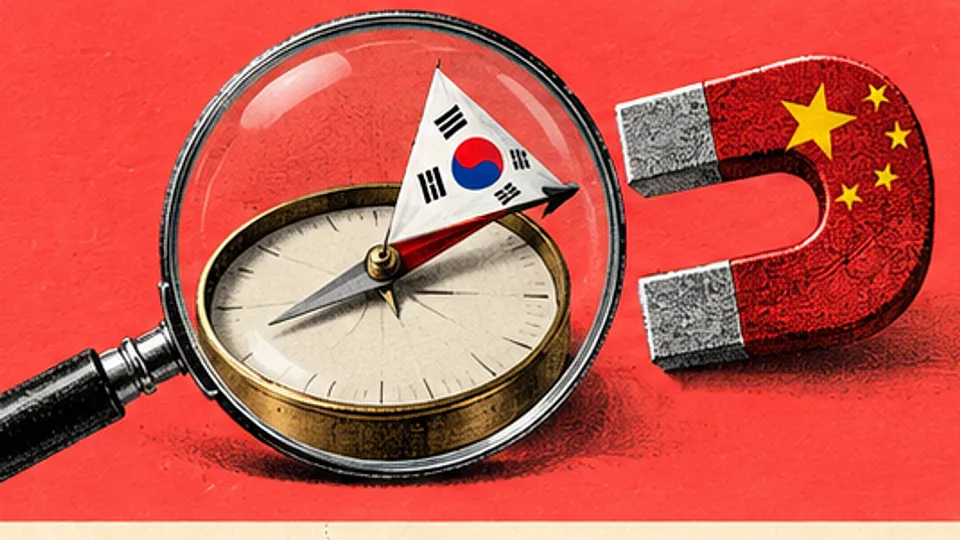
John Moolenaar, the Republican chairman of a U.S. House committee on strategic competition with China, told Secretary of State Marco Rubio in a letter on Monday that South Korea’s shifting stance toward China poses significant risks to U.S. interests, the Chosun Ilbo reported on Tuesday.
Moolenaar said Seoul’s changing approach in economic, technology and diplomatic policy toward China went beyond disputes over the treatment of U.S. digital firms such as Coupang, according to the newspaper. He said the friction could amount to a “structural shift” in South Korea’s foreign policy requiring close monitoring and joint action.
The House Select Committee on Strategic Competition between the United States and the Chinese Communist Party is a bipartisan body created in January 2023 with about 20 members, including Korean-American Representative Young Kim and Representative Tom Suozzi. Moolenaar, serving his sixth term, has criticised Beijing’s military and economic pressure and called for united action by the U.S., South Korea and Japan.
Copies of the letter also went to War Secretary Pete Hegseth, Commerce Secretary Howard Lutnick and U.S. Trade Representative Jamieson Greer. Moolenaar wrote that the alliance “remains indispensable” but that differences between allies on vital national interests “are not a matter to be taken lightly.”
Citing Rubio’s comment to Congress in June that South Korea’s elected leaders were taking positions contrary to U.S. interests, Moolenaar said the pace of South Korean-Chinese summit contacts over the past nine months was unprecedented, pointing to President Xi Jinping’s visit to Seoul in October 2025 and President Lee Jae Myung’s state visit in January 2026.
With China in a diplomatic dispute with Japan over Taiwan, Xi’s reference to the “sacrifice” against Japanese militarism 80 years ago amounted to “an overt attempt to drive a wedge” between two U.S. treaty allies, Moolenaar wrote. He said Seoul and Beijing’s decision to expand export-control and supply-chain consultation channels could create a structure separate from Washington.
He described Samsung Electronics’ and SK Hynix’s semiconductor plants in China as “leverage” for the Chinese Communist Party, saying they could create a commercial incentive for Seoul to compromise with Beijing.
Moolenaar acknowledged South Korea had made “progress” in sharing defence burdens but said steps such as higher defence spending and the transfer of wartime operational control were being framed as reducing reliance on the U.S. rather than increasing contributions to the alliance. He also cited friction over a February sortie by U.S. forces in Korea over the West Sea and reported U.S. limits on intelligence sharing after a leak controversy involving Unification Minister Chung Dong-young.
Quoting Lee’s past remark about what business South Korea had with events in the Taiwan Strait, Moolenaar said the South Korean government appeared to have “effectively ruled out” supporting any regional response to a Taiwan crisis caused by Chinese aggression.
Moolenaar contrasted the growing South Korean market presence of Chinese platforms such as AliExpress and Temu with what he called repeated enforcement against U.S. companies. He said regulators made no on-site searches for four months after AliExpress concealed a platform hack, while 11 agencies pursued Coupang over a less sensitive personal-data leak and imposed a “staggering” $409 million fine.
South Korea’s Personal Information Protection Commission fined Coupang 624.681 billion won in June, the largest penalty of its kind. The dispute has lasted nearly a year and has acted as an obstacle in bilateral relations, the Chosun Ilbo reported.
Moolenaar asked the State Department to brief the committee by October 31 on changes in South Korea-China relations and the administration’s response.