
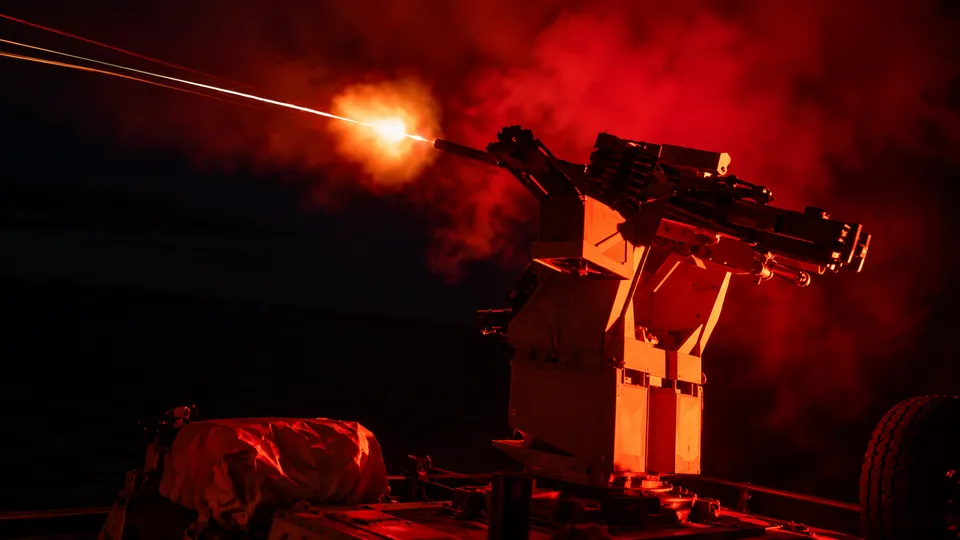
There is a basic problem in air defense, which is that the thing you are shooting at generally costs less than the thing you are shooting it with. If your enemy launches a cheap drone at your city, and you knock it down with an expensive missile, you have won the engagement and lost the arithmetic. Do that two thousand times a month and you are not really winning. So the dream, for a country under drone attack, is a gun that aims itself: something that sits on a rooftop or a bridge, spots an incoming drone with a camera, does the math in a few hundredths of a second, and fires a burst of ordinary machine-gun ammunition that costs a rounding error. Ukraine now says that dream is scoring real kills.
Yurii Ihnat, a Ukrainian Air Force spokesperson, confirmed on Monday that automated gun turrets using AI and machine vision have shot down Russian jet-powered drones for the first time, including the Geran-5, the newest and fastest model in Russia’s arsenal. He described the turrets as “innovative technologies” that rely on AI and machine vision, and noted — this part matters — that the guns have limited range. According to Business Insider, which reported Ihnat’s remarks from a national telethon, President Volodymyr Zelenskyy said on Sunday that more than a dozen of the turrets have been installed around Kyiv, with another eight planned for the wider region, and that at least some will sit on the capital’s bridges.
The bridges are not a decorative choice. Russian forces have targeted Kyiv’s bridges with drones multiple times over the past week, as part of a broader escalation against Ukrainian civilian infrastructure. If you are Russia and you have found a weapon fast enough to get through traditional defenses, the logical target list is the stuff that is hard to move, hard to replace and embarrassing to lose. Bridges qualify. The logical counter is to put the cheap automated shooter directly on the thing being attacked, which is roughly what Ukraine is doing.
Ukraine has not said exactly which turret system is deployed, though Zelenskyy revealed it carries a .50-caliber machine gun — the standard heavy weapon of mobile air defense crews, and a clue that the technology here is not the gun but the brain deciding when to fire it. Last year Ukraine confirmed deploying the Sky Sentinel, an AI-powered turret billed as capable of downing Russian attack drones. Whether the new kills belong to that system or a successor, Ukraine isn’t saying.
To see why the turrets matter, look at what happened to the attack itself. Russia has shifted heavily toward drones powered by mini turbojet engines, and the volume curve is the story: Kyiv says Moscow launched about 350 drones in June and 2,800 in August. That is an eight-fold increase in two months. The Geran-5, the fastest of these, can reach 375 mph. Against the older, slower propeller-driven models like the Geran-2, Ukrainian air defenses were intercepting more than 85% of incoming drones. Against the jet-powered ones, Ihnat said Monday, the interception rate drops to 50% to 70%. In other words, Russia figured out that speed was the soft spot, built accordingly, and roughly doubled the number of drones getting through — at least until someone mounted a computer on a machine gun.
And the turrets are only one line of this particular arms race. Ukrainian defense companies are also working on speed, building faster interceptor drones — drones that hunt drones — and some next-generation models have already downed jet-powered targets, including the Geran-5. Zelenskyy said over the weekend that the “Bars” long-range drone has the best record among Ukraine’s interceptors, with a 30% shoot-down rate. “Others are catching up as well,” he added.
A 30% success rate would be a bad grade on most tests, but Zelenskyy volunteered it on the record, which tells you something about the terms of the competition. Nobody in this fight expects a silver bullet. The game is attrition economics: raise the cost and lower the reliability of each Russian strike until the exchange ratio stops making sense for the attacker. An interceptor that works a third of the time, plus a turret on a bridge that works automatically, plus the existing layered defenses, starts to add up to a real tax on every launch.
There is a quieter implication in all this, and I think it is the interesting one. For decades, air defense meant big radars, big missiles and big budgets, built by prime contractors on long timelines. What Ukraine is fielding instead is closer to consumer-electronics logic: cameras, machine vision, commodity compute, bolted onto a weapon design older than most of the soldiers using it. The expensive part is the software, and software is the one military input that gets better and cheaper at the same time. If an AI turret can reliably kill a 375 mph drone, a lot of very expensive defense programs elsewhere are going to have some explaining to do.
For now, though, the numbers on the other side of the ledger are the ones to watch. Two thousand eight hundred launches in a single month is a bet that volume and speed can overwhelm improvisation. The turrets around Kyiv are the first returns on the counter-bet: that a machine gun with good eyesight, multiplied by enough bridges and rooftops, can make that wager uneconomic. Neither side has won the arithmetic yet. But the arithmetic is the war.