
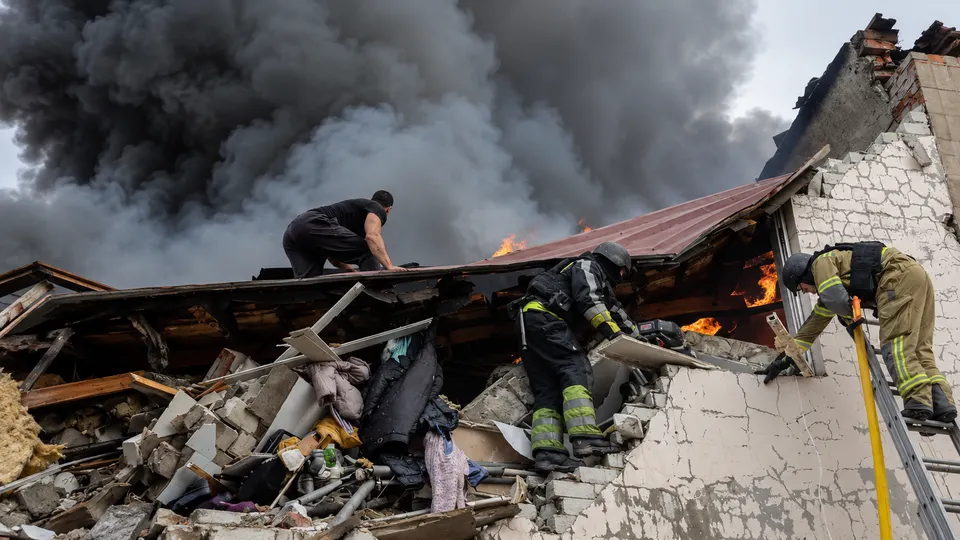
The count from a single Russian missile strike rose through more than a day of digging: 22 people killed, five of them children, after a missile hit a five-storey apartment building, a children’s and youth creativity centre and a business in Pryluky, in the Chernihiv region, on the morning of 7 October, according to Anadolu’s updated report. While crews were still in the rubble, Zmina recorded a lower number — at least 18 dead, four of them children — which is why figures from that first day should be read as floors, not totals. Pryluky sits far behind the front; the strike happened as the front itself moved the other way, with Al Jazeera reporting that Russian forces are retreating in the eastern Donetsk region.
Lyman, and the belt behind it
The clearest admission of the Russian retreat came from the Russian side. The Kremlin-aligned Telegram channel Rybar said on 7 October that Moscow’s forces were losing villages south of Lyman, per Al Jazeera’s account. Lyman matters less for itself than for what it unlocks: Russia has been trying to take the town as a springboard for a full-scale offensive on the “fortress belt” cities of Sloviansk and Kramatorsk, the urban strongpoints anchoring Ukraine’s remaining hold on Donetsk.
The mechanism, as the Institute for the Study of War describes it, was a pincer: take Lyman in the north and press from Dobropillya in the southwest to encircle the belt — in effect, Lyman → Sloviansk → Kramatorsk, with a second arm closing from below. The ISW says Ukrainian forces have now eliminated the Russian salient north of Lyman, breaking the northern arm of that plan, and Euromaidan Press adds that Russian milbloggers have acknowledged Ukrainian advances east of Slovyansk and Kramatorsk in what Ukraine calls Operation Vivaldi. Russian commanders still treat Lyman as the necessary launchpad, but their infantry cannot hold ground inside it, per the Ukrainian military’s assessment.
The tempo and the tally
Slower assaults are what disruption looks like in the numbers. Russian forces averaged 14 attacks per day in the Slovyansk direction in August 2026; in September the rate fell to five per day, according to the ISW, against 20 and 34 attacks a day in the two other directions it tracks. A front going quiet is not the same as a front won — shaping and pauses both show up as falling attack counts — but a drop of two-thirds in the direction the encirclement plan depends on is consistent with the Ukrainian claim, and with what Rybar conceded.
The territorial ledger is closer to balance than either army’s rhetoric suggests, at least in the figures President Volodymyr Zelenskyy chooses to cite. Russian forces have occupied roughly 990 square kilometers (about 380 square miles) of Ukrainian territory since the start of 2026, while Ukrainian forces have retaken about 820 square kilometers (316 square miles), according to figures Zelenskyy gave, adding that Kyiv aims to bring the two closer to parity by year’s end. On what Ukraine can do offensively, he was plainer: “We can do limited offensives,” he said, pointing to recent actions in the Dnipropetrovsk and Lyman areas, “but it’s relatively small.” These are a wartime leader’s numbers, published by his office’s account of the war; independent estimates of daily gain and loss are sparser.
Two numbers will show which side of the ledger moves next: whether the Slovyansk-direction attack rate stays at five a day or climbs back toward August’s 14, and whether the 990-to-820 square-kilometer gap in Zelenskyy’s tally narrows by December the way he has said it will.