
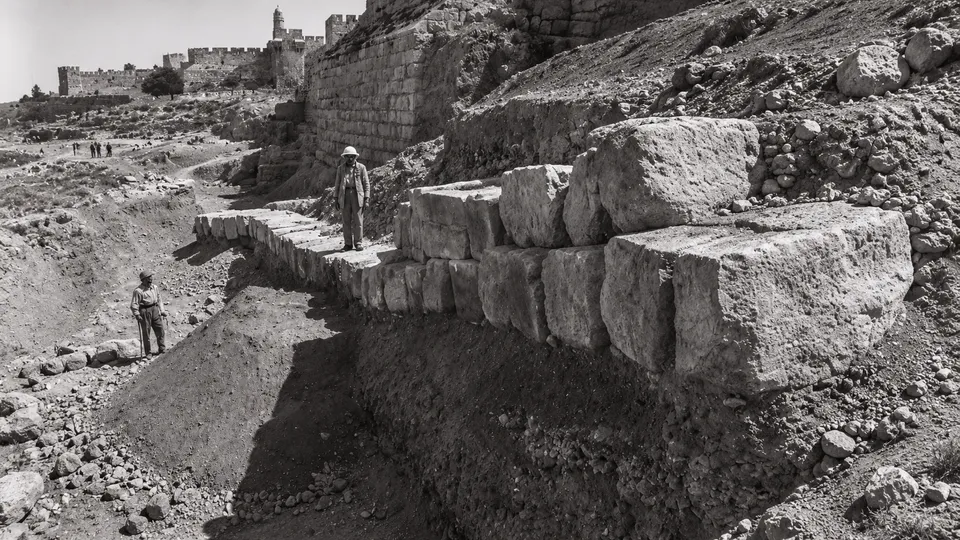
In AD 70, after a long siege, Roman forces under Titus took Jerusalem and destroyed much of it, the Second Temple included. According to the first-century historian Flavius Josephus, Titus spared three monumental towers, Phasael, Hippicus and Mariamne, along with a stretch of the western city wall. He did not keep them out of reverence. He kept them because soldiers would have to live behind them. Rome then left a legion in the ruins, Legio X Fretensis, the Tenth, to hold a conquered country down, and it stayed for more than two hundred years.
Historians have always known the legion was there. Nobody could say exactly where it slept.
A new study offers an answer. As arkeonews reported, the archaeologist Shimon Gibson of the University of North Carolina at Charlotte argues in the Journal of Roman Archaeology, in a paper published online on 20 November 2026, that he has found the southwestern corner of the legion’s fortified base. He did not dig a new trench to find it. He went back to the archive: excavations carried out between 1975 and 1978 by Magen Broshi just south of the present-day Citadel, whose architectural results were never published. The paper’s abstract calls the camp’s whereabouts “One of the enduring mysteries of ancient Jerusalem.”
A corner on a ruined tower
Broshi’s team uncovered two substantial walls, catalogued as W31 and W32, meeting to form a clean corner. One runs about 9.5 meters north to south, the other 7.6 meters east to west. Both sit on the remains of an older defensive tower, part of the city’s fortifications before the Roman conquest. The builders put their new wall on top of the one their army had just broken.
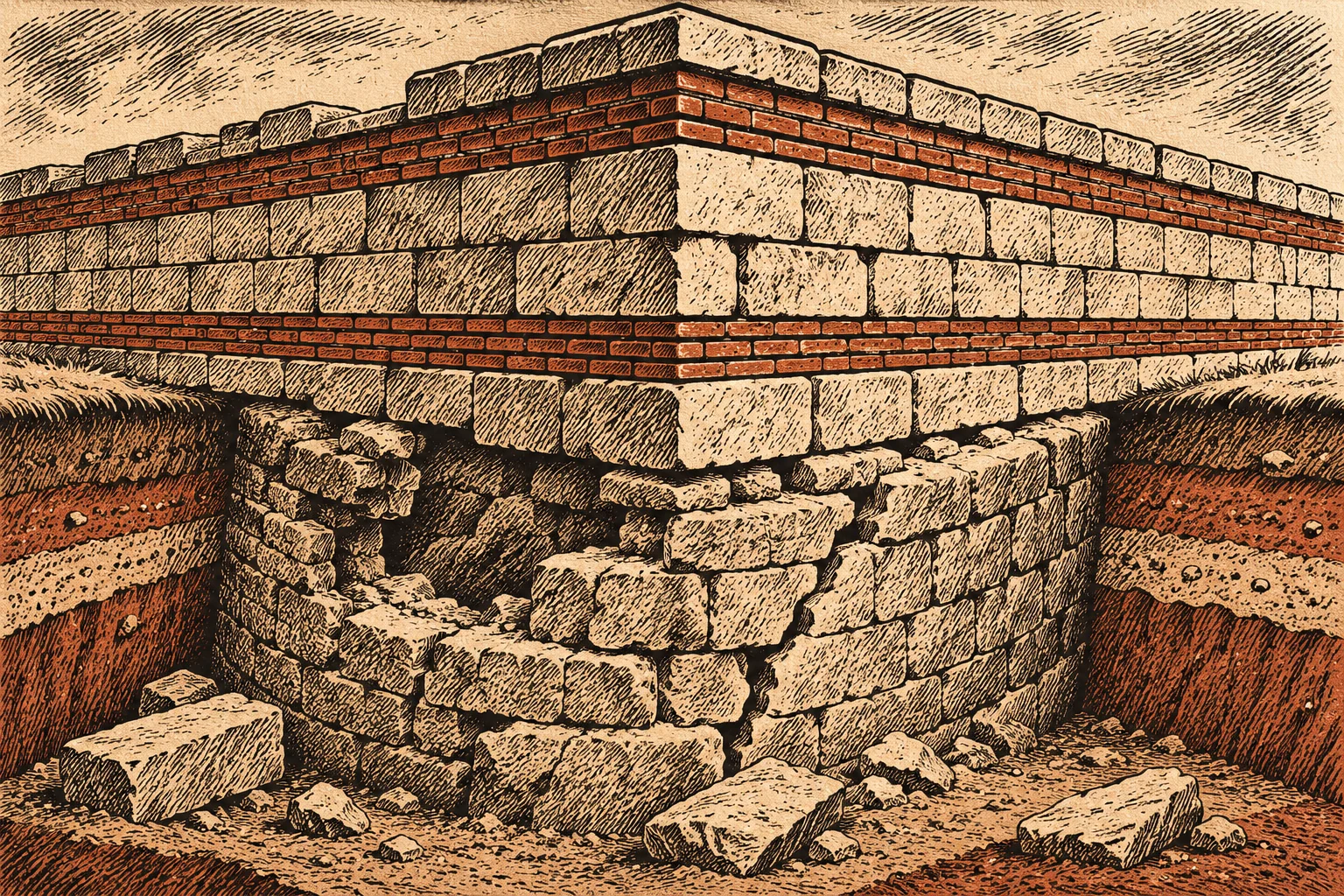
The dating rests on pottery. Several ceramic types from the associated deposits were once filed broadly as Early Roman, but they are now known to have stayed in production after AD 70 and until roughly AD 130. Gibson attributes the remains to the Tenth Legion in the window between 70 and 130 CE, which fits the camp’s first construction.
Then there is a road. The excavators found a sloping street preserved for about 37.7 meters, its edge built partly from large stone blocks and from reused column drums. Gibson suggests it led up to a gate in the camp’s western side. Columns that had once stood upright in some other building ended their working lives as a curb for the occupier’s traffic. Conquerors in every age have built this way, out of whatever the conquered left lying around.
Two hundred and eighty-five meters
Gibson connects his corner to a Herodian tower that still stands inside the Citadel, which he takes to be the camp’s northwestern corner. The two points are about 285 meters apart, and he argues that this was the length of the western defensive wall. If the camp was roughly square, 285 by 285 meters, it covered about 8.12 hectares, or 20 acres. He calls the figure provisional, because the eastern and southern boundaries have not been established.
The paper compares it with the legionary base at Legio-Caparcotani near Megiddo, home at different times to the II Traiana and VI Ferrata legions. That base measured 325 by 485 meters internally, about 16 hectares. On those figures the Jerusalem camp was “roughly just half the size,” though still much larger than the typical auxiliary forts of 2 to 4 hectares, such as Tel Shalem.
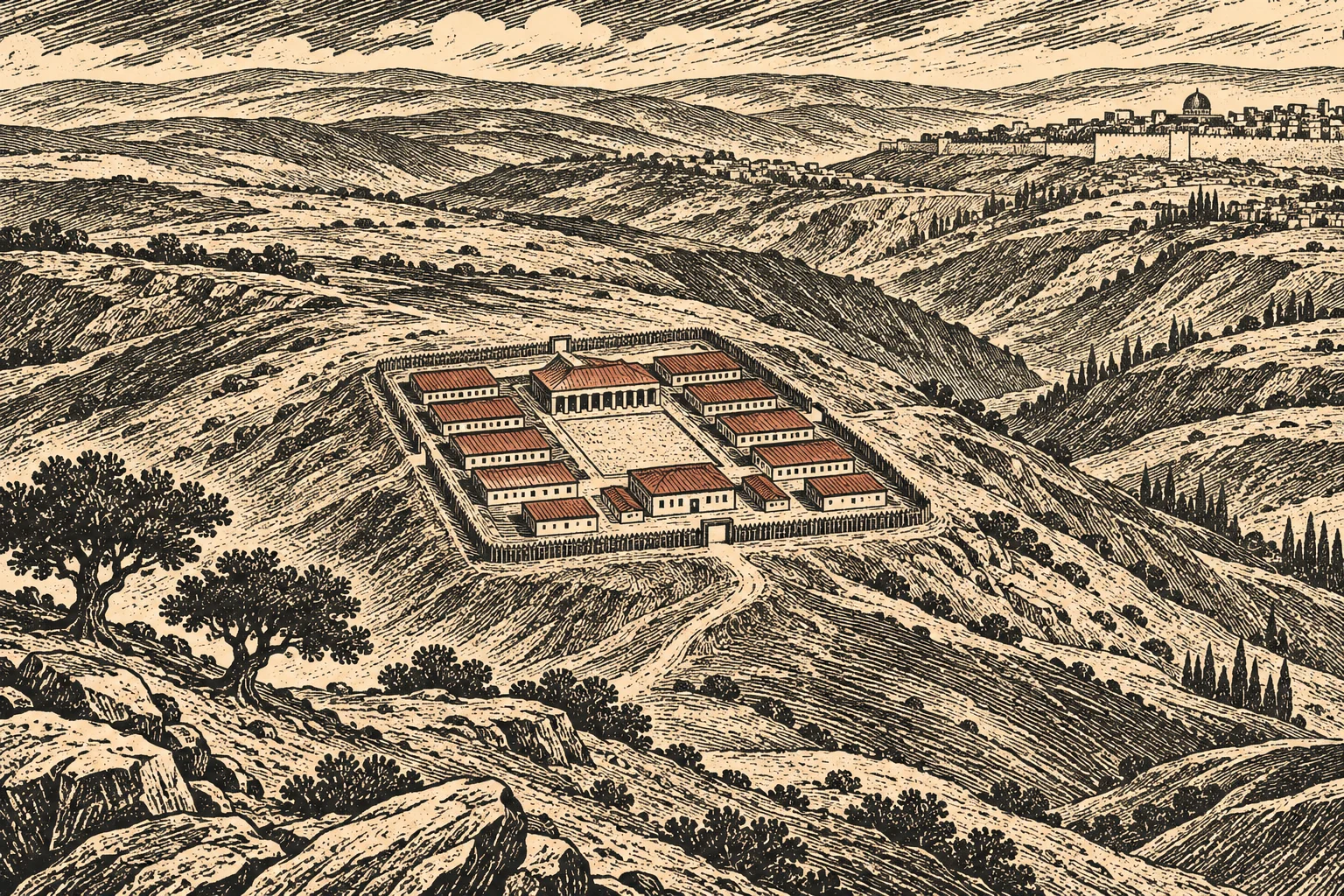
A smaller camp means a smaller garrison. Gibson estimates the Jerusalem compound could have held about 1,800 to 2,200 soldiers and attached specialists, well short of a full legion. In his reading it was a regional military and administrative headquarters, the hub of a network, with other detachments of the Tenth posted across Judaea.
In the house of Herod
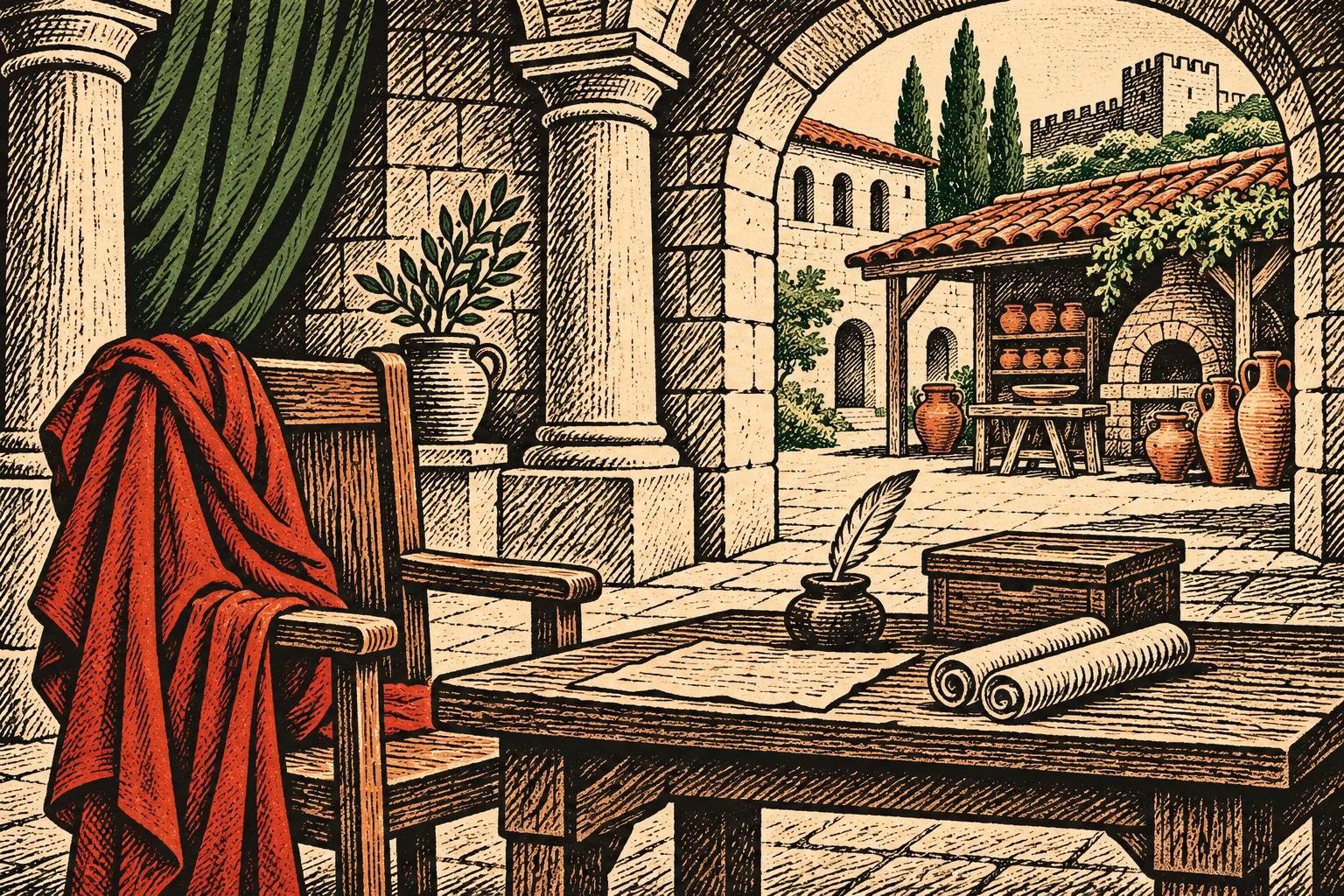
Gibson suggests that parts of Herod the Great’s palace complex, which sat on a commanding position on the Western Hill and had already served Roman administration, may have been absorbed into the headquarters. Its surviving buildings and courtyards would have spared the army a good deal of construction. One reflection, offered as reflection only: those who rule by force seldom build their offices from scratch. They move into the palace of the king they have replaced and hang their own standards in his rooms.
Outside the walls, the evidence points to a civilian settlement, especially around Mount Zion, where people supplied and served the garrison. Romans called such places canabae: workshops, shops and houses that grew up wherever soldiers were paid. Gibson is careful to say that his plan of the camp’s interior, with its streets, barracks, headquarters buildings and water supply, is a reconstruction, and that only further excavation will place them. Jerusalem keeps its empires stacked in layers, as the Hasmonean aqueduct under Ramat Rachel shows, and the layers do not give up their order easily.
Why so little was left
How does a legion live in a city for two centuries and leave so few walls behind? According to the paper, the camp was in use until the legion moved to Aila, modern Aqaba, in the last third of the third century, under Diocletian. Gibson asks whether the soldiers took the place apart before they left. Excavations have turned up roof tiles and water pipes bearing military stamps, and dumps of discarded building material that point to demolition or clearance. Some of those deposits may belong to the departure. Later Byzantine builders, who removed and reused Roman material in large quantities, may account for the rest.
The paper is three days old, and the coverage, in Archaeology Magazine and in Discover, has largely followed its argument. The Spanish site La Brújula Verde chose its verb more carefully: Gibson “claims” to have solved it. The debate goes back to the nineteenth century, and other specialists have barely had time to reply.
Gibson also brings in a witness. The Bordeaux Pilgrim came to Jerusalem in AD 333, some decades after the legion had marched south, and wrote of walls and routes around Mount Zion. Gibson reads those lines as a possible record of what remained of the enclosure. By then the garrison had gone and Herod’s rooms stood empty. A traveller passing through noted the walls left standing where Rome’s soldiers had once lived.