
Take a map of Massachusetts and find the spot, ten miles north of Boston, where Wakefield ends and Stoneham begins. The line between them crosses streets of similar houses, sold at similar prices, to similar families. Census figures show Wakefield slightly wealthier, its homes worth a bit more, but neither town has seen the kind of population shift that historians of schools look for when numbers move. In both districts the classrooms are the same size, the students mostly white, and in each about 20 percent of children are low-income and about 20 percent have a disability. A bureaucrat in a ministry of education, shown only the statistics, would conclude he was looking at one town drawn twice.
And yet the test scores have separated like two rivers that share a source. As the Boston Globe reports, Wakefield’s math scores in Grades 3 through 8 now stand three percentage points above their 2019 level, while Stoneham’s have fallen thirteen points below it — among the steepest declines in the state. The pandemic’s damage to learning is a global story, and this corner of New England has produced its own parable: the same flood, two boats, different carpenters.
The dean and the turnover file
Wakefield has had one superintendent since 2018, Doug Lyons, who waves away any heroic reading of his town. “There’s no secret potion,” he said. “There’s no magic.” What there is, by his team’s account, is deliberate, dull consistency: a fast return to in-person schooling after the lockdowns, teachers who stay, and an early overhaul of what and how every classroom teaches.

Stoneham’s file at the state house must be thicker, and messier. The district has burned through four superintendents in a decade. The last but one, David Ljungberg, faced public criticism for failing to alert parents quickly after a convicted sex offender was chased by police off an elementary school’s grounds and arrested. Voters rejected several budget overrides; salaries sagged below neighboring districts’; teachers left. When Kristin DeFrancisco took the helm last year, she had more than 30 teaching positions to fill. “When you looked at what we were paying our educators compared to the surrounding spaces,” she said, “there was no wonder why folks were going to other spaces.” Contract talks dragged on for more than a year and a half before an agreement finally came this past spring. A year of lost teachers is a tax collected quietly, in children’s arithmetic.
Wednesday was for cleaning
In the autumn of 2020, when the virus was the only curriculum anyone discussed, the two towns chose differently. Some Stoneham students returned briefly that September, then went back to mostly remote learning until late spring of 2021. Wakefield’s teachers and administrators sat down together and built a schedule that kept children in school every weekday except Wednesday — a day given over to deep cleaning while students logged in from home.
“My kindergartner was in the basement on an iPad for hours. We had access to our kids in person nearly every single day. That was a huge benefit.”
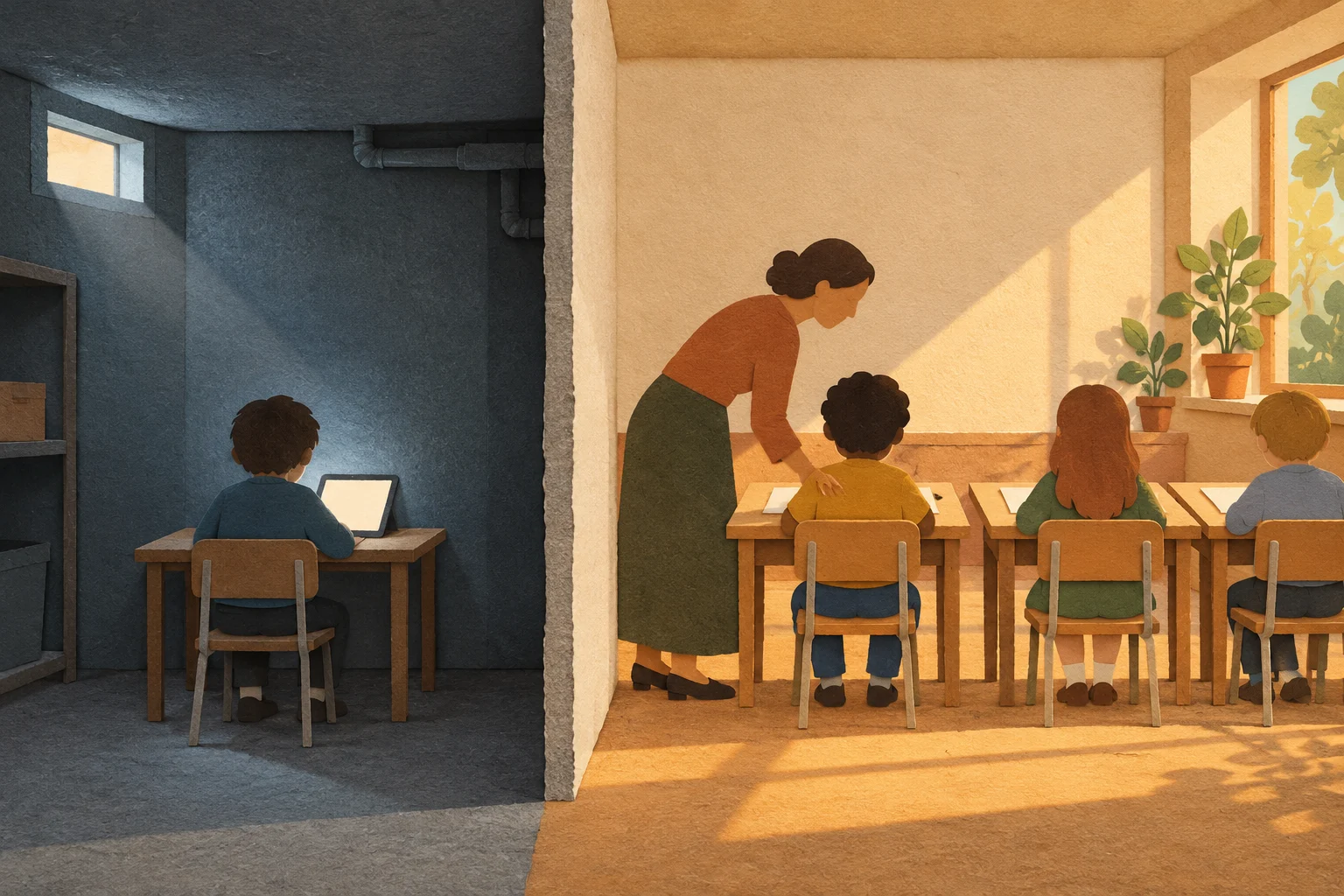
That is Jay Wallace, a third grade teacher at Wakefield’s Greenwood Elementary, comparing his own child’s experience in another district with the one he taught in. Richard Manzi, who has taught seventh grade English at Galvin Middle School for 28 years, put the principle more bluntly: “Never were the students sent to go off and learn on their own.” His colleague Christopher Gorski, a science teacher at Galvin, offered the district’s quiet boast: “Teachers here stay and they stay a long time.” State data backs the boast — Wakefield’s teacher retention is among the highest in the region.
One curriculum, one struggle
The third difference was decided before the virus arrived. As the pandemic struck, Wakefield officials were already hours into Zoom meetings reviewing how the town taught its core subjects, with teachers helping choose what would replace the old patchwork — every school, every teacher, stitching lessons together from different sources. The new order is uniformity deliberately chosen: the same curriculum across grades and schools. In English, Wakefield adopted the phonics-based approach known as the Science of Reading before the state required it. In math, the emphasis shifted from memorization and solitary worksheets to collaboration and conceptual understanding.
The Globe was in Kristin Liberti’s fourth grade classroom at Walton Elementary as she taught fractions, the children’s hands rising, pressed to explain not the answer but the road to it. Liberti teaches only math, sees each of her classes twice a day, and prepares students for the state’s MCAS exams throughout the year rather than in a final week’s panic. Another teacher, Cardarelli, who uses cubes to build columns and rows, described the method as productive struggle: students must work through difficulty without the teacher’s hand on their shoulder. “It might not be easy for them at first,” he said, “but once they start getting used to the routines and knowing what’s expected, they really do come out on top.”

Money, inevitably, runs under all of it like water under a road. “We’ve been lucky to have the support of the town and the school committee for our local budget,” said Assistant Superintendent Kara Mauro, adding that Wakefield “capitalized on every grant that the state has been putting out for the last six years.” It is worth remembering, as earlier reckoning with Massachusetts’ school funding showed, that the state’s big equity bet of 2019 has not moved scores everywhere. Stoneham, meanwhile, only this year won from voters the override it had long failed to get.
DeFrancisco is not pleading hopelessness. The new contract, she said, has already improved recruitment and morale — “the morale has changed for sure. It’s noticeable.” Her plan is the same medicine her neighbor took, administered late: keep leaders, keep teachers, rebuild the teaching itself. Stoneham started with literacy and is now reviewing its math curriculum.
There is an old consolation governments offer, that geography is destiny — that a town’s children learn roughly what their neighbors’ children learn, wealth to wealth, street to street. The border between Wakefield and Stoneham now disproves it, nine MCAS seasons running. The children on either side of the line are the same. What differed was the patience of adults: who stayed, who was paid, who returned to the classroom first, and who, in the long Zoom autumn of 2020, was already deciding what to teach when everyone came back.