
For years, the science of how a brain decides has belonged to monkeys staring at dots. In the laboratory’s favourite ritual — the random-dot-motion task — a cloud of flickering specks drifts, almost imperceptibly, in one direction, and the subject must say which way. From this humble theatre we learned that neurons in the primate neocortex gather evidence grain by grain, their firing rates climbing until, at some invisible threshold, the animal commits. The monkey sees, weighs, decides. But birds have no neocortex. And so the question hung there: how does a mind built on entirely different plans reach the same judgment?
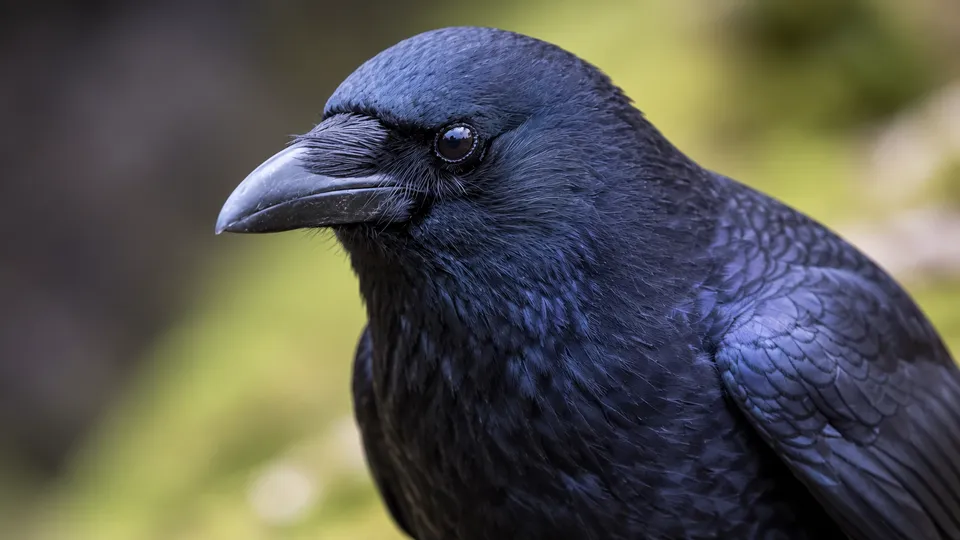
It was, as Jacek Krywko reported for Ars Technica, precisely what Andreas Nieder wanted to know. “This was the big question,” said the University of Tübingen neurobiologist. “How [would] a differently organized avian brain encode decisions?” So Nieder and his colleague Philipp Schmidbauer offered the test to two hand-raised carrion crows — and the birds solved it the way primates do, by the same mathematical logic, on machinery with no shared blueprint. They simply did it twice as fast.
The examination hall
The chamber was arranged with pedantic fairness. Before each crow, a touch-sensitive screen showed white dots on black, some fraction of them drifting coherently left, right, up or down; the bird reported the direction by pecking a target flanking the display, and a correct answer bought a mealworm. “We intentionally wanted to have exactly the same random-dot motion task,” Nieder said. “The only difference was that the crows had to peck to indicate their decision, whereas monkeys were indicating by making an eye movement.”
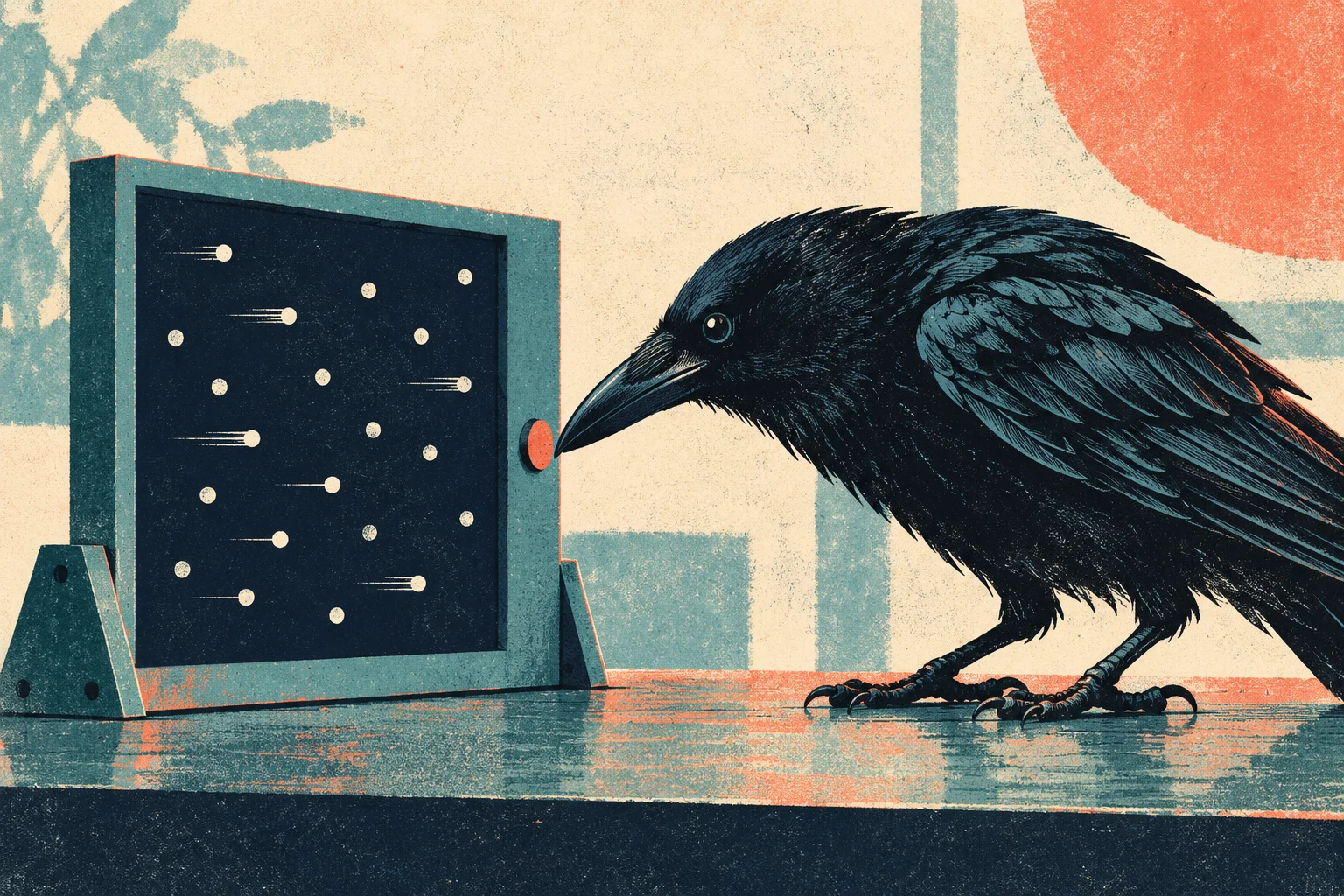
The difficulty stretched from 81 percent of the dots moving in concert — easy even for a distracted laboratory assistant — down to 3 percent, a whisper of motion barely distinguishable from noise, and at the very bottom, a zero percent condition with no correct answer at all. Both birds beat chance even at 3 percent. As they worked, the researchers listened in on 248 neurons in the NCL, the nidopallium caudolaterale, the structure at the top of the avian processing hierarchy widely taken as the functional counterpart of the primate prefrontal cortex, though built to no common plan.
A different architecture
Birds and mammals parted company more than 360 million years ago, and each line built its thinking organ in its own fashion. The mammalian cortex stacks its cells in sheets; the corresponding tissue of the bird is gathered into dense clusters with no layering whatever. One might expect the copy to be the poorer machine. The copy turned out to be faster.
Measured from the appearance of the dots to the first turn of the bird’s head toward the button, the crows averaged 235 milliseconds. In closely matched versions of the same task, monkeys in three separate studies took roughly 410, 490 and 600 milliseconds. The suspicion arrives naturally: perhaps the swiftness was bought with sloppiness. It was not. “This would be a simple explanation, that they are very fast at the cost of precision. But that’s not what’s happening,” Nieder said. The crows matched monkeys and humans for accuracy. “We’ve never forced the crows to be as quick as possible. We just gave them a self-paced decision. And even in this situation, they were twice as fast compared to any monkey or human that I’m aware of.”
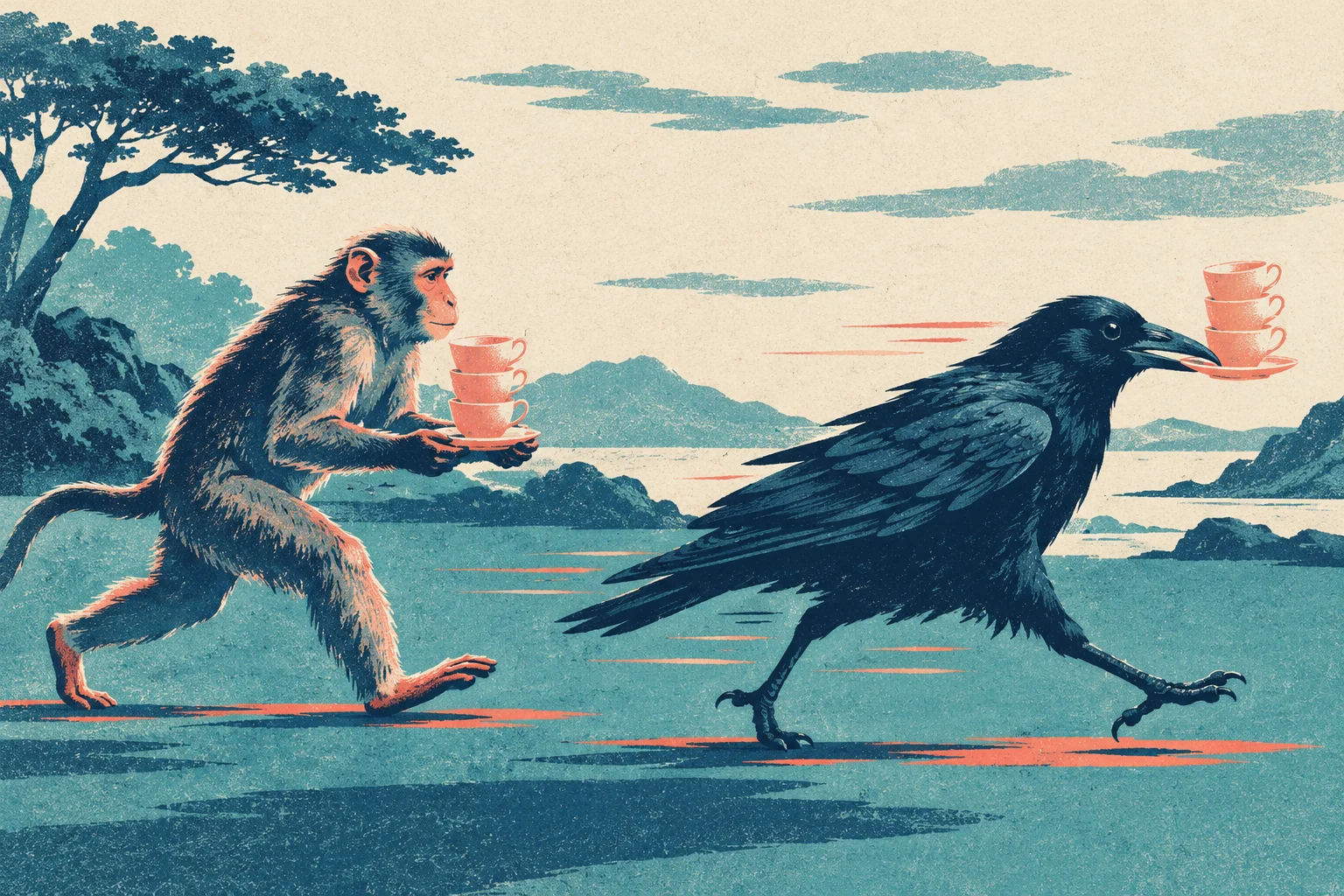
Nor is the bird brain, he argues, merely a clock spitting out answers on a fixed deadline. True, the crows’ reaction times ran only from 220 milliseconds on the easiest trials to 254 on the hardest — but zoom in, Nieder said, and the lengthening with difficulty is there, the same signature primates show, only compressed. “They show the same effect as mammals. It’s just much less pronounced, because everything happens much faster.” And there were no cues but the dots themselves: “That’s why I think they do accumulate evidence. They have to.”
The signature of decision
The recordings bear him out. Of 248 neurons sampled, 58 fired differently depending on the direction the bird would eventually choose — and they began registering the choice about 70 milliseconds after the dots appeared, some 170 milliseconds before the head ever moved. In the trade this is called a decision variable: a running tally of evidence climbing toward commitment. “It turns out that what we find in the crow brain looks basically the same,” Nieder said. “And that’s interesting considering their brains have evolved very distinctly, as if evolution has found the same physiological mechanism twice, independently.”
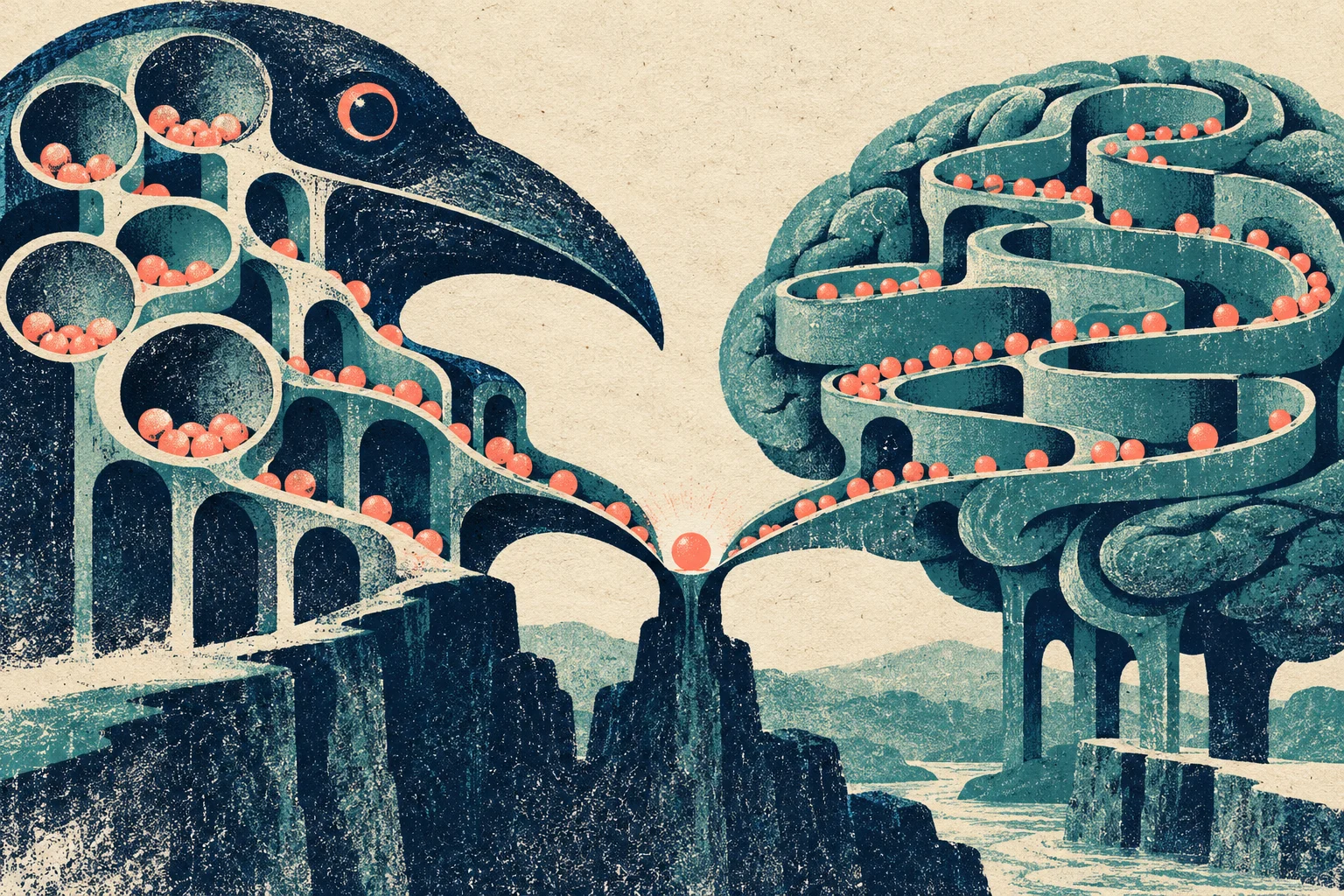
What makes the bird so quick? No single process, Nieder thinks, but a cascade — vision exquisitely tuned to motion, a swift decision, a swift muscular answer. Two facts of avian life stand behind it. The first is size: flight imposes a tyranny of weight, so birds pack immense numbers of very small neurons into very small heads, and their axons — the long cables between cells — are short. “Long lines take time. Short lines speed everything up,” Nieder said. The second is heat. The human body holds to about 36.6° Celsius; birds run at 41, even 42. Warmth quickens every chemistry. “Every ion channel would open and close faster. Every transmitter would move through the synaptic cleft faster,” he explained. “Evolution really took their bodies to the limit. This is life in the fast lane, not only in the brain, but also respiration, the cardiovascular system.”
The honest caveats
Two birds is, of course, a small parliament. Nieder concedes it “a valid constraint,” while noting that monkey studies of this complexity, marrying behaviour to electrophysiology, typically rest on the same modest number of subjects. The milliseconds, too, belong to this particular task, which by its nature asks the brain to wait and watch. And there remains a last, delightful uncertainty: perhaps speed is not a property of birds at all but of crows alone. “The problem with many other birds is that they are not as smart as corvids and crows,” Nieder said, “and you need a smart bird in order to train it to do exactly this task.” Among birds, as he admits, the corvids are renowned for intelligence “so maybe there’s something special about them.” The study appears in Science, DOI: 10.1126/science.aed6459.