
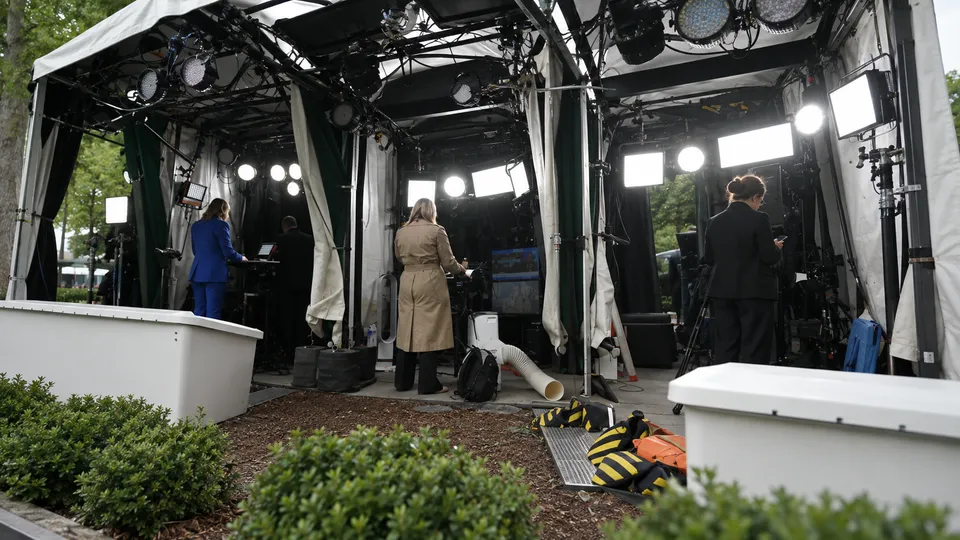
In the space of eight hours this week, two courts told Donald Trump that the First Amendment still applies to his government. In Iowa, a district judge threw out the president’s lawsuit against a pollster whose numbers had displeased him. In Washington, a federal judge ordered the White House to restore CNN, MS NOW and Politico to the press area “immediately,” after Trump announced their ban last Friday. The administration appeared to defy that order for several hours before the reporters went back to work.
The two defeats sit in a long column of them. Reuters counted last month a total of 75 federal rulings since Trump’s second inauguration in which judges found his administration had “infringed on First Amendment rights including freedoms of speech, religion, and the press.” Judges have scolded the government for punishing critics of ICE, for silencing the Voice of America network, and for serving secret subpoenas on news organisations. A judge in Oregon went so far as to block a rule against noisy protests outside federal buildings, holding in effect that loud speech is still free speech. The administration has fought some of these rulings, though not all.
In Des Moines, district judge Scott Beattie dismissed Trump’s suit against the pollster J. Ann Selzer, her polling company, the Des Moines Register and its parent, USA Today Co. His finding was blunt: the “Iowa Poll and its reporting are fully protected political speech.” It was a highly unusual case — a president suing a pollster over published numbers — and Trump’s legal team has already vowed to appeal.
Hours later in Washington, judge Timothy Kelly struck down the press ban. His emergency order, though, runs for only two weeks while the broader legal battle plays out, and media lawyers expect the White House to keep targeting outlets it dislikes. The administration has already shown what it thinks of the spirit of such rulings: it has kept CNN off Air Force One and put a friendlier network in the seat.
Adam Steinbaugh of the Foundation for Individual Rights and Expression marked the timing on X: “Between the press ban and Selzer/Des Moines Register, the leader of the free world lost in two separate legal cases over his efforts to suppress ‘fake news.’ In the span of eight hours.”
Trump took office in 2025 promising to “stop all government censorship” and to “bring back free speech to America.” Free-speech advocates say he has done the opposite, and they can produce a list. His administration has sought to detain and deport foreign-born students and activists over their pro-Palestinian advocacy; judges have ordered some released, while other cases grind on. He has sued The Wall Street Journal, The New York Times and the BBC for defamation; courts have treated the claims with scepticism, though they have let him refile them and try again.
The strangest front is in Minnesota, where the Justice Department charged two journalists, Don Lemon and Georgia Fort, with interfering with the First Amendment rights of worshippers — that is, for covering a demonstration inside a church in St. Paul. A federal magistrate judge rejected the government’s first attempt to bring the charges, raising the question of how prosecutors then secured grand jury indictments. Last month judge Laura Provinzino took the unusual step of demanding the grand jury materials, which suggests she is weighing grounds for dismissal; she has not said she found any misconduct. Both journalists call the case a vindictive prosecution. “The government should not be permitted to use criminal prosecutions to chill journalism disfavored by the president,” Lemon’s lawyers wrote in a motion to dismiss.
Over the summer the Justice Department subpoenaed several New York Times reporters in a leak investigation. The Times fought the subpoenas; a judge criticised the government’s sloppy legal work; the subpoenas were withdrawn. Still pending are Disney and ABC’s lawsuit accusing the FCC of violating the First Amendment, and the Times’ challenge to the Pentagon’s press access restrictions.
Those around the president expect the pressure to continue. An executive at one of CNN’s network rivals, quoted by CNN shortly after the ban was announced, reached for Jurassic Park: “Trump is always testing, testing,” like the velociraptors “testing the fences for the weaknesses, systematically. They remember.” The executive added: “He’s probing to see what he can get away with.”
This time the fences held partly because the outlets moved as one, in what law professor and commentator Harry Litman called “collective resistance.” “We thought it was important — and I was in touch with the other news organizations — to find a way to make a unified action against the White House,” Matt Murray, the executive editor of The Washington Post, said at the Texas Tribune Festival on Thursday. “It’s important media organizations act together at this moment.”
We always have to anticipate the prospect that a feckless and reflexively defiant White House will inject heart attacks into the legal system. But if the media hangs tough and the courts stay faithful to the law, we can continue to ride out the storm.
The count now stands at 75 rulings and rising. Kelly’s order lapses in two weeks, and the Iowa appeal is already promised.