
In November 2025, Narendra Modi returned to an old inheritance. British rule had lasted two centuries, he said in a lecture, and although India had become independent in 1947, the work of emancipation remained unfinished. The country still needed to “decolonise the mind”. He set out a decade-long plan to pursue that goal.
Almost exactly a year later, on Wednesday, the Indian prime minister was due to host Prince William and Catherine, the Princess of Wales, in New Delhi. Their three-day visit had begun in Mumbai, where they played street cricket with Sachin Tendulkar before travelling on to the capital. As Usaid Siddiqui reported for Al Jazeera, the royal visit places a growing India–United Kingdom partnership alongside the prime minister’s denunciation of the mental afterlife of colonial rule.
The itinerary and the lecture
The contrast does not require either position to be insincere. Modi’s remarks were directed at the endurance of colonial habits long after the departure of colonial administrators. The reception of a British prince addresses a separate question: how two sovereign governments conduct their relations now. A state can dispute the authority of the past and still negotiate with the institutions descended from it.
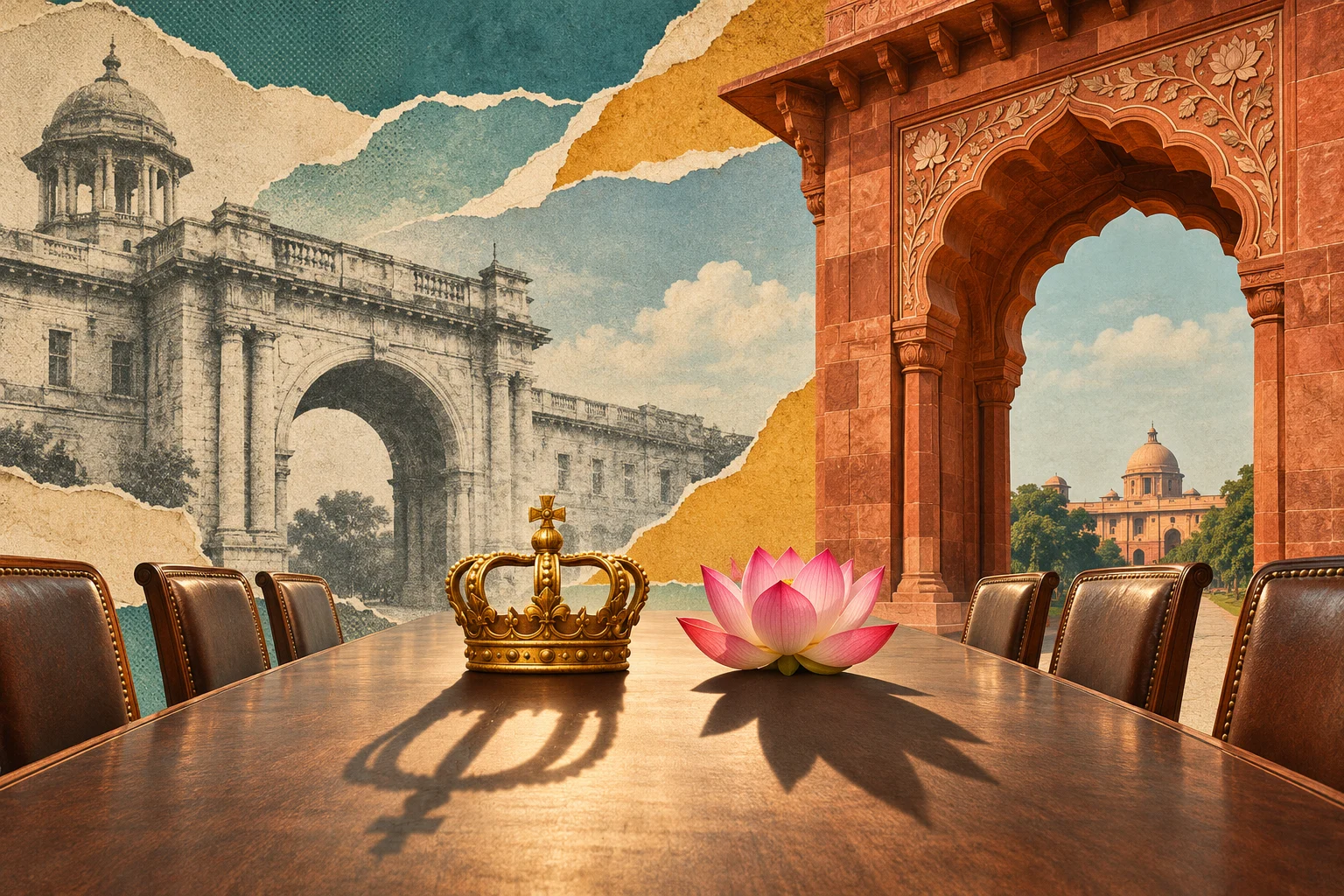
Yet a royal itinerary carries meanings that an ordinary ministerial visit would not. William and Catherine represent a monarchy under whose name India was governed during part of the period Modi described. Their presence in New Delhi therefore gives the language of partnership a visible historical counterweight. It is the living form of the relationship against which the rhetoric of decolonisation must be read.
The Mumbai cricket match supplies the journey’s lighter public image, but it also keeps the encounter on distinctly Indian ground. The guest from the former imperial power joins a game in which India possesses its own heroes and authority, personified here by Tendulkar. The future king appears beside an Indian sporting legend rather than at the centre of an imperial ceremony.
What independence did not settle
Modi’s phrase locates colonialism beyond flags, treaties and dates. Independence in 1947 ended British rule as a formal political arrangement; his lecture argued that it did not automatically end every way of thinking acquired under that rule. The decade-long plan makes decolonisation an ongoing national task rather than a completed anniversary.
A developing partnership with Britain can proceed beside that argument because pragmatism and historical reckoning operate on different clocks. One concerns current relations between states; the other concerns how a nation interprets itself. Their coexistence during this visit is the story’s central fact, and also its limit: the report supplies no meeting communique, trade announcement or account of what Modi and the royal couple discussed.
For the moment, the evidence is the sequence itself. First the lecture about freeing the Indian mind from the residue of empire. Then Mumbai, cricket and New Delhi’s welcome for the Prince and Princess of Wales. Between them lies the practical territory of postcolonial diplomacy, where memory remains forceful but rarely has the only seat at the table.