
Imagine you are an opposition movement in a country where the president has gathered most of the power into his own office. You have a basic problem. There are a lot of you and you disagree about almost everything. The one thing you agree on, that the president should have less power, doesn’t tell you who gets to lead the effort to take it from him. Every party would like to lead and none of them wants to follow anyone else. So either nobody marches, or everyone marches separately, in small groups the police can handle without much trouble.
On Saturday in Tunis, that problem got solved, at least for an afternoon. Thousands of people marched through the capital against President Kais Saied in what Al Jazeera, drawing on AFP and Reuters, described as the biggest protest against him in years. The Tunisian General Labour Union (UGTT), an influential federation of trade unions, led the march, with opposition parties and civil society groups behind it. AFP put the crowd at more than 3,000. Nobody could independently confirm that figure.
“Biggest in years” is a relative measure, and 3,000 people is not an enormous crowd for a capital city. Who showed up matters more than how many. There were lawyers, doctors, journalists, unemployed people, activists and members of parties from across the political spectrum. Their long-running divisions had, Reuters noted, weakened the opposition’s ability to draw large crowds. They gathered on Habib Bourguiba Avenue in central Tunis, which was a focal point of the 2011 protests. Hundreds of police were deployed across the capital and several surrounding roads were closed. The reports mention no arrests or clashes.
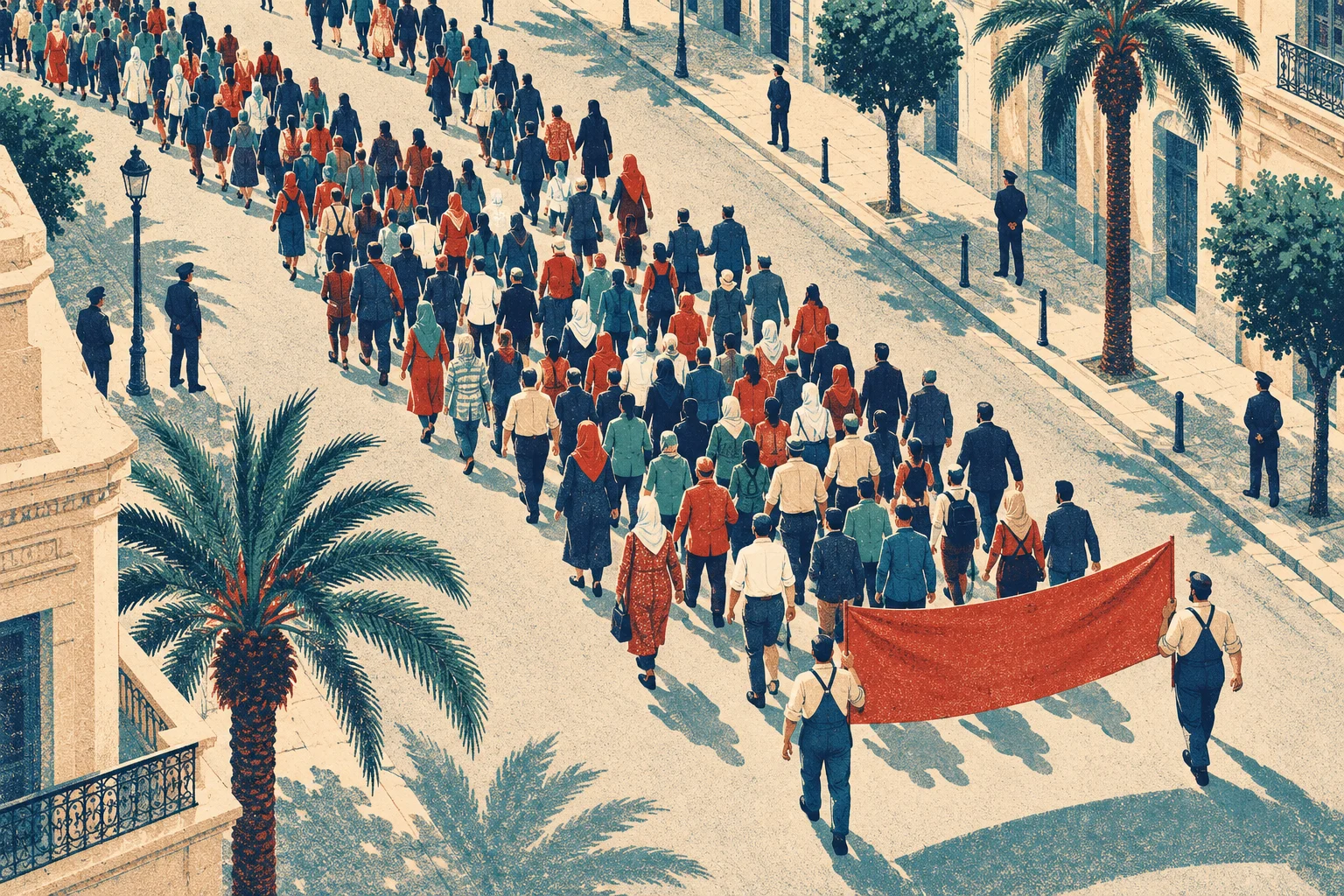
The demands were the release of detained government critics and an end to what protesters called attacks on trade union rights. Placards read “No democracy without freedoms” and “No dignity with poverty.” According to Reuters’ account as carried by The New Arab, the crowd chanted “No fear, power belongs to the people!” and “The prisons are full, people are hungry!” It also revived the best-known slogan of the 2011 uprising: “The people want the fall of the regime!”
Why the union
It makes sense that a labour federation solved the coordination problem the parties couldn’t. A party’s interests are tied to its own prospects, so cooperating with rival parties costs it something. A union’s business is representing workers, and it can do that whatever the ideology of whoever governs, as long as it keeps the right to organise. That is also why the UGTT has an unusually direct stake here. One of Saturday’s demands was about its own operating licence. When the government restricts union rights, it is going after the union’s core product. That gives the UGTT a reason to turn out its people that doesn’t depend on any party winning anything.
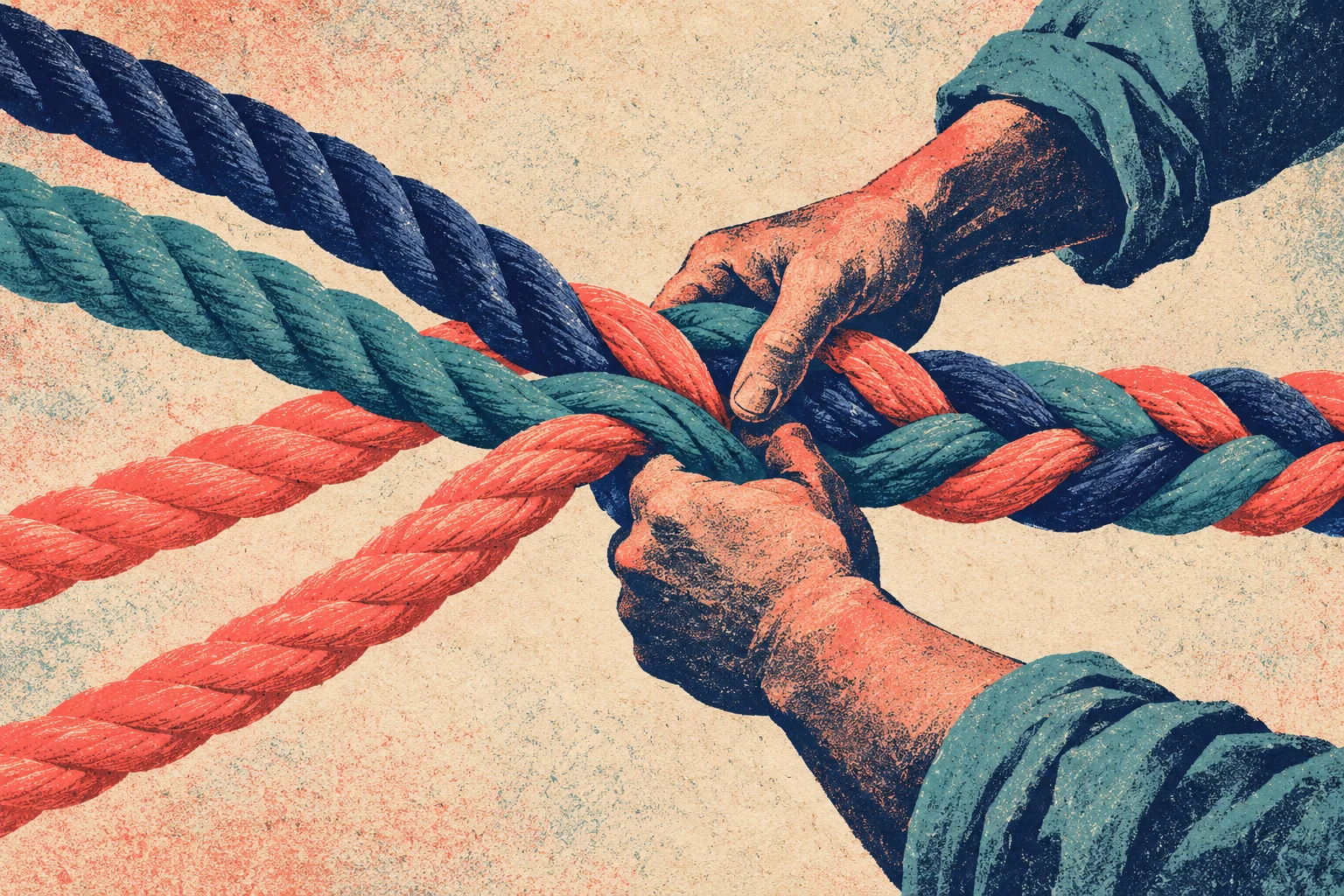
The federation has also been flexing a bit lately. Last month a UGTT-affiliated federation led a two-day strike by fuel transport workers over pay and conditions. On Saturday the UGTT’s secretary-general, Salah Eddine Salmi, criticised how much power has piled up in the presidency. “Silence will no longer be acceptable,” he said, adding that a state cannot be built by putting all powers in one person’s hands.
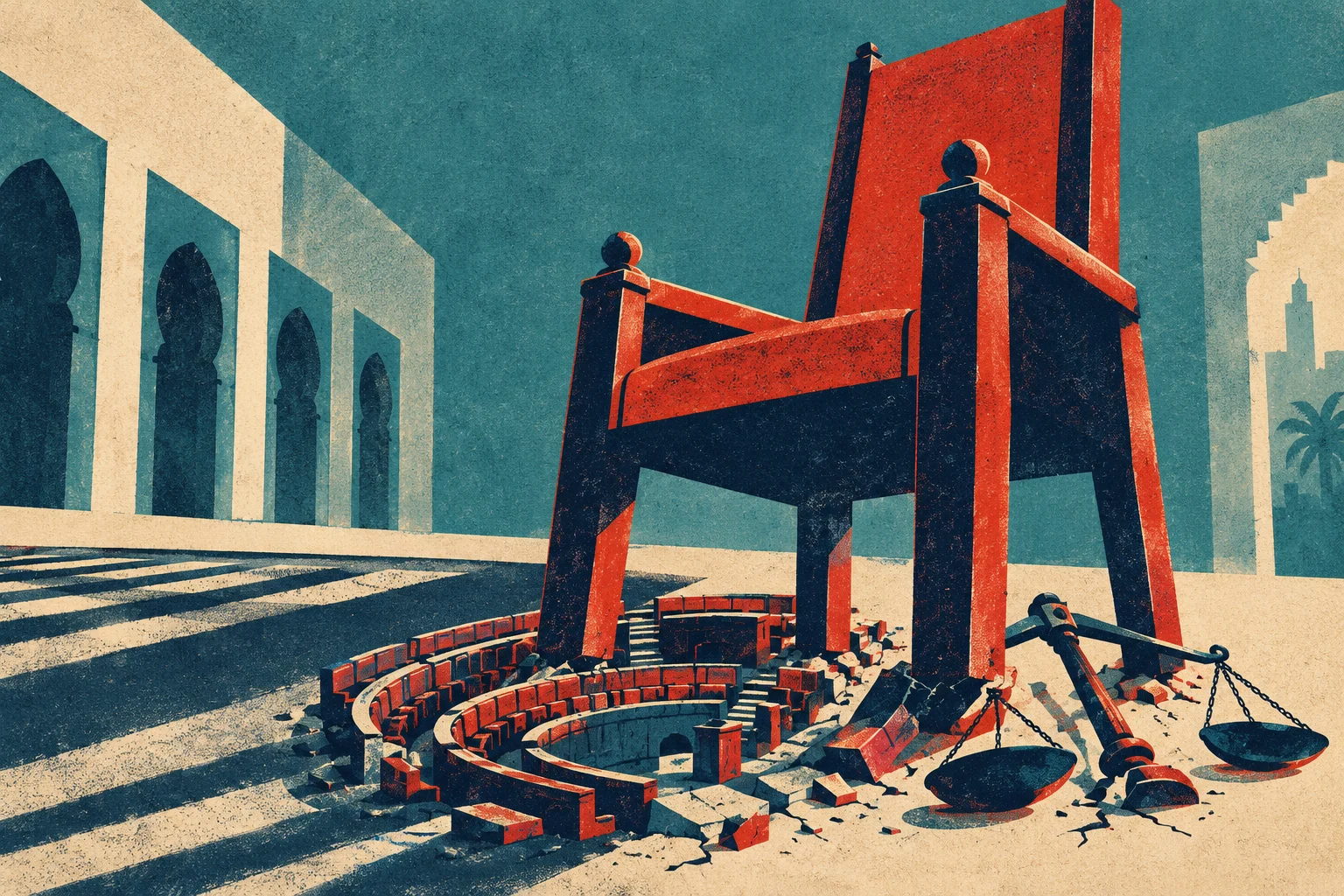
That pile-up is recent. The 2011 uprising toppled the longtime president, Zine El Abidine Ben Ali, and helped set off protests across the Arab world. Competitive elections and wider freedoms followed, but unemployment and poor public services stayed sources of anger. Saied offered himself as the alternative to that system. In 2021 he suspended parliament and dismissed the government, citing corruption and political deadlock. He later dissolved parliament, dismissed dozens of judges and ruled by decree, and a 2022 constitution expanded presidential powers. His opponents called it a coup. Rights groups say he has since stepped up a crackdown on civil society, journalists and opposition figures.
The economy part
The political complaints would be easier for the government to wave away if the economy were working. It isn’t. Tunisia is going through a long stretch of hardship: public services are getting worse, water and power cuts keep coming back, and medicines and other essentials are in short supply. People are increasingly angry about the cost of basic goods and how little their money buys. On 20 August, protesters in Tunis rallied against rising prices and shortages. Saturday’s march took those complaints and tied them to the political ones. That is what “No dignity with poverty” means, and it is a harder message to dismiss than either complaint alone.
Yassine Gharseli had come from Sfax, about 250 km south of Tunis. “I came from Sfax to stand up for my freedom,” he told Reuters, adding that repeated disruptions to services had deepened his frustration. In other words, it is the outages and the shortages that turn freedom from an abstraction into a reason to make the trip.
The reports carried no government response to Saturday’s march. Saied’s general position is on record, though. He rejects the allegations of a crackdown, says he is not a dictator, and has accused his opponents of engineering economic crises to stir up social unrest.
I think that last claim deserves to be taken seriously on its own terms, because it asks for a lot. On the president’s account, the opposition is capable of causing nationwide water cuts, power cuts and medicine shortages. It also, as Saturday showed, needed years to work out how to walk down the same street together.