
One way to give up $4bn a year is to go on Fox and Friends on the morning of the midterm elections and say you agreed months ago to stop paying it. That is what Donald Trump did on Tuesday. “Now, as far as paying Israel, Bibi Netanyahu and I have made a deal that we give Israel $4bn a year, and we made a deal months ago that we’re stopping,” the president told the show, as Al Jazeera reported. “We’ve already agreed that by the end of this year we won’t be paying Israel. Now we’ll help Israel if they need it.”
He also said, according to CBC, “We were giving them 4 billion, we are, but it gets cut off at the end of the year,” and that Israel could still buy whatever weapons it wants. The State Department did not immediately respond to a request for comment. Neither Netanyahu’s office nor Israel’s foreign minister confirmed the deal. Nobody said exactly which aid Trump meant.
So it helps to know where the money comes from. The main pipe is a memorandum of understanding signed on September 14, 2016 under Barack Obama, worth $38bn over fiscal years 2019 through 2028. The State Department describes it as $3.3bn a year in Foreign Military Financing plus $500m for cooperative missile defence. $3.3bn plus $0.5bn is $3.8bn, which Trump rounded up to $4bn. Fine.
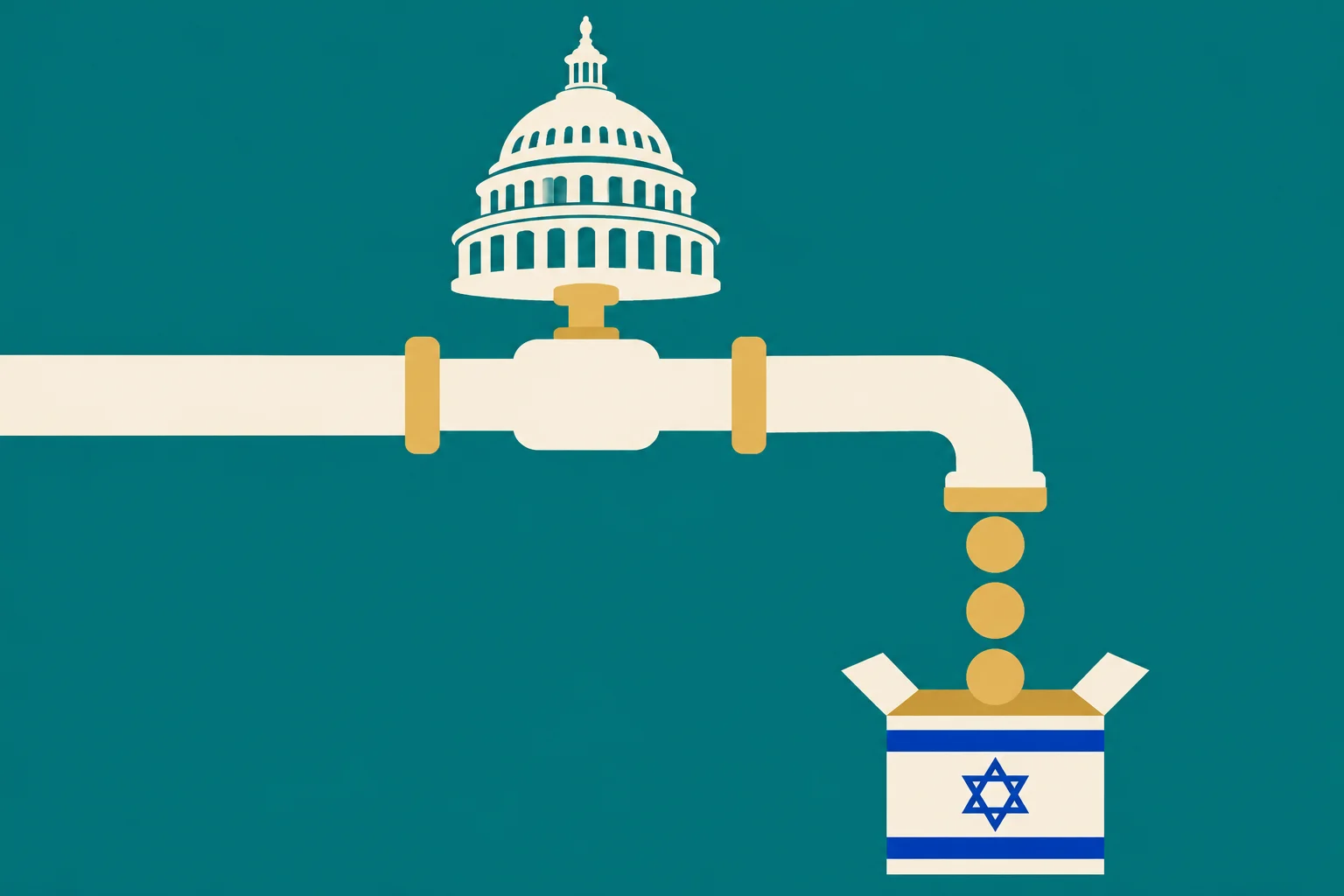
The key point is that an MOU is not a cheque. It is a promise by the executive branch to ask for the money, and the money only arrives when Congress appropriates it. The Congressional Research Service’s overview of US aid to Israel notes that the whole $38bn depends on annual appropriations, and that every administration since 2016 has asked for the $3.8bn. Al Jazeera’s White House correspondent Kimberly Halkett made the same point. “The money is appropriated by Congress, Trump can’t end this aid unilaterally,” she said. “What’s unclear is whether this is a last-minute attempt to get votes or whether or not this could be a tangible change.”
The calendar is a problem too. The US government’s fiscal year starts on October 1, so fiscal 2027 began about a month ago, and the MOU runs to the end of fiscal 2028. That leaves two years and roughly $7.6bn of promised money. Cutting it off at “the end of this year” means stopping a quarter of the way into a fiscal year, in the middle of a ten-year agreement. Presidents can do odd things with budgets. This would be odd even by those standards.
Then again, maybe the date was set by a different calendar.
The talking point
Trump explained his reasons, more or less. He named Abdul El-Sayed, the Michigan Senate candidate and a loud critic of US support for Israel: “Why should we suffer the slings from lunatics like an El-Sayed when they don’t need it? It’s a bad, it’s a bad talking point.” Put plainly, the aid had become a campaign liability, and the cheapest fix for a campaign liability is to announce it is gone.

The liability is real. A Quinnipiac poll in June found that 48% of voters and 66% of Democrats think the US is too supportive of Israel. When the question was asked in 2017, the figures were 16% and 20%. That is three times as many voters overall and a bit more than three times as many Democrats. In July the House voted 314 to 104 against an amendment from outgoing Kentucky Republican Thomas Massie that would have cut off aid to Israel, even though nearly half of Democrats backed it. That was a defeat, but a much closer one than this vote used to be.
The strangest part is Trump’s claim that the request came from the recipient. “Can I be honest with you, (Netanyahu) brought it up, he said ‘I think it would be appropriate if we do not receive aid’, because he understands this is one of their points of contention.” People don’t usually ask to stop being paid. But Netanyahu said in a May interview with CBS that he hoped to wean Israel off US aid. And if the money has become something your American allies get attacked over, offering to give it up, at least in principle, may be worth more to you than the money. Whether Netanyahu said it this way is something only he can confirm, and so far he hasn’t.
Meanwhile, in Israel
Netanyahu also has a more immediate problem. Israel’s October 27 election produced no clear winner, and Al Jazeera’s weekly Palestine roundup sets out the numbers. Arab-led parties won a record 19 seats. Nearly 840,000 people voted for Ra’am and the Joint List, 64% more than in 2022. Add those seats to opposition leader Gadi Eisenkot’s bloc and an anti-Netanyahu coalition has 67 seats, six more than the 61 needed to control the 120-seat Knesset. Take them away and that bloc has 48. Then the only options are a unity deal between the main Zionist blocs or another election.
So the only majority against Netanyahu that adds up depends on the votes of Palestinian citizens of Israel. According to Al Jazeera, the week after election night brought a wave of Israeli politicians’ rhetoric attacking the legitimacy of those votes. Meanwhile Palestinians in the occupied West Bank, who had no vote at all, dealt with closures, including the continuing Hebron lockdown, and with deadly raids, while killings continued in Gaza.
Former Republican congresswoman Marjorie Taylor Greene, now a Trump opponent, was unimpressed by the timing. “Amazing how being on the verge of Republicans getting wiped out in the midterms changes hearts and minds,” she wrote on X. “Trump getting permission from Netanyahu to end annual aid to Israel isn’t going to change today’s election results.”
She may be right about the results. But as ways to cut $4bn go, this one is very efficient: it costs nothing unless someone, somewhere, actually stops paying.