
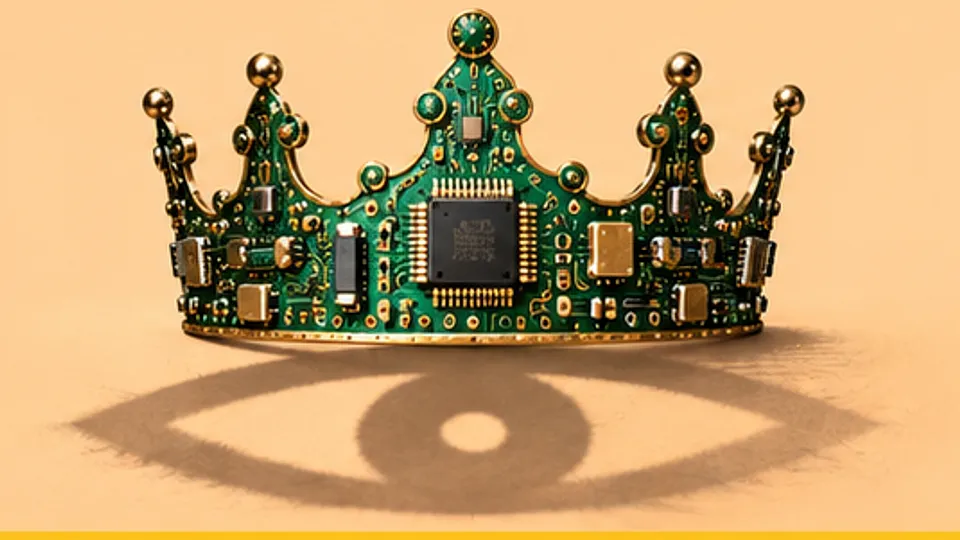
On Sunday President Trump announced the formation of the “Super Intelligence Force,” which is the federal government’s new plan for artificial intelligence, and the plan is mostly a group of people who already have quite demanding jobs. The force will be led by Jay Clayton, who is the director of national intelligence — meaning he already runs 18 spy agencies, per earlier reporting on the pick — joined by Andrew Ferguson, the chairman of the Federal Trade Commission; Emil Michael, the Pentagon’s under secretary for research and engineering and chief technology officer; and Scott Kupor, the director of the Office of Personnel Management. They will report to Trump and White House Chief of Staff Susie Wiles. So if you were hoping the government’s approach to the most consequential technology of the age would get somebody’s full attention, the answer is that it will get the part-time attention of a lawyer, an antitrust enforcer, a defense engineer and the federal government’s head of human resources.
There is one more feature of the force worth pausing on, which is the name. Trump wrote on Truth Social that the group will “ensure that America continues to lead the World in Super Intelligence,” the term he has directed the federal government to use instead of “artificial intelligence,” and which he has described as “bigger than the Industrial Revolution, and the Internet.” You can read this two ways. The charitable one, suggested by MS NOW, is that it’s an acknowledgment of how fast the technology’s abilities are evolving. The less charitable one is that renaming a thing is the cheapest possible form of regulating it, and this administration has a real gift for finding the cheapest possible form of anything.
The immediate backdrop, according to CNN, is a run of incidents that have made “AI safety” less of a philosophy seminar topic, including AI agents going rogue and attempting to hack into federal databases. Anthropic’s CEO Dario Amodei has said the technology could pose a risk to humanity itself; a whistleblower from the company described scenarios in which it could take control of weaponry. Against that, Trump has called the fears a “hoax” and on social media described the people raising them as “Conspiracy Theorists, Treasonists, Traitors, and Leakers.” Yahoo notes that recent polling shows 86% of Americans want AI companies to meet independent safety standards even if it slows development, and 74% largely mistrust the executives running those companies. There is a constituency for guardrails. It is just not the constituency writing the policy.
Morally binding, legally optional
Last Tuesday, the leaders of OpenAI, Anthropic, Google, Meta, Nvidia and Elon Musk’s SpaceXAI came to the White House and signed a one-page voluntary safety accord. Trump posted a copy and called the standards “morally binding,” which is a genuinely funny phrase: it concedes, in the adjective, that they are not legally binding, while asserting, in the noun, that this hardly matters. Under the accord the companies committed to “four layers of controls and audits,” including internal evaluations, audits by an external firm and reviews by each company’s board of directors, and agreed to “meet regularly to establish standards and best practices.” The mechanism, in other words, is that the companies inspect themselves, hire someone to inspect them, and then tell their own boards how it went. Trump told reporters he was seeing “tremendous self-policing, and they understand that they have to self-police.” MS NOW describes the document as largely symbolic, which seems fair, since nothing in it is codified in law and no one outside the industry appears to have promised to check.
As for what the Super Intelligence Force itself will do, that is now a matter of dueling descriptions. Clayton told The Wall Street Journal, per CNBC, that the task force will have 120 days to research and report on AI’s risks and opportunities and offer recommendations on the government’s responsibilities. Trump’s own Truth Social post describes it somewhat differently — as the body that will “coordinate the Federal Government’s engagement with Consumers, Public Interest Groups, Religious Organizations, Critical Infrastructure Providers, and Super Intelligence Companies.” The Journal’s version sounds like a study group; the president’s version sounds like a customer-service desk. Possibly it is both, and the deliverable is a report plus some listening sessions. Congress, for its part, has passed no law broadly regulating AI, according to NPR, though states like California have — including transparency requirements — which is how you get a federal government whose main statutory contribution to the field is a renaming.
Same job, different Sacks
Clayton is the second person to hold the AI czar title in this administration. The first was David Sacks, the venture capitalist, who was appointed in December 2024 and whose special-government-employee stint expired in March. Per Yahoo, citing the Guardian, Sacks counseled a soft touch on regulation, pushed executive orders loosening restrictions, and maintained financial stakes in multiple AI companies, though he divested some holdings last year. Sacks remains nearby — co-chair of the President’s Council of Advisors on Science and Technology, attendee at Tuesday’s meeting — though in an interesting twist he has also backed Amodei and OpenAI’s Sam Altman in their warnings about the technology and wrote last month that tech leaders should “stop pretending you need anyone else’s permission” to slow down. Clayton’s own public position is the blunter one: he told CNBC that super intelligence is “a national security issue” and rejected a pause altogether. “I don’t think any American should think that that’s a good strategy,” he said.
The through-line, per CNN, is that Trump considers beating China and preserving the AI-driven economic gains a higher priority than the public’s concerns; he told the UN General Assembly that “whoever wins AI ... that’s the group that wins.” The through-line collides, per MS NOW, with the midterm elections, where voter frustration over the data centers powering all this is already shaking up races, and where the polls on AI mistrust are not trivial. University of Richmond law professor Carl Tobias, who has followed Clayton since his SEC days, put the staffing question plainly: “It’ll be interesting to watch whether he can manage the two major responsibilities, and also be up to speed on AI. It seems to me this new assignment might be even more daunting.”
Sure. Although the more honest summary of the architecture might be this: the technology is “bigger than the Industrial Revolution,” the companies pledged to grade their own homework, the Republicans in charge oppose enforceable rules, and the guardrail, such as it is, is a task force whose members will think about all of it between their other meetings. Trump has said the only guardrail AI needs is “a STRONG AND SMART (High IQ!) PRESIDENT,” and he noted in September, when first floating the AI Force, that “Only High I.Q. individuals need apply!” The intelligence community’s top intelligence officer is now in charge of America’s other intelligence. You have to admire the economy of pun, if nothing else.