
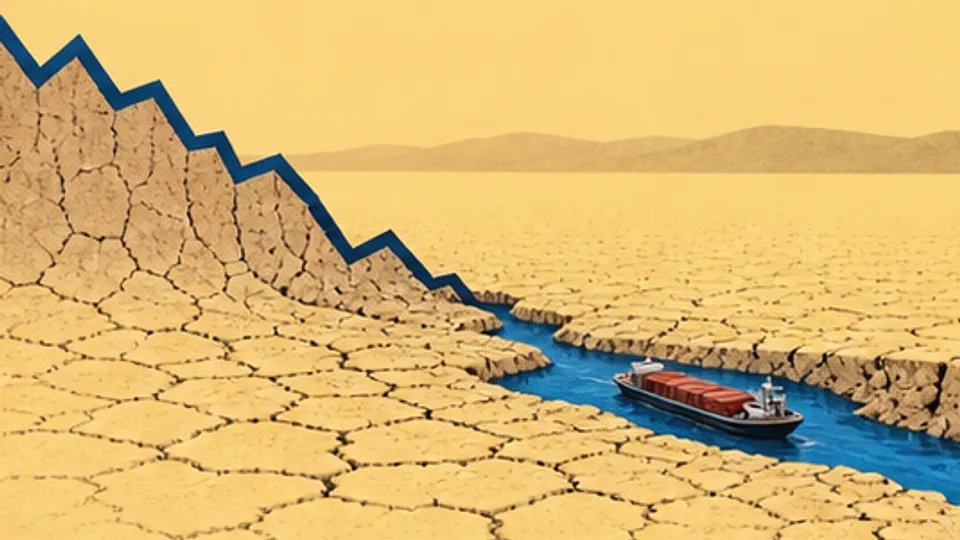
Europe’s busiest industrial artery is running perilously shallow again. Water levels on the Rhine plummeted to record lows over the weekend, threatening traffic on the shipping corridor that carries energy and industrial commodities across central Europe, Bloomberg reports.
At Kaub, the critical chokepoint for coal, fuel and industrial commodities, the water level fell to 3 centimetres below a key threshold on Saturday—a benchmark ship operators use to judge how much cargo vessels can safely carry without damage or grounding. Levels later recovered from the dip into negative territory, reaching 2 centimetres on Monday, according to data from the German Federal Waterways and Shipping Administration. The respite may be brief: the German Federal Institute of Hydrology forecasts that levels at Kaub could sink below the threshold again on Tuesday evening.
Cargo owners are already paying for the squeeze. The cost of shipping diesel from Rotterdam to Karlsruhe climbed 15% on Monday alone, after more than doubling this month as dry conditions lingered. Barges sliding over a few fingers of water simply cannot take their usual loads, so more journeys are needed to move the same volume of fuel.
The stakes extend well beyond diesel. The Rhine is lined with major chemical plants, refineries and steel factories belonging to the likes of BASF, Bayer, Covestro and Shell, and remains an essential link between European factories and global markets. Western Europe’s hottest summer has brought repeated waves of heat and drought, sharply cutting water flows into the river. The months-long disruption has already forced some chemical producers to curb output or declare force majeure on certain products—an unwelcome extra burden for an industry grappling with weak demand, high energy costs and intensifying competition.
The drought is also sorting firms into the prepared and the unprepared. Companies along the river are confronting the possibility that dependable access to the waterway can no longer be assumed. Arne Lohmann Rasmussen, head of research at Global Risk Management, argues that replacing the Rhine’s freight capacity would be difficult—likely requiring 3,000 tanker trucks a day just to offset oil cargoes. “Low Rhine water levels are the last thing the German economy needs,” he wrote in an analysis on LinkedIn. “Rain will eventually raise the Rhine again. The longer-term problem remains: low water is no longer only a rare weather event. It is becoming a recurring economic, logistical and regional price risk.”
There is modest relief in sight: dry conditions are expected across the region this week, but river levels are poised to start rebounding by early October. A few centimetres of water may seem a small thing on which the fortunes of Europe’s largest economy should turn. Then again, so did the weather forecasts that once made such summers unusual.