
Candlepin bowling has spent years losing alleys. The ones still standing, Billy Baker argues in the Boston Globe, have worked out that a bowling alley can no longer survive as only a bowling alley. His main example is Cape Ann Lanes in Gloucester, Massachusetts, a 16-lane alley that was on its last legs when a family bought it nearly a decade ago. It is still open, so the model seems to work. The model has three parts and three people, and it is more complicated than “bowling.”
Part one is the bowling. Jim Frontiero, 62, known in the family as Uncle Jim, is an electrical engineer who was already running the leagues under the previous owner when that owner started hinting he might be done. Frontiero now handles the leagues, the walk-ins who need rental shoes and the pin-setting machinery in the back, which dates from the 1950s and always needs something. If you were going to put an electrical engineer anywhere in a bowling alley, that’s where you’d put him.
Part two is the food and drink. Nic Pszenny, 42, is Frontiero’s nephew. He grew up in a bowling family in Gloucester, started brewing beer while he was in the Marine Corps and wanted a brewery of his own. When the two of them bought the alley, the dining options consisted of a snack bar. Now there is the Laneside Pub and Brewery, in a space that used to be a party room with four lanes in it. By 2020 the brewery was pouring, and Caitlin Pszenny told a local paper at the time that “It has been a longtime plan to install a brewery.”
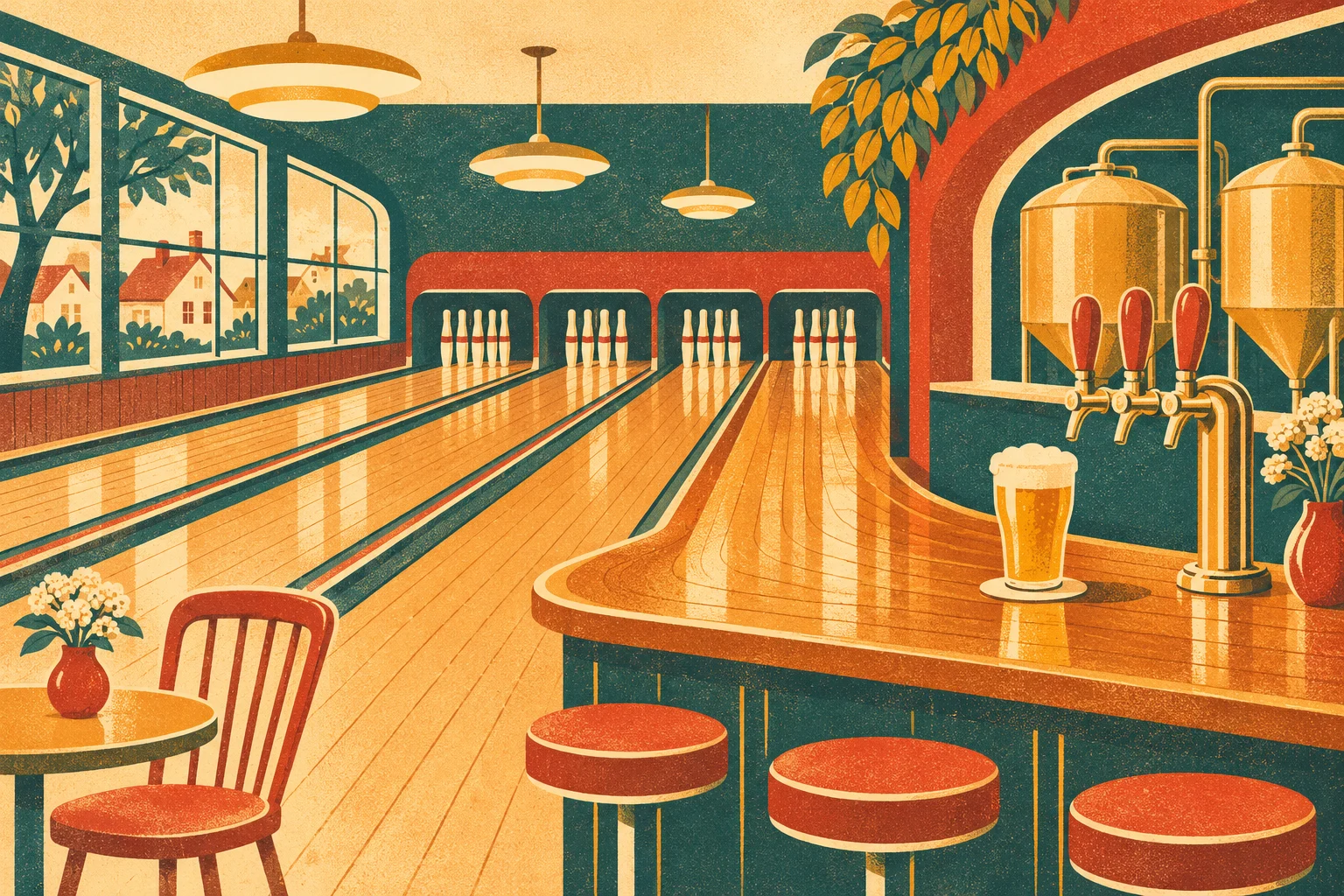
I think the four lanes are the interesting decision. This is my framing, not the owners’: think of it as a capital allocation problem. A lane earns money only while someone is bowling on it, and four lanes in a party room presumably earn money only when there’s a party. A bar can sell to everyone in the building: the league bowlers, the people waiting for a lane, the friends who came along and will never touch a ball. The alley of the smoke-filled 1970s and ’80s sold games and snacks. This one sells an evening out, and the bowling helps bring people in. Pszenny’s pitch problem is that nobody expects much from a bowling alley kitchen:
“The hardest part is convincing people that a bowling alley can have good food and beer.”
Part three is everything else, and it belongs to Caitlin Pszenny, Nic’s wife and co-owner, whom the Globe calls the accidental hero of the story. “In the original plan, I was not supposed to be involved,” she said. She was 29 when they bought the place. Over the following decade she had three children and became involved in “everything. You need to know how to do absolutely everything.” That covers staffing, permits and events: book clubs, birthday parties, bands, sports banquets, even wedding receptions. It also covers going into the back to free a stuck candlepin from the machinery, which is how she tore her shoulder. The Cape Ann Chamber of Commerce directory lists her as general manager, a title that is accurate but undersells it.
Her summary of the business model is the best line in the piece: “We have to run five or six different businesses to run this one business.” Analysts usually say that about conglomerates, and usually as a complaint. Here it’s just what the job involves. Some nights she gets home at 2 a.m. and tells Nic they should sell everything and move into an RV. “But neither of us are quitters, for better or worse.”

Stabilization, sort of
John Pumphrey, president of the International Candlepin Bowling Association, puts the industry picture carefully. “It’s not easy to say whether candlepin is growing or shrinking right now,” he said. “We’re losing some centers, yes, but on the flip side you see owners who are investing in their centers to make them into entertainment destinations, revamping the alleys, adding restaurants and bars, and those businesses are thriving and growing.” In other words, the sport isn’t clearly growing or shrinking, but the alleys are sorting themselves: the ones that invest do well and the ones that don’t close. He calls what is happening in Gloucester, and at lanes from Somerville to Amesbury, a quiet stabilization.
He also says interest in leagues is stronger than it has been in a generation. That matters because leagues are what fill the lanes on weeknights. A league is a group of people who have agreed to show up every week, which makes it something like a subscription. On a Wednesday night in Gloucester the alley was packed for a women’s league, a newer addition so popular that Caitlin Pszenny struggled to get onto a team in her own building. On Mondays there is the Variety League, a highly competitive league in its 100th year. Nic and his uncle were both bowling in it before they owned the place.
She describes the women’s night as 16 lanes of socializing, and says that’s the part she cares about. “We modeled it as being a third place for people, beyond home and work, and those places are disappearing,” she said. “It’s a community social center with a game in the middle of it.”
The game in the middle
The game is famously hard. Candlepin was born in Worcester and is played only in New England and Canada’s Maritime provinces. Bowlers get three balls per frame, and the pins that fall stay on the lane as deadwood. In ten-pin, which locals call “big ball bowling” and don’t mean kindly, Americans bowl 50,000 to 55,000 perfect 300 games a year. Nobody has ever come close in candlepin. The best score is 245, set by Ralph Semb in 1984 and tied by Chris Sargent in 2011. The Globe reported last year that Semb bowled his at an alley in Westfield that no longer exists. Elite bowlers average around 120. That’s 40 percent of a perfect game, and the record is about 82 percent.
“There’s a reason you drink doing this sport,” Caitlin Pszenny said. So the difficulty of the game helps sell the beer.
Nic Pszenny, sitting at his own bar after another 2 a.m. night, sampling a new batch in a “Friends only let friends bowl candlepin” T-shirt, says Monday-league opponents assume he has bowled about 10 games that week when he bowls well. “They don’t believe me when I say I only bowl three strings each week, during the league,” he said. “There’s just so much other stuff to be done.” The guy who owns the bowling alley gets very little time to bowl.
And yet he wants to buy more bowling alleys. “It’s hard to explain, but it feels like my purpose, my calling,” he said. His parents met decades ago at the Beverly Bowl-O-Mat, which closed in 2018. “Bowling has always been an important part of my family,” he said. “I want to preserve these places that are so much more than just a place to bowl.”
Most people who found out that one bowling alley meant running five or six businesses would decide they wanted fewer bowling alleys. He has decided he wants more. In a sport where nobody has ever bowled a perfect game, that seems like the right temperament.