
The small galaxies near us are the provinces of the cosmos. Some hold a few thousand stars, others hundreds of millions, and they sit at the edges of the great systems like our own. The outcome of their history is written in what they managed to keep. Their stars make oxygen and then explode. Astronomers knew some of that oxygen gets thrown out. Until now nobody had counted, galaxy by galaxy, how much was lost.
The count was published on Monday, 2 November 2026, in The Astrophysical Journal. As the University of Utah reported, republishing NASA’s announcement, the researchers studied 37 nearby dwarf galaxies and found that much of the oxygen they expected to see is not there. Simulations predict these galaxies should hold significantly more of it. Oxygen here stands in for a wider family of heavy elements, so its absence means they are missing too.
The ledger
The work belongs to a project with a name like a bureaucratic acronym, Galaxies Losing Oxygen via Winds, or GLOW, funded by NASA and the National Science Foundation. Its principal investigator is Kristen Wingfield McQuinn, an associate professor at Rutgers University in New Brunswick, New Jersey, and mission head of the Science Operations Center at the Space Telescope Science Institute in Baltimore for the newly launched Nancy Grace Roman Space Telescope. The preprint of the paper, titled “GLOW II: A Census of Oxygen in Low-Mass Galaxies”, lists her as lead author, with co-authors including Grace Telford, Andrey Kravtsov, Evan Skillman and Julianne Dalcanton.
Why oxygen? Because it can be measured. It is the most abundant element after hydrogen and helium, it is fairly easy to detect, and astronomers understand well how stars produce it. That makes it a dependable marker of where a galaxy’s chemical wealth has gone.
“So, it’s really for practical reasons that we’ve chosen oxygen,” said McQuinn.
The method is an audit. According to Sci.News, the galaxies lie within roughly 19.5 million light-years of Earth and have stellar masses from about 3 million to 3 billion times that of the Sun. Archival optical images from Hubble resolved their individual stars, and from these the team rebuilt each galaxy’s star formation history. That gave the expected amount of oxygen. Then they counted what remains in gas, stars and dust, using data from Hubble, NASA’s retired Spitzer Space Telescope, the ground-based Very Large Array and the Australia Telescope Compact Array.
The galaxies retained between 4% and 25% of the oxygen their stars had made, with a mean of about 11%. Nearly all of what remains is in the gas, with very little in stars or dust.
The sample was chosen with care. The 37 galaxies fall in the mass range where theory predicts that supernovae should expel an increasing share of their oxygen. They are also close enough for Hubble to see their stars one by one, which is not true of most known dwarf galaxies, too distant for this kind of accounting.
Explanation
Telford, an assistant professor in the Department of Physics & Astronomy at the University of Utah and a co-investigator, reasons from where the oxygen was made:
“Oxygen is produced by stars, which are inside of galaxies. We know that the oxygen had to be inside of the galaxies at some point in the past, so the oxygen must have been ejected. And to do that, you need energy from massive stars and supernova explosions to drive material out of the host galaxies and into the space between galaxies.”

The idea that supernova-driven winds empty small galaxies is old. This study puts firm numbers on it, and the numbers say the winds work harder than current models assume. A 2014 study had found that star-forming galaxies like the Milky Way also lose a large fraction of their oxygen, some of it parked in the diffuse halo of gas around them, the circumgalactic medium. GLOW carried the question down to the smaller galaxies, across many masses and surroundings.
Neighbours
Location turned out to matter. Galaxies more than 3.3 million light-years from a massive neighbour consistently kept less than 15% of their oxygen. Those in denser surroundings, or within that distance of a large galaxy, varied more widely and accounted for most of the highest retention values. The researchers offer two possibilities: oxygen may be falling back into these galaxies, or they may be taking in gas that their larger neighbours had already enriched. A reflection, offered as nothing more: those that live alone keep the least. Those near a large neighbour may be living partly off what it gives away.
Where it went
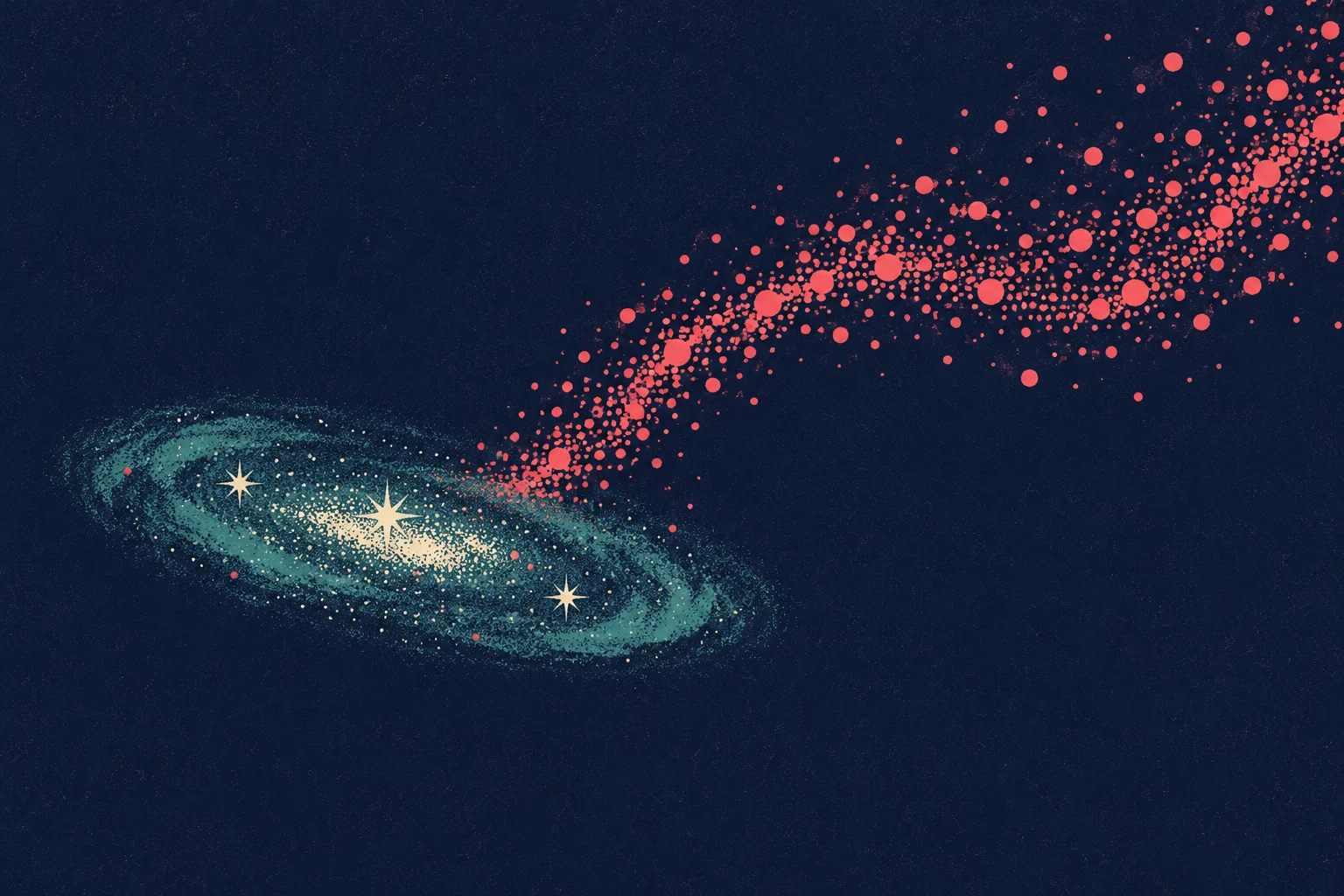
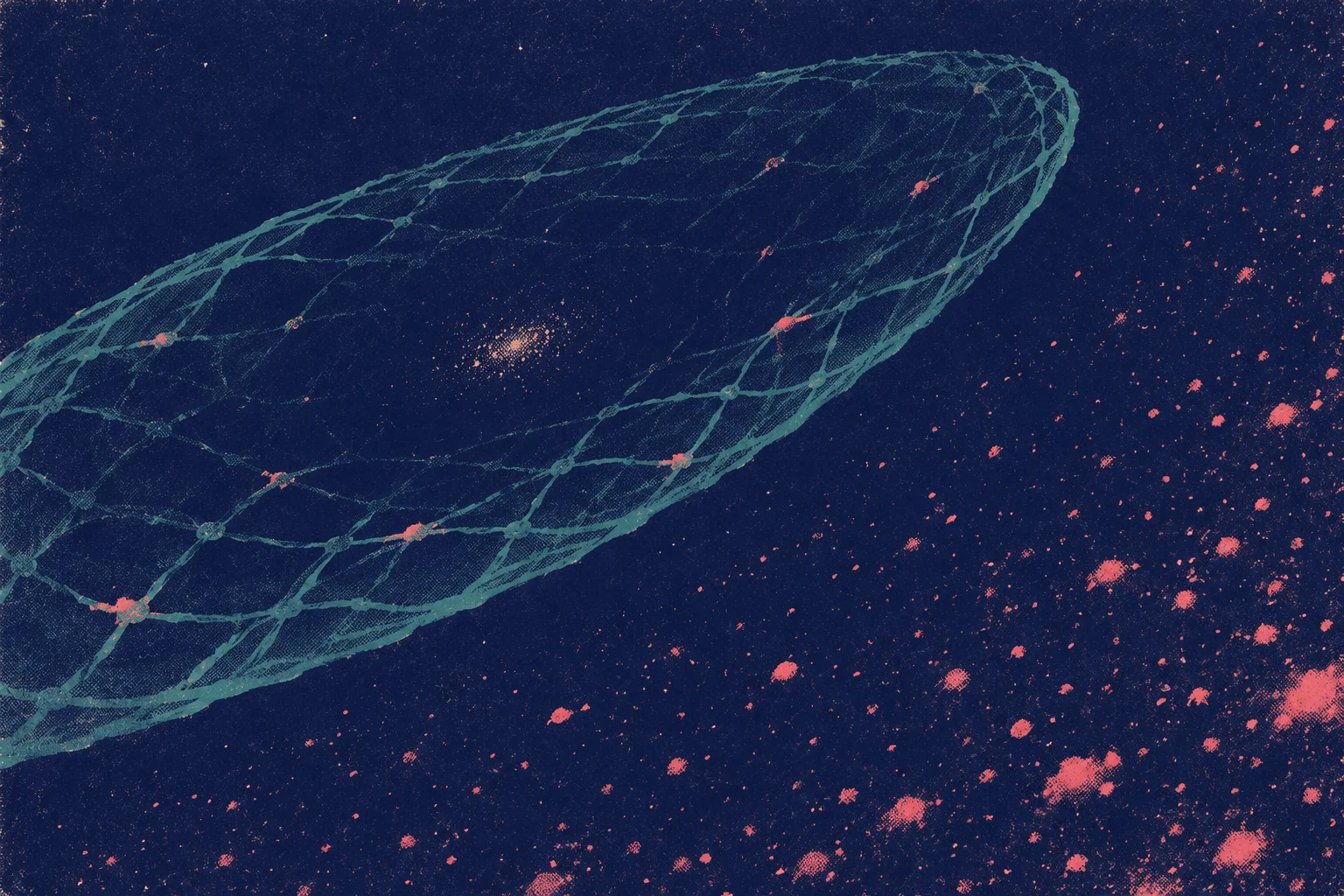
Earlier ultraviolet observations of a highly ionised form of oxygen in the halos around such galaxies account for roughly 1% to 7% of what the galaxies produced. After correcting for other ionisation states, the authors estimate the halos could hold 5% to 35%. That leaves a large share which may have escaped the galaxies’ gravity altogether and entered the space between galaxies, the intergalactic medium. Whether most of the missing oxygen still sits in the halos or has left entirely is, by the team’s own account, still unclear.
The theorists have some explaining to do. The team compared its results with three cosmological simulations. All three reproduce the known relation between a galaxy’s mass and its metal content, and all three let dwarf galaxies keep more of their metals than the observations show. A simple galaxy-evolution model fit the data best under three conditions: outflows carry away proportionally more mass from smaller galaxies, the outflowing gas is about twice as metal-rich as the galaxy’s interstellar gas, and the inflow of fresh gas onto these galaxies is suppressed by about 40%.
“Being able to trace how much oxygen gets made, and then how much is distributed inside and outside of galaxies, helps us understand galaxy evolution,” McQuinn said. “It also helps us learn where and how much galaxies are enriching the space between galaxies, called the intergalactic medium.”
Fainter still
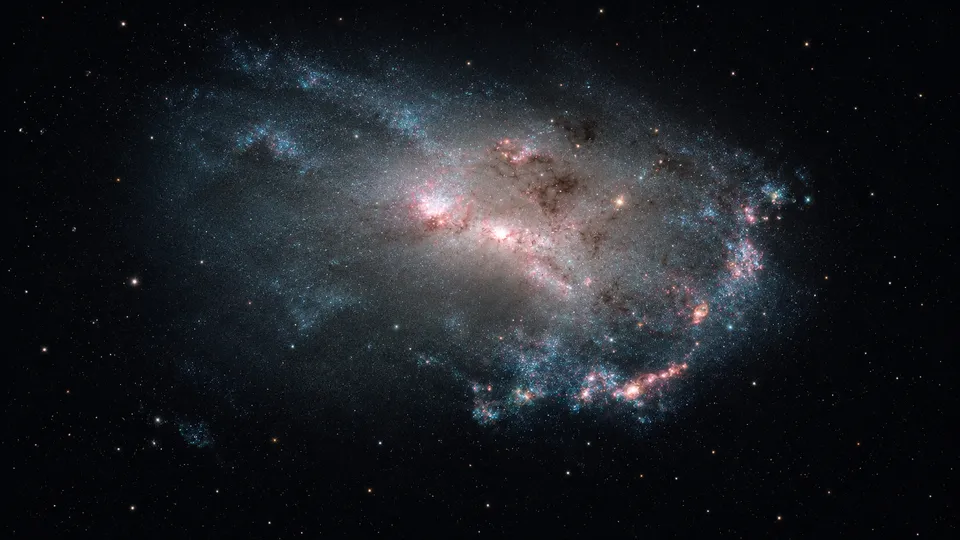
McQuinn has an approved program to use the Roman telescope to find even fainter, smaller galaxies across a wide area of sky, then study their stars more deeply with Hubble and the James Webb Space Telescope to reconstruct how they formed stars over cosmic time. Telford is using Hubble to examine the massive stars that make the oxygen and drive it out, using some of the nearby GLOW galaxies to measure how such stars differ in small systems. Among the galaxies in the study is NGC 4449, whose Hubble portrait NASA chose to illustrate the work.
The instrument behind all this has been in orbit for more than three decades, and the agency that runs it is now seeking ways to keep it from falling. It is Hubble’s stored archive, built up over those years, that made possible this account of what small galaxies have lost.