
In 1976 the fastest computer on earth went to the desert of New Mexico. According to the company’s own history, the first Cray-1 was installed that year at Los Alamos National Laboratory. Its record speed was 160 million floating-point operations per second, with a main memory of 8 megabytes. The same history gives a price of $8.8 million. Other accounts, among them the machine’s Wikipedia entry, say Los Alamos only had serial number 001 on a six-month trial, and that the first real sale was serial number 3, which went to the National Center for Atmospheric Research in 1977 for about $8.86 million. Wikipedia lists the Cray-1A at 5.5 tons, drawing 115 kilowatts.
It was designed in Chippewa Falls, Wisconsin. Hewlett Packard Enterprise, which owns the Cray name today, calls it the first commercially successful supercomputer. This year the United States put it on a one-dollar coin. Few machines get that treatment. The coin is the state’s way of saying the machine belongs to the past.
Computing power works like any other kind of power. Each ruler is sure he will last, and each one ends up in a museum, in the room after his successor’s.
The pretenders
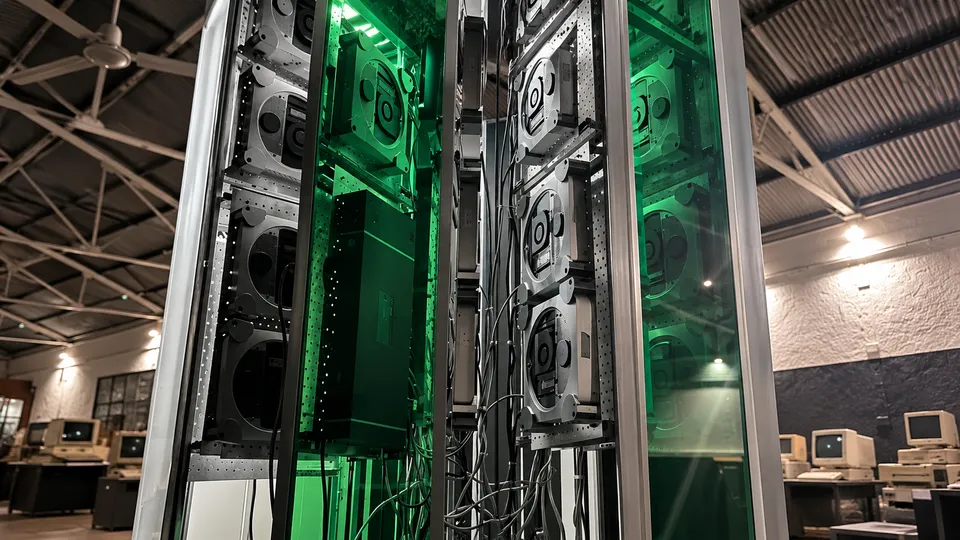
The museum in this story is the Museo de Historia de la Computación. Spanish press reports place it in Majadas de Tiétar, a village in the province of Cáceres in Extremadura, and date the unveiling to 26 September. The museum has built a full-size replica of the Cray-1, matching the original’s outward form at 1:1 scale. Inside it are thirty Mac Minis, almost all from 2012. Ars Technica reported that the project took eighteen months and was meant to mark two fiftieth anniversaries: the Cray-1’s and Apple’s founding.
The team didn’t buy new hardware. Five of the machines are quad-core i7 models and the other twenty-five are dual-core i5s. Two are from 2014. The rest are from 2012, made more than ten years before the project began. Ars put the word “obsolete” in quotation marks in its headline, and the marks are earned. These machines had been retired, and the museum gave them work again.
Here are the numbers. In the latest tests, 64 active processing cores reached a combined 1.3 teraflops. Before that, the museum reportedly got 1.5 teraflops out of all 70 available cores, until one node went offline. A custom Python script that multiplies matrices produced the benchmarks. On paper, 1.3 teraflops is roughly eight thousand times the original’s 160 megaflops. That comparison sets a measured result against a theoretical peak. One history of the machine notes that its maker’s manual never states the 160 figure: it was derived, and reachable only by code that fit the hardware perfectly. Even allowing for that, the gap is enormous. Hardware that sold as consumer kit in 2012 can do far more than the machine built for the national laboratories.
Two ways of thinking
The replica copies the Cray-1’s appearance. It doesn’t copy how the Cray-1 worked. The 1976 machine used vector processing: one instruction was applied to many pieces of data at the same moment, a single command for many hands. The thirty Mac Minis work as a parallel cluster. The job is split up and handed to independent processors, each doing its own share and passing results along. The museum presents the replica as a way for visitors to see how computer architecture has changed since the original. The change shows in the cabinet itself. A single central design gave way to many small machines cooperating.
To manage the cluster, the team picked macOS Mojave, version 10.14, over a more usual Linux distribution. The reason was practical. Mojave has built-in support for MPI, the Message Passing Interface, which is the software that lets the nodes pass tasks to one another. So an Apple operating system eight releases old is running a monument to the Cray-1.
Visitors can watch matrix algorithms run in real time. The display shows performance growing from a single core to the whole cluster working in parallel. Spanish outlets also describe a copy of the original’s C-shaped tower with its padded bench, a three-screen console, a Raspberry Pi running an emulator, and two real Cray CX1 systems, now retired, displayed alongside.
Silence
Anyone who has stood in a server room knows the noise of the fans. The museum chose not to use them. The Mac Minis are cooled by passive convection: a steel rack chassis, with each machine on an aluminium tray. According to Ars, the cluster is nearly inaudible next to a modern data centre.
The original drew 115 kilowatts. Its successor, many times faster on paper, cools itself on metal trays in a village museum, and is almost silent. The original belonged to the state and its weapons laboratories. Today the same kind of power sits, unused, in drawers and second-hand shops wherever people bought computers in 2012.
The replica is on permanent display. According to the Spanish press reports, the museum gives guided tours on Saturdays, from half past eleven until two.