
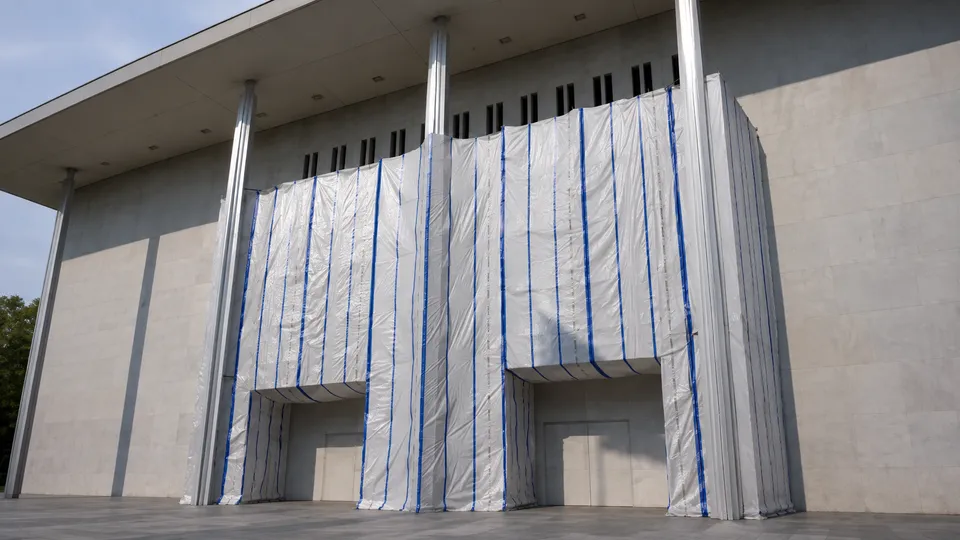
On September 4, in the Grand Foyer of the Kennedy Center on the Potomac, a section of ceiling plaster came down. The security camera simply recorded it — and in Washington these days a camera recording is a political instrument. Within days the footage had become the government’s case for locking the doors of the country’s best-known arts institution, perhaps for years.
Commerce Secretary Howard Lutnick circulated the video of the falling plaster, and President Donald Trump shared it in turn. The building, the administration declared, had “completely unsafe conditions,” and, as Lutnick put it, “people cannot be allowed to go into this building any longer.” The plaster, in other words, had fallen precisely where the argument needed it.
The Letter
On Thursday, a lawyer named David Seide wrote to the congressional committees that oversee the center, on behalf of clients who do not give their names: whistleblowers inside the institution, telling a different story about that ceiling. The letter, obtained by CNN and first reported by The New York Times, says the leaks above the Grand Foyer were no surprise to management — and that the repairs meant to stop them were stopped instead.
Matt Floca, the center’s director, has known about the leak problems “for years,” the letter says. In April, it alleges, he halted plans to fix them — although Congress had already provided $9.3 million for roof replacement the year before, money the whistleblowers say Floca himself requested and received. The repairs, Seide wrote, “were not treated as priorities nor as acute risks to public safety.”
According to the whistleblowers, the funding arrived through the president’s signature One Big Beautiful Bill Act, and Floca “stopped the remediation process from moving forward,” delaying the work ever since the bill’s passage last year. The roof, then, had a budget before it had a collapse — and the budget sat unused.
The Answer
The Kennedy Center rejects the account. “The safety of our patrons, artists, and staff comes first,” it said in a statement. Floca conceded the institution has known for years that the roof overhang leaked — but only this summer, he said, did it learn how far the damage had spread inside. There was, he said, “a change in the approach to procuring and delivering the work, not a determination that the work was unnecessary.”
The Larger Quarrel
The ceiling fell into a building already claimed by a bigger fight. In his second term Trump has installed himself as chairman of the center’s board and swept through its leadership and programming. Early this year he announced the institution would close for roughly two years of renovations; the doors were to shut on July 4, until a federal judge temporarily blocked the move.
Representative Joyce Beatty, a Democrat and ex-officio board member, is suing to keep Trump’s name off the building. The center’s lawyers, pressing the case for renovation, have warned that without more extensive work the building “will deteriorate further into an unsafe, decrepit structure that will be required to be taken down” — and have threatened, in court, to demolish it. This week, in a filing, the center said it will remain closed until September 30 to assess the safety risks.
So the sequence stands: the administration secured the money for the roof, the roof went unrepaired, the plaster fell, and the falling plaster became the reason the people cannot come inside. Governments have always found it easier to justify pulling a house down than to explain why they let it rot — that is reflection, not evidence. The evidence is the letter, the $9.3 million, and the camera above the Grand Foyer that recorded everything.