
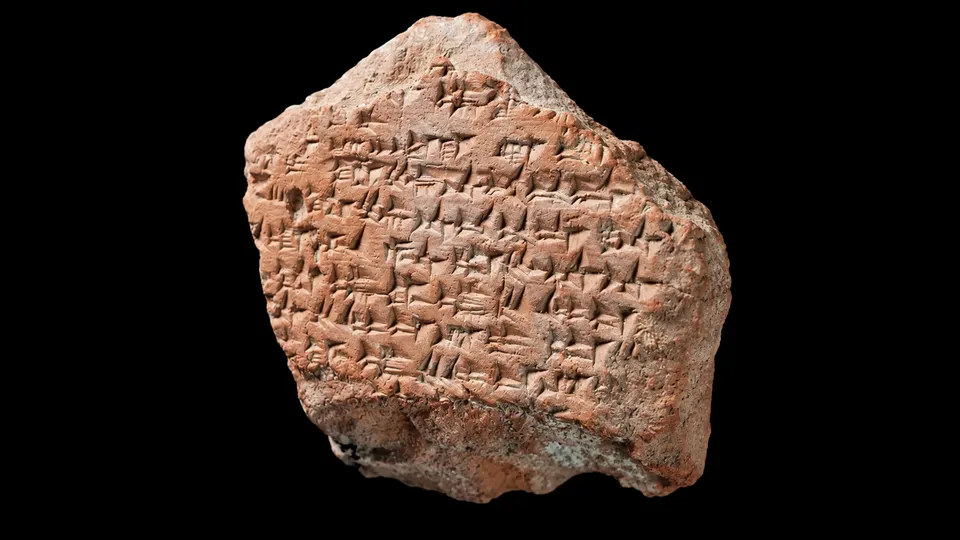
Peace treaties are meant to be filed, ratified and quietly forgotten. The oldest one known to history has taken a different course: it keeps being dug up. Turkey’s Ministry of Culture and Tourism has announced that archaeologists have unearthed a 3,400-year-old fragment of the Treaty of Kadesh, the accord struck around 1269 BC between the Egyptian pharaoh Ramesses II and the Hittite king Hattusili III, and widely regarded as the world’s first international peace treaty.
The fragment, a piece of clay tablet inscribed in Akkadian cuneiform, emerged during excavations at Buyukkale, the royal palace complex of Hattusha, the ruined Hittite capital in Turkey’s north-central province of Çorum. The site is a Unesco world-heritage property, and its soil has yielded diplomatic archives before: fragments of the same treaty were first identified there in 1906, and those pieces now sit in the Istanbul Archaeological Museums. According to the Smithsonian, researchers studied the newly found inscription for about a year before going public, and they hope further digging will turn up the rest of this copy.
What the fragment says is as notable as where it was found. Experts say it contains lines from articles 12 to 20 of the treaty—the clauses governing the treatment of people who fled Egypt or Hatti, the Hittite realm, and sought refuge in the other. The text warns against destroying such refugees’ homes. “The statements concerning the destruction of people’s homes carry a powerful message from thousands of years ago to the present day,” Mehmet Nuri Ersoy, Turkey’s culture and tourism minister, said, according to the state-run Anadolu Agency. Announcing the find, Mr Ersoy declared: “We have found traces of peace, thousands of years old, in the soil of Anatolia.” It “reminds us of our responsibility to protect human life and dignity,” he added.
The treaty it belongs to was hard-won. Egypt and the Hittites had spent the better part of two centuries contesting the lands of the eastern Mediterranean, Syria above all—the stretch of territory lying awkwardly between them. The struggle culminated in the Battle of Kadesh, a clash involving tens of thousands of soldiers and some of the largest chariot battles ever fought, which ended in stalemate. A first, unpreserved settlement probably followed, Egyptologist Camilla Di Biase-Dyson told ABC Radio National in 2024; then, some sixteen years later by that account, Hattusili III—successor to Muwatallis, the king at Kadesh—sought a fuller alliance with Ramesses II, partly to shore up his own grip on power.
The result was lofty. As the United Nations summarises it, the treaty promised “eternal friendship, lasting peace, territorial integrity, nonaggression, extradition and mutual help.” Its surviving text is effusive about the two monarchs: “He is a brother to me and he is at peace with me; and I am a brother to him and I am forever at peace with him,” runs one line in the Turkish ministry’s translation. “The country of Egypt and the country of Hatti will be forever in a state of peace and of fraternity as it is with us.” The brotherhood was conducted at a distance: the two rulers never met face to face.
Oddly, the document never mentions Kadesh itself, which is why it travels under several aliases—the Egyptian-Hittite peace treaty, the Eternal Treaty, the Silver Treaty. That last name recalls the original: the agreement was first inscribed on silver tablets, long since lost. What survives are copies. Hieroglyphic versions were carved on temple walls in Egypt—first identified at Thebes, modern Luxor, in the early 19th century—and Akkadian cuneiform versions on clay at Hattusha, of which at least three were already known. A copper replica of the treaty hangs at UN headquarters in New York, an early exhibit in diplomacy’s hall of fame.
The eternal peace, in the event, was eternal only in the manner of warranties. The Hittite empire, which had ruled central Anatolia from about 1650 BC, collapsed around 1200 BC—so the fraternity outlasted its signatories by roughly seven decades, but no more. Egypt endured rather longer. Still, for a Bronze Age détente hammered out between two exhausted superpowers, seventy years without war counts as a success, and the refugee clauses excavated at Buyukkale suggest the treaty aimed at something rarer than a ceasefire: rules. Archaeologists now hope the rest of this copy lies nearby, waiting to be pieced together—which is more than can be said for most of its modern successors.