
Lakes cover less than 2% of Earth’s land surface but do roughly 20% as much work as fossil-fuel combustion does to the greenhouse-gas budget: according to a study published November 16 in the Proceedings of the National Academy of Sciences (PNAS), led by Ke Zhang of the Nanjing Institute of Geography and Limnology at the Chinese Academy of Sciences, lakes emit greenhouse gases equivalent to about 20% of fossil-fuel emissions, bury carbon faster per unit area than the oceans do, and hold roughly half as much organic carbon as all the world’s soils. The new finding is not about any single lake. It is that roughly 2,000 lakes studied worldwide are starting to behave as one coupled system rather than 2,000 independent ones, a shift the paper’s authors call, without much hedging, “a genuine, global-scale phenomenon.”
The term for what they measured is spatial synchrony: the degree to which far-apart lakes rise and fall together on the same variables at the same time, instead of each responding to its own local weather, watershed and pollution load on its own schedule. Historically, lakes have been a textbook case of spatial heterogeneity — Lake Baikal and a farm pond in Iowa do not share a bloom season — and that diversity functions as a firebreak. If one lake’s ecosystem collapses from a heatwave or a nutrient spike, its neighbors, running on different clocks, stay unaffected and can reseed or buffer the damage. Erase the time lag between lakes and you erase the firebreak.
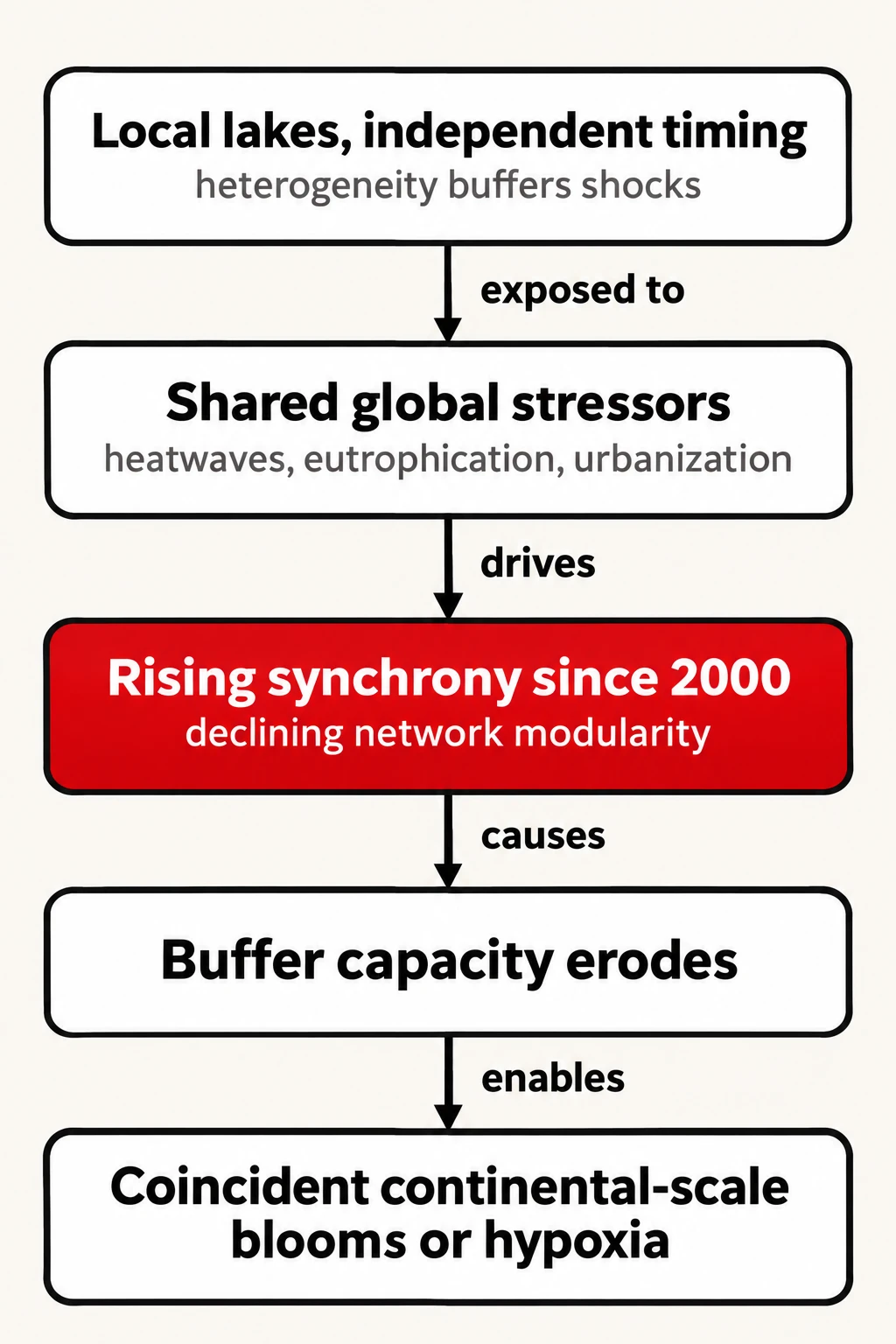
| From | To | How |
|---|---|---|
| Local lakes, independent timing (heterogeneity buffers shocks) | Shared global stressors (heatwaves, eutrophication, urbanization) | exposed to |
| Shared global stressors (heatwaves, eutrophication, urbanization) | Rising synchrony since 2000 (declining network modularity) | drives |
| Rising synchrony since 2000 (declining network modularity) | Buffer capacity erodes | causes |
| Buffer capacity erodes | Coincident continental-scale blooms or hypoxia | enables |
Based on Zhang et al., PNAS 123(47), 2026
Zhang’s team didn’t rely on one data source for that claim, which is the part of the paper worth checking closely because synchrony studies are notoriously easy to produce as an artifact of how you define your network. They used three separate, independently derived measurements: satellite-retrieved chlorophyll-a concentration (a proxy for algal biomass) across thousands of lakes, water clarity measured via the Forel-Ule optical index, and sedimentary pigment records pulled from lake-bottom cores at 119 lakes, which extend the record back roughly a century before satellites existed. All three show the same thing — an acceleration in cross-lake synchrony since 2000, paired with what the paper describes as a significant decline in network modularity, the measure of how cleanly lakes cluster into separate, loosely connected regional groups rather than one tightly linked whole. Three different instruments agreeing is stronger evidence than one instrument agreeing with itself, which is the baseline a skeptical reader should apply to any single-proxy trend claim in ecology.
The paper is explicit, as 404 Media reported, that the absolute size of the synchrony increase is statistically significant but modest — the authors are not claiming lakes have snapped into perfect unison, only that the correlation between distant lakes’ conditions has moved measurably in one direction, consistently, across three independent proxies, for two and a half decades. That distinction matters because a modest, statistically robust shift in a system this large and this undersampled historically (most of the planet’s roughly 117 million lakes have never been monitored at all; this study covers about 0.0017% of them, 2,000 out of 117 million, chosen because they have long-enough satellite or sediment records) is a different kind of claim than a dramatic one. The mechanism, not the magnitude, is the finding.

What’s driving lakes into sync
The paper attributes the synchronization to what it calls environmental telecoupling: shared global stressors — heatwaves, eutrophication from fertilizer runoff, and urban encroachment on watersheds — that now hit many lakes on overlapping schedules because the stressors themselves (a continental heat dome, a fertilizer price spike that changes farm runoff everywhere at once) operate at continental or planetary scale rather than local scale. Phytoplankton biomass and water clarity serve as the paper’s two live proxies for lake metabolic activity; when both move together across a continent, it indicates the underlying driver is also continental, not local.
This builds on an earlier finding from overlapping authors: a 2024 paper in Geophysical Research Letters (DOI 10.1029/2024GL109298), using satellite water-quality indices and early-warning statistical signals across 1,049 lakes from 2000 to 2018, found that 46.7% of those lakes showed a significant decline in ecological resilience, concentrated since the early 2010s and most strongly linked to human population density and nutrient pollution. Lakes in alpine regions were the exception, gaining resilience from glacial meltwater and warming. That 2024 result and this new one are not the same measurement — resilience (how well a single lake recovers from a shock) is distinct from synchrony (whether multiple lakes move together) — but they point the same direction: individual lakes are both getting less able to absorb local stress and more likely to experience that stress on the same calendar as everyone else. A separate, earlier finding often cited alongside both — the 2023 Science paper led by Fangfang Yao, finding 53% of the world’s largest lakes lost water volume between 1992 and 2020 — measures water quantity, not quality or synchrony, and shouldn’t be read as the same data point.

The policy mismatch
Lake management, almost everywhere, is organized by watershed, state or municipality. Zhang’s team argues that a planetary-scale synchronization problem can’t be addressed at that resolution, and proposes treating interconnected lake networks as a “planetary commons” — tracked with the same rolling-synchrony and modularity metrics the paper uses to detect the trend, in order to flag what the authors term Strategic Planetary Lake Areas: regions where a regional subnetwork of lakes is converging fastest, and where, per phys.org’s account of the study, targeted intervention would do the most to preserve the remaining heterogeneity rather than to chase synchrony to zero, which the authors say isn’t the goal and likely isn’t achievable.
Coincident algal blooms or hypoxia events could trigger parallel lake ecosystem collapses across continents, eroding the regional diversity essential for ecosystem recovery and adaptation.
Zhang told phys.org that synchronized lakes can concentrate biophysical fluxes into “high-amplitude global pulses,” meaning simultaneous greenhouse-gas release or widespread hypoxia across many lakes in one season rather than the staggered, locally-contained events the current monitoring and regulatory apparatus was built to handle. Whether that amplitude risk is realized depends on whether the modularity decline keeps accelerating past 2026 or levels off — the paper documents a trend through its sample period, not a forecast, and the authors’ own framing treats the current magnitude as modest even as they argue the direction is unambiguous. The number to watch is whether the next satellite update, covering the next few years of chlorophyll and clarity data from the same roughly 2,000 lakes, shows the synchrony curve continuing to steepen or flattening out.