
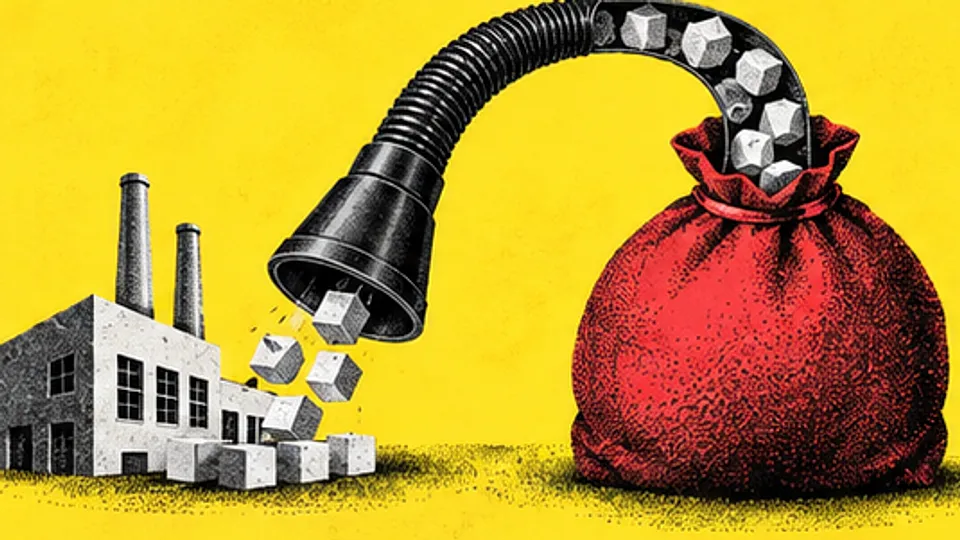
The word in the title is looting. Senator Elizabeth Warren first put it in a bill in 2019, revived the bill in 2021, and has now brought it back for a third time, in the 119th Congress, at a moment when the industry’s size has begun to read less like finance than like weather. Global private equity assets under management have grown roughly thirteen-fold in two decades, from under $1 trillion in 2004 to nearly $9.7 trillion today. Close to a quarter of buyout activity is in technology and software, about a fifth in healthcare; consumer, financial-services and industrial companies make up most of the rest. The capital runs toward essential, recurring-revenue industries, which is another way of saying the ones people cannot do without.
“This year, Congress proved with our bipartisan housing law that we can stop private equity from rolling through industry after industry, jacking up prices and leaving businesses and workers in the dust,” Warren said. “The Stop Wall Street Looting Act takes a stand against private equity’s looting and puts power back in the hands of workers and consumers.” Two weeks earlier, she and other senators and representatives had introduced a companion of sorts, the Stop Corporate Takeovers of Physicians Act.
The model the bill addresses is, at its core, an arrangement of the downside. Nearly every buyout runs on debt — typically 60% to 80% of the purchase price — and the debt is placed on the balance sheet of the company being bought, not of the firm buying it. When the deal succeeds, the firm collects management fees, monitoring payments and dividends. When it fails, the losses descend on employees, creditors, suppliers and communities, while the funds that orchestrated the deal are typically shielded from the liabilities of the companies they control. Moody’s and other rating agencies have found that private equity-backed borrowers default at roughly twice the rate of other corporate borrowers when monetary policy is tight; in Chapter 11 cases of $500 million or more, PE-backed companies account for roughly half — as much as 56% — though the industry represents under 10% of the broader commercial market.
The pattern has a human arithmetic. Tens of thousands of workers in retail, healthcare and software lose their jobs each year as debt-laden firms cut costs to keep up with interest payments. In bankruptcy, secured lenders are paid first; workers owed wages, severance or health benefits stand in line as junior creditors and often recover little, and since no law requires private equity firms to offer severance, the displaced fall back on state unemployment insurance. Taxpayers, in effect, backstop the downside. Advocates of the bill point especially to healthcare, where some private equity-backed hospital systems sold their real estate to real estate investment trusts to fund dividend payouts, then collapsed under rents they could no longer afford.
The worry has moved up the chain. The Federal Reserve recently reported that large and regional banks are tightening lending standards to private equity funds and other nonbank credit intermediaries — on maximum loan size, maturity, risk premiums, covenants and collateral requirements alike. “That accountability is especially urgent as the Trump administration moves to include private equity in workers’ 401(k) retirement accounts,” said Oscar Valdés Viera, a senior policy analyst at Americans for Financial Reform. “Workers should not be forced to risk their jobs, their communities, and now their retirement savings to subsidize Wall Street’s destructive business model and pad the pockets of billionaires.”
The bill runs to six titles. It would make funds and controlling investors jointly and severally liable for a portfolio company’s debts, and void indemnification agreements that try to move that liability elsewhere. It would restrict post-acquisition dividends, buybacks and outsourcing, tighten fraudulent-transfer rules, cap interest deductions on acquisition debt, and bar federal healthcare payments to firms that sell hospital real estate to REITs. It would raise the bankruptcy priority of wages, severance and benefits, limit executive retention bonuses, protect striking workers and gift-card holders, close the carried-interest loophole, require fuller disclosure of fees and returns, extend oversight to the private credit market, and impose risk-retention on firms that package risky corporate debt for sale.
What is new in this version is, in part, a record of what has changed since 2019. The bill now bars private equity-backed firms from federal bailout funds unless they meet labor standards, extends explicit protections to striking workers, and reaches into private credit and direct lending, a market that has ballooned since the earlier drafts. The Federal Reserve’s own survey data, Forbes notes, amounts to an admission that the industry’s exit backlog and private credit’s concentration of maturities have moved from an industry talking point to a supervisory concern.
The industry’s trade groups will argue what they argued in 2019 and 2021: that leveraged buyouts can and do rescue struggling companies, and that sweeping liability rules would raise the cost of capital and deter investment in distressed but salvageable businesses. Warren’s office answers that the current rules let investors keep the upside of financial engineering and bill the downside to workers and taxpayers. Neither earlier version made it out of committee, and this one faces a closely divided Congress; the lobbyists have already signaled the fight. What does not require a vote is the question underneath the bill — who bears the risk when a leveraged buyout goes wrong — and Americans keep meeting the industry anyway, as Forbes put it, not as investors but as employees, patients, or renters.