
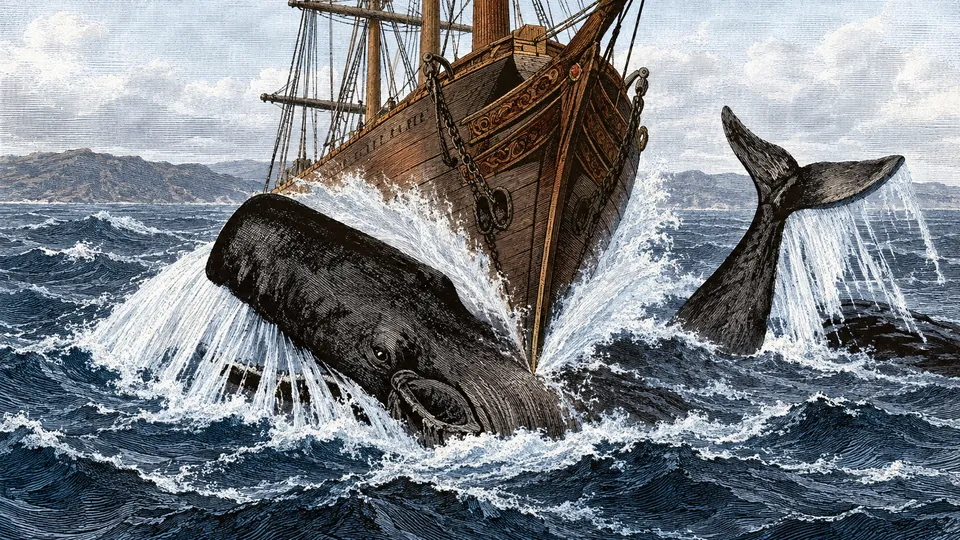
On the morning of 20 November 1820, fifteen-year-old Thomas Nickerson had just escaped one whale — the beast had punched a hole in the side of his boat — and was rowing hard back toward the whaleship Essex when he took the helm and spotted a second whale, much larger, speeding straight at them. He alerted first mate Owen Chase; there was shouting and alarm, and then, as Nickerson wrote fifty years later, “a tremendous crash.”
The impact knocked every man aboard off his feet. The whale drew off 900ft (270m), turned sharply and came back at its utmost speed, and the second collision caved in the entire bow. The Essex was sunk. What followed — twenty men clambering into three whaleboats, 1,300 miles of open ocean between them and land — became one of the most gruesome ordeals in maritime history, and the raw material for Herman Melville’s Moby Dick. What the novel never quite answered is the mechanics: how does one animal sink a ship many times its size?
Now, 175 years after the book’s publication, researchers say they have the answer — and it was predicted correctly more than two centuries ago by none other than Chase himself, a working whaler whose theory the learned world spent the intervening two hundred years ignoring. Call it the Great Forehead Question, and note where the answer lives: in the very place the whalers came to plunder, inside the whale’s enormous head.
The biggest brain on Earth
Start with the dimensions. A sperm whale’s head accounts for about a third of its total body length and houses a brain weighing up to 9kg (20lbs) — the largest of any animal on Earth. In the forehead sits the spermaceti, a large, fatty, squishy organ unique to the species and filled with an oily substance of the same name, so christened because whalers mistook it for semen. Despite all that harvesting, nobody has settled what the organ is for. One theory: it is a weapon. “This wasn’t originally our hypothesis, it was Owen Chase’s,” Dave Carrier, a retired evolutionary biologist, told the BBC. “An 18th-Century whaler argued that the forehead was a weapon, and we set out to test that.”
In a 2002 study Carrier proposed that the sperm whale’s hugely enlarged melon — the fatty forehead organ common to all toothed whales — evolved as a battering ram, capable of delivering a fatal blow to a rival, just like a hippo. “Whales are mammals, closely related to animals like deer and rams, where males compete by ramming – so this behaviour may be inherited from their ancestors,” he explains. In his reading, “the whaler’s intuition and experience were probably correct.” Then came the pictures: Alec Burslem, an ecophysiologist at the University of Hawaii, captured young sperm whales on camera head-butting one another around the Balearic Islands and the Azores — “a lucky coincidence,” he says — while a 2015 study had already judged the organ cushioned enough that whales could ram without harming themselves.
A bus at 40mph
Burslem measured multiple collisions and ran the numbers. The hardest blow he recorded came from a juvenile male closing at 15ft per second (4.5m per second) and landing with roughly 460kN of force. Scale up to a large fully-grown adult at the same speed and the estimate reaches about 1,200kN — the experience, in human terms, of being struck by a bus travelling at 40mph (65km/h). Turned against a wooden hull, that is no longer a mystery but a verdict.
Michael Harrison, chief curator at the Historical Society in Nantucket — home to a formidable collection of original logbooks and artefacts — counsels perspective: “In history, only three whaling ships were attacked by whales,” he says, though whales routinely went after the small open boats lowered overboard whenever quarry was sighted. All three attackers of mother ships were sperm whales: the Essex; the Ann Alexander, charged and wrecked outright in the South Pacific in 1851; and the Kathleen, wrecked off the Galapagos Islands in 1902. “The logbooks don’t often do justice to the drama of this,” Harrison says.
How often sperm whales actually ram things when no drone is overhead, nobody knows, Burslem cautions, and the spermaceti may serve more than one master. Whales make sound with “monkey lips,” a pair of phonic lips at the front of the nose; the call travels forward into the water and backward to the end wall of the spermaceti, and a female hearing the combination can judge the size of a suitor’s organ — and, by extension, of the suitor. The forehead may be as much billboard as battering ram. “We have a huge amount still to learn about these animals. We need to prioritise keeping them around,” Burslem says. “We’re really only just starting to understand.”