
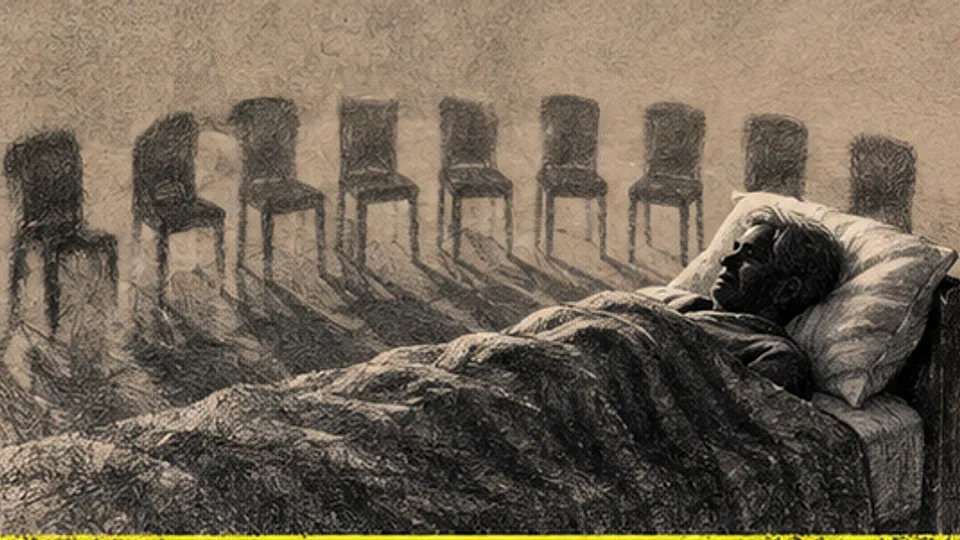
Every night, one of the men Ron McAndrew killed comes and sits at the foot of his bed. McAndrew knows they are coming. He shifts over in his sheets to make room. “They never said anything,” he told CNN, his aged voice straining. “They just sat there and looked at me.” But their eyes would talk. They would ask: “How could you do such a thing? You always claimed to be a good person. And now you’re killing people.”
It is nearly three decades since McAndrew, warden of Florida State Prison until 1998, watched the life slip from the faces of eight convicted murderers. He remembers all of it: the last words, the last meals, the silent signal to kill. His team electrocuted three men in Florida. Then he went to Texas to help with lethal injections of several more. He came to believe one of his prisoners was innocent. One execution was botched, setting fire to an inmate’s head.
He regrets it all. “I really believed in the death penalty,” he says. “I can’t believe that I did, today. I simply cannot believe it.”
Now 88, McAndrew is an opponent of the punishment he once administered. Lawyers, advocacy groups and death row inmates compete for what time he has left. “I had to look at myself,” he said on a recent afternoon at his home in Dunnellon, an hour south of Gainesville, above the swampy waters where the Rainbow River joins the Withlacoochee. “You really start thinking about what you’ve done. Why you did it.”
His own state works against him. Since the start of 2025, Florida has executed more people than any other state — nearly as many as the rest of the country combined. On Tuesday it is set to carry out its 16th execution this year: Curtis Beasley, 77, convicted of the 1995 bludgeoning death of a woman. His lawyers argued his deteriorating cognition makes the death penalty unreasonable. Florida’s Supreme Court denied his appeal earlier this week.
The pace of it agonises McAndrew. He does not like the word “execution.” “I prefer to call it a premeditated ceremonial political killing. Because that’s what it is.”
The job, done properly
McAndrew was an ambitious corrections official when he became warden in 1996. “I was so anxious to climb the ladder,” he says. Officers competed for places on his execution squad. The state gave him $40 for each final meal; when more was needed, he paid from his own pocket. He banned the nickname for the electric chair, “Old Sparky,” and ended the tradition of a post-execution team trip to a nearby diner, after locals high-fived his squad. “Nothing about what we’re doing is a joke,” he told them.
On each fateful morning he would go to the inmate’s cell and send the guards away. “It’s just me and you,” he told them. “Anything you want to say?” He promised each man he would never repeat what passed between them, and he has kept the promise. Asked about their state of mind, he falls silent, and when the answer comes it is short: “Tears. Anxiousness. A fast tapping of feet. Surprise.” Then he would pull the handcuffed man’s shoes off his feet, and leave him alone.
In the chamber, everyone knew his job. The first was to slam the prisoner into the chair. “By making it so brutal,” McAndrew explains, “it creates a shock within that person that actually calms them. For a bit.” His own station was the right ankle — Ted Bundy, executed there eight years earlier, was said by the guards to have had “the strength of a dozen men.” A microphone went before the face for the last words while 26 witnesses looked on — “judges, lawyers, citizens, curiosity seekers, bloodthirsty assholes,” McAndrew calls them. A leather mask was fixed so tightly “it automatically breaks the nose.” Blood ran from under the mask every time. “But they couldn’t scream.”
The governor would telephone: “There are no stays, there are no stays.” Then McAndrew gave a small, unnoticed signal to a man in black robes and a hood behind a partial wall — the executioner, hired at $150 a time, his identity unknown even to the staff. A secret language with one meaning. The signal meant: pull the lever.
How a man is made for the work
McAndrew grew up poor in rural North Carolina, born in 1938, shaped by Depression and war and raised by a Methodist minister. When news of an execution in Raleigh came over the radio, his grandfather would say: “It’s just like the Bible says. An eye for an eye, and a tooth for a tooth.” “You take that on with you right into adulthood,” McAndrew says. “It’s a part of your personality. It doesn’t just leave you.”
It survived the Air Force, four marriages and a decade selling perfume abroad. In the 1970s, out of work, he scoffed when a friend told him a Florida prison was desperate for men — “You think I’d work in a prison?” — then rose from officer to sergeant, lieutenant, major, and finally warden at Starke. Before the appointment he was asked whether he could send men to their death. “No, sir,” he answered, and repeated the grandfather’s formula.
“I knew something was going on inside of me,” he says now. He took the prisoners’ case files home. He grew sure that one of them, Leo Jones — condemned for the fatal shooting of a Jacksonville police officer, protesting his innocence and calling his confession coerced — might not have done it. “This investigation was piss poor,” McAndrew says.
The state showed the other side of the trade even plainer. The flames that leapt from the head of Pedro Medina in Florida’s electric chair in March 1997, while McAndrew was warden, horrified two dozen witnesses, according to the Washington Post’s report at the time. The man they had strapped down burned in front of them. That is not an argument; it is what happened, and McAndrew was the man the room belonged to.
Lawmakers who vote for the needle or the chair are never in that room. They read the names from lists. McAndrew took the shoes off the men’s feet and gave the signal, and now, at 88, he makes room in the bed for them, night after night. On Tuesday the state will kill again.