
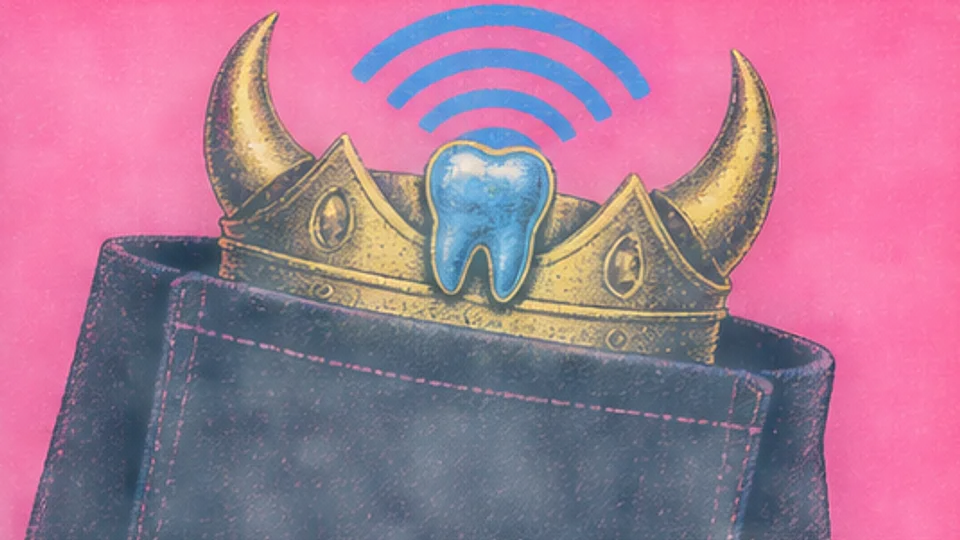
Few monarchs achieve true immortality. Harald Gormsson, a Viking king of Denmark, managed it without anyone quite noticing. Billions of people speak his nickname daily, usually while fumbling with their headphones. He is Bluetooth.
The story is told by Lindsey Galloway on the BBC, and it begins in Jelling, a town of 4,000 people about 250km west of Copenhagen. Two ancient runestones there recount Harald’s reign in the 10th century. His nickname—Blátǫnn in Old Norse—was first documented 150 years after his death and is thought to refer to a “blue” or rotted tooth. It is not the most flattering route to household-name status, but it has proved durable.
Denmark’s birth certificate
Harald’s most consequential act was Denmark’s conversion to Christianity, thought to have taken place around 965. The larger of the Jelling stones, which he commissioned, declares that he “won himself all of Denmark and Norway and made the Danes Christian”. It also bears one of the earliest depictions of Christ in Scandinavia. Until then, much of northern Europe was a patchwork of small territories ruled by chieftains. Christianity gave Harald a way to consolidate power, tighten ties with Christian Europe and bind an emerging state together.
Adam Bak, curator at the Kongernes Jelling Experience Center and Museum, describes the project briskly: “It is the nation building of Denmark after 200 years of the Viking age, where the Northerners had a pretty steep learning curve.” They became, he says, well versed in European politics, in what Christianity could do for them and in the centralisation of power. Conversion, in other words, was statecraft as much as faith.
Jelling was the seat of power in Harald’s day, and his story is written into its landscape. The older, smaller runestone was commissioned by his father, Gorm, in memory of his wife, Thyra, and is believed to contain the first written use of the name “Denmark” within the country. Locals have a phrase for it. “We call it Denmark’s birth certificate,” Anne Havgaard Mikkelsen, a resident of nearby Vejle, told the BBC. Jelling, then, is its birthplace.
The site was originally a pagan burial ground, and under Harald it became a place where pagan and Christian traditions overlapped. Today white posts mark the palisade that once enclosed the monuments, while hundreds of markers trace the outline of a vast ship-shaped layout, possibly dedicated to Thyra. Two burial mounds and a Christian church complete the scene. Mr Bak argues it is less about “bold Viking warriors and Thor and Odin” than about “politics and transition, the change from something older to something new”. In 1994 the mounds, stones and church became Denmark’s first UNESCO World Heritage site; the runestones now stand behind glass at the nearby visitor centre.
A codename fit for a king
Harald’s second career began in the late 1990s, when engineers from Toshiba, IBM, Nokia, Intel and Ericsson were building a technology to connect devices across different brands. They needed a codename. Jim Kardach, an American Intel engineer working with Swedish colleagues, fell to talking about Vikings, immersed himself in a book on the history—a copy is on display at Kongernes Jelling—and became fascinated by the king who had united Denmark and Norway, much as the new gadgetry might unite incompatible devices. The codename leaked before the official press release was written, and it stuck.
Not everyone was delighted. “The PR guys hated the name because they associated ‘Bluetooth’ with bad tooth hygiene,” says Mr Bak. The alternatives, he notes, explained the product better but were “way more boring. Bluetooth blew up because it was so distinct a name.” The logo helped, too: the familiar symbol fuses the Norse runes for “H” and “B” in Harald’s honour.
The tale has a properly Scandinavian ending. In 2023, on the technology’s 25th anniversary, Mr Kardach and fellow founders travelled to Kongernes Jelling to offer a lighthearted apology for using Harald’s name without permission. The museum accepted it and granted them leave to keep using it for the next 1,000 years—roughly the span since the king himself. “Harald loved showing off,” says Mr Bak. “I think he would be very happy to know that billions of people say his name on a daily basis today.” A man who unified a kingdom would surely relish uniting the world’s gadgets—even if posterity remembers the tooth.